We use Google Analytics to understand how visitors use this site. Analytics cookies are only activated with your consent. For details, read our Privacy Policy.
Profile lensThe same player, read from a different angle.
Athletic80
Acceleration
72
Pace
78
Agility
74
Strength
76
Balance
88
Jumping
87
Stamina
84
Fitness
84
Technical78
Dribbling
73
Short Passing
76
Long Passing
73
Finishing
58
Shot Accuracy
62
Shot Power
85
Shooting Technique
66
Heading
85
Tackling
89
Crossing
68
Free Kick
60
Penalties
60
First Touch
75
Mental78
Composure
80
Aggression
88
Consistency
80
Creativity
65
Leadership
70
Work Rate
88
Tactical82
Vision
74
Off the Ball
65
Defensive Positioning
87
Teamwork
82
Anticipation
84
Marking
88
Player Traits
Attacking68
Crossing
68
Finishing
58
Heading Accuracy
85
Shot Accuracy
62
Off the Ball
65
Technique71
Dribbling
73
Free Kick
60
Short Passing
76
Long Passing
73
First Touch
75
Shot Technique
66
Movement78
Acceleration
72
Pace
78
Agility
74
Balance
88
Physicality83
Shot Power
85
Jumping
87
Stamina
84
Strength
76
Fitness
84
Defending88
Marking
88
Tackling
89
Def. Positioning
87
Mentality & Game Reading77
Aggression
88
Composure
80
Penalties
60
Vision
74
Leadership
70
Work Rate
88
Teamwork
82
Anticipation
84
Consistency
80
Creativity
65
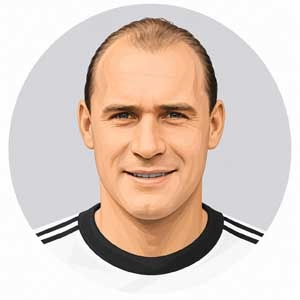
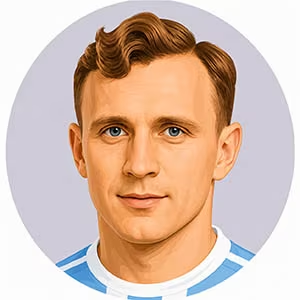
Germany - Centre-backErhardt, Herbert
There is a photograph from Santiago, June 1962, of a German defender sitting on the turf in tears after his team's World Cup elimination — not injured, not protesting a decision, simply undone by the result. It is a small, specific image, and it says more about Herbert Erhardt than most of what was written about him at the time, because the rest of his reputation was built almost entirely on the opposite quality: a man who did not visibly feel much of anything during ninety minutes of actual play.
Born in Fürth in 1930, Erhardt spent nearly his entire playing career at his hometown club, SpVgg Fürth, before a brief final chapter at Bayern Munich closed out his playing days. He began as a full-back and was gradually pushed inside through the 1950s, settling by the decade's end into the center-half, or stopper, role that defined his international career — a position built on physical directness, positional discipline and a reputation for hard, uncompromising tackling rather than technical elegance. He was capped 50 times for West Germany between 1953 and 1962, playing at three consecutive World Cups, and was part of the side that won the 1954 tournament in Switzerland, one of German football's foundational results. Decades later the German federation listed him among the country's twenty finest defenders, and Bayern Munich included him among the best sixteen players in the club's history as selected in the 1980s, a recognition earned despite only two seasons in Munich at the tail end of his career.
His limitations are harder to establish with precision than his achievements. He was not a large or physically dominant player by the standards later eras would demand of a central defender, and his game depended on toughness and anticipation rather than pure physical superiority; against sides that could isolate and outmuscle him directly, or that stretched him with pace he did not obviously possess, the available record suggests he was more vulnerable than his reputation for defensive solidity implies, though the surviving accounts do not detail specific tactical failures in the way later, more heavily scouted careers are documented.
Temperamentally, what survives is a picture of dogged, captain-like reliability on the pitch and something more emotionally exposed underneath it. Erhardt was consistently described, across the sources that discuss him at all, in terms of doggedness and hard tackling rather than flair or vocal leadership — a defender who did the difficult, physical work of the position without apparent complaint. The 1962 quarter-final loss to Yugoslavia, in which Germany lost 1–0 and Erhardt was photographed both preventing further damage defensively during the match and then visibly weeping afterward, offers a rare, dated glimpse of a player for whom the result clearly mattered on a level beyond professional obligation — an emotional transparency that contrasts with the stoic, physical reputation the rest of his career suggests. He married in the same period as that tournament, in his hometown of Fürth, and remained closely tied to the city for the rest of his life, dying there in 2010 close to his eightieth birthday. Beyond these fragments, the documentary record does not offer the density of anecdote available for the corpus's more thoroughly chronicled figures — no substantial account of conflicts with coaches or teammates, no record of disciplinary controversy, and no first-person interviews of the kind later players gave regularly. Physically uncompromising in a role that demanded it, and emotionally exposed in at least one well-documented moment that the toughness of his playing style did not otherwise suggest, Erhardt represents a defender whose psychological interior is visible to us today mainly in outline rather than in detail.