We use Google Analytics to understand how visitors use this site. Analytics cookies are only activated with your consent. For details, read our Privacy Policy.
Profile lensThe same player, read from a different angle.
Athletic81
Acceleration
74
Pace
76
Agility
73
Strength
87
Balance
82
Jumping
86
Stamina
84
Fitness
89
Technical76
Dribbling
70
Short Passing
74
Long Passing
73
Finishing
52
Shot Accuracy
55
Shot Power
77
Shooting Technique
63
Heading
83
Tackling
89
Crossing
65
Free Kick
60
Penalties
60
First Touch
72
Mental85
Composure
82
Aggression
88
Consistency
90
Creativity
62
Leadership
84
Work Rate
90
Tactical81
Vision
68
Off the Ball
64
Defensive Positioning
87
Teamwork
82
Anticipation
83
Marking
87
Player Traits
Attacking64
Crossing
65
Finishing
52
Heading Accuracy
83
Shot Accuracy
55
Off the Ball
64
Technique69
Dribbling
70
Free Kick
60
Short Passing
74
Long Passing
73
First Touch
72
Shot Technique
63
Movement76
Acceleration
74
Pace
76
Agility
73
Balance
82
Physicality85
Shot Power
77
Jumping
86
Stamina
84
Strength
87
Fitness
89
Defending88
Marking
87
Tackling
89
Def. Positioning
87
Mentality & Game Reading79
Aggression
88
Composure
82
Penalties
60
Vision
68
Leadership
84
Work Rate
90
Teamwork
82
Anticipation
83
Consistency
90
Creativity
62
England - Centre-backCarragher, Jamie
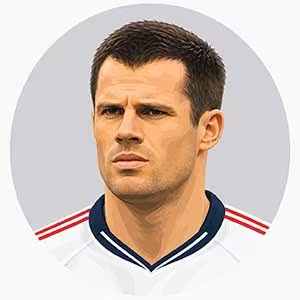
He never accepted that a match was safe. Liverpool could be three goals up in the eighty-eighth minute and Jamie Carragher would still be screaming at a full-back about a five-yard positional error, arms rigid, face red, treating a trivial lapse as the first crack in a dam. Teammates found it exhausting and understood exactly why it worked. In Istanbul in 2005, with cramp seizing both legs in extra time of a Champions League final, he threw himself into two last-ditch blocks that had no business being made by a man who could barely stand. Anxiety, in his case, was not a weakness. It was the engine.
Born in Bootle in 1978 into a family of Everton supporters, Carragher joined Liverpool's academy at nine and stayed at the club for his entire career, retiring in 2013 with 737 appearances — second only to Ian Callaghan in the club's history. He began as a midfielder and full-back and was converted into a centre-back in his mid-twenties, where he became one of the most positionally intelligent defenders in England. He was not quick, not tall for the role at 1.85m, and not physically overwhelming; he defended by reading, by organising the players around him, and by an almost pathological willingness to put his body in front of the ball. His passing range was short and functional, and he never pretended otherwise. He won the Champions League in 2005, the UEFA Cup in 2001, two FA Cups, three League Cups, and two UEFA Super Cups — but never a league title, the one absence that defined his career and which he spoke about with undisguised regret for years afterwards. For England he collected 38 caps across three tournaments, a return well below his club standing, in a period when the national side never quite knew what to do with him.
His limitations shaped where he could play. Carragher was vulnerable to genuinely quick forwards running in behind, which meant he was far better in a deep block than in a high line, and he offered close to nothing in build-up play at a time when the game was beginning to demand it. He was never a goal threat despite his aerial commitment, and in matches that opened up into transition contests his lack of pace could be exposed repeatedly rather than occasionally.
The temperament was the loudest in any dressing room he occupied. Carragher organised by continuous, abrasive shouting — correcting, warning, demanding a step up from the line, and berating teammates immediately and publicly for errors regardless of their status. It came from genuine anxiety rather than aggression: he was a chronic worrier who prepared obsessively, studied opponents in detail, and could not tolerate the possibility of something going wrong through inattention. He argued with referees, committed tactical fouls without hesitation, and accumulated cards for dissent, but he rarely lost control in a way that endangered his team. Provocation from opponents did not affect him because he was already at maximum agitation, and hostile away grounds visibly raised his level. He was a fierce Scouser in identity as much as accent — deeply attached to the city, openly emotional about Hillsborough and about the club's history — and he turned down bigger clubs and larger wages without ever appearing to consider it a sacrifice. Away from football he was conventional, family-oriented, and later became one of Britain's most prominent broadcasters, carrying the same blunt, argumentative intensity into television. Limited, anxious and utterly indispensable, Carragher made himself into a great defender by refusing, for two decades, to relax for a single minute.


 All Time LiverpoolClub