We use Google Analytics to understand how visitors use this site. Analytics cookies are only activated with your consent. For details, read our Privacy Policy.
Profile lensThe same player, read from a different angle.
Athletic86
Acceleration
93
Pace
86
Agility
90
Strength
77
Balance
77
Jumping
92
Stamina
87
Fitness
85
Technical84
Dribbling
78
Short Passing
80
Long Passing
78
Finishing
93
Shot Accuracy
93
Shot Power
77
Shooting Technique
92
Heading
92
Tackling
52
Crossing
74
Free Kick
73
Penalties
87
First Touch
79
Mental83
Composure
86
Aggression
88
Consistency
80
Creativity
75
Leadership
80
Work Rate
88
Tactical87
Vision
78
Off the Ball
93
Defensive Positioning
44
Teamwork
82
Anticipation
96
Marking
39
Player Traits
Attacking89
Crossing
74
Finishing
93
Heading Accuracy
92
Shot Accuracy
93
Off the Ball
93
Technique80
Dribbling
78
Free Kick
73
Short Passing
80
Long Passing
78
First Touch
79
Shot Technique
92
Movement87
Acceleration
93
Pace
86
Agility
90
Balance
77
Physicality84
Shot Power
77
Jumping
92
Stamina
87
Strength
77
Fitness
85
Defending45
Marking
39
Tackling
52
Def. Positioning
44
Mentality & Game Reading84
Aggression
88
Composure
86
Penalties
87
Vision
78
Leadership
80
Work Rate
88
Teamwork
82
Anticipation
96
Consistency
80
Creativity
75
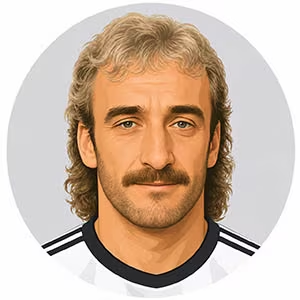
Germany - StrikerVöller, Rudi
Dynamic forward runs, predatory anticipation, and relentless physical bravery established Rudolf Völler as the quintessential German center-forward of the late 1980s and early 1990s. Making his breakthrough at Kickers Offenbach and 1860 Munich before exploding into superstardom with SV Werder Bremen, Tante Rudi (Auntie Rudi) was a nightmare for rigid man-marking stoppers. Standing five-foot-eleven with quick-twitch acceleration over ten yards, he combined deceptive aerial power with a sharp, low center of gravity that allowed him to spin off heavy challenges in the penalty box. Far from a static target-man, his technical baseline featured crisp first-time volleys, direct diagonal drives toward goal, and a rare knack for winning penalties through sharp changes of direction inside the eighteen-yard box. His club career reached continental heights during a prolific five-year spell with AS Roma—winning the 1991 Coppa Italia and reaching the UEFA Cup final—before capturing the inaugural 1993 UEFA Champions League with Olympique de Marseille and closing his playing days at Bayer Leverkusen. For West Germany and unified Germany, he scored 47 goals in 90 caps, forming a lethal striking partnership with Jürgen Klinsmann, lifting the 1990 World Cup in Rome, and reaching the finals of both the 1986 World Cup and Euro 1992.
Emotionally and psychologically, Völler was an authentic, warm-hearted, and intensely competitive warrior whose fiery passion on the pitch never compromised his core decency. He played with an infectious, blue-collar enthusiasm that made him an immediate folk hero across every fanbase he represented, from the Weserstadion to the Stadio Olimpico. His psychological resilience was definitively demonstrated during the high-voltage 1990 World Cup clash against the Netherlands: when Frank Rijkaard notoriously spat in his hair twice and both players were unjustly sent off, Völler maintained his fundamental dignity amid intense provocation, returning in subsequent knockout rounds to spearhead Germany's charge to the title. Inside the locker room, he was a joyful, unpretentious, and unifying figure whose natural charisma, honest communication, and absence of ego made him an organic leader. When facing bruising physical defenders who frequently kicked him off the ball, Völler absorbed the punishment with aggressive resilience, immediately getting back to his feet to demand the next through-ball. Toward match officials and opponents, he was hard, direct, and emotionally expressive, but fundamentally honest, leaving an enduring legacy as one of the most beloved, clutch, and prolific strikers in European football history.


 All Time RomaClub