We use Google Analytics to understand how visitors use this site. Analytics cookies are only activated with your consent. For details, read our Privacy Policy.
Profile lensThe same player, read from a different angle.
Athletic85
Acceleration
91
Pace
86
Agility
82
Strength
80
Balance
80
Jumping
88
Stamina
82
Fitness
87
Technical85
Dribbling
81
Short Passing
77
Long Passing
76
Finishing
94
Shot Accuracy
95
Shot Power
81
Shooting Technique
93
Heading
85
Tackling
33
Crossing
71
Free Kick
72
Penalties
76
First Touch
83
Mental82
Composure
87
Aggression
76
Consistency
82
Creativity
75
Leadership
76
Work Rate
81
Tactical85
Vision
76
Off the Ball
95
Defensive Positioning
40
Teamwork
75
Anticipation
90
Marking
30
Player Traits
Attacking88
Crossing
71
Finishing
94
Heading Accuracy
85
Shot Accuracy
95
Off the Ball
95
Technique80
Dribbling
81
Free Kick
72
Short Passing
77
Long Passing
76
First Touch
83
Shot Technique
93
Movement85
Acceleration
91
Pace
86
Agility
82
Balance
80
Physicality84
Shot Power
81
Jumping
88
Stamina
82
Strength
80
Fitness
87
Defending34
Marking
30
Tackling
33
Def. Positioning
40
Mentality & Game Reading79
Aggression
76
Composure
87
Penalties
76
Vision
76
Leadership
76
Work Rate
81
Teamwork
75
Anticipation
90
Consistency
82
Creativity
75
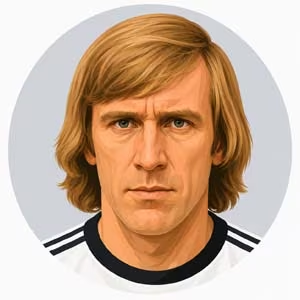
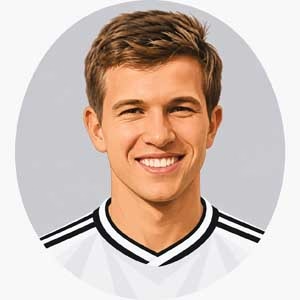
Germany - StrikerHeynckes, Jupp
Before becoming one of the most revered tacticians in European history, the boy from Mönchengladbach spent the late 1960s and 1970s operating as the sharpest, most lethal dynamic dagger in the Bundesliga’s golden era. Josef "Jupp" Heynckes—often overlooked in international retrospectives simply because he shared an era with Gerd Müller—was the ultimate modern, high-intensity complete forward: a relentless attacker capable of devastating opponents as an explosive left-winger, an inside-forward, or a mobile center-forward who scored with surgical regularity off either foot.
Heynckes possessed an electric change of pace over twenty yards, immaculate timing on diagonal runs off the shoulder of center-halves, and a venomous, low-backlift shot that tore past goalkeepers before they could set their feet. As the attacking spearhead and soul of Hennes Weisweiler’s fabled Fohlenelf (Foals) at Borussia Mönchengladbach between 1965 and 1978 (interrupted only by a prolific stint at Hannover 96), he netted an extraordinary 220 Bundesliga goals in 369 matches—ranking fourth on the league’s all-time scoring list. In Gladbach's colors, he amassed four Bundesliga championships (1970–71, 1974–75, 1975–76, 1976–77), the 1972–73 DFB-Pokal, the 1974–75 UEFA Cup (scoring a hat-trick in the final against Twente), and claimed the Bundesliga top-scorer crown twice (1973–74, 1974–75), while also finishing as top scorer in the European Cup, Cup Winners' Cup, and UEFA Cup across his career. For West Germany, across 39 caps and 14 goals, he was an integral part of the golden double, winning Euro 1972 and the 1974 World Cup on home soil.
His hyper-dynamic, direct profile, however, was fundamentally geared toward fast, vertical transitions and continuous collective movement. Heynckes was not a stationary, back-to-goal target man built to wrestle rugged six-foot-three stoppers in congested six-yard boxes under long aerial bombardments; he needed momentum and running channels to be at his most lethal. When deployed in overly rigid, static systems that forced him to hold up possession with his back to goal against suffocating, physical man-markers, his finishing opportunities could be curtailed. Furthermore, a severe, complex knee injury suffered late in his career gradually compromised his explosive initial burst, accelerating his retirement at age 33.
Psychologically, Heynckes was an obsessive, hyper-focused perfectionist whose outwardly calm exterior concealed a burning, competitive furnace—a fiery drive that in his early days earned him the moniker Osram for the way his face turned bright red during heated contests. He carried an uncompromising professional ethos, treating every match with monastic discipline, utterly devoid of vanity, theatricality, or public posturing. Defeat felt to him like an unacceptable flaw in execution, which he channeled into relentless, punishing work ethic on the training ground. On the pitch, his body language was all coiled, kinetic alertness: pressing defenders on the back-pass, timing his diagonal blind-side cuts with razor precision, and celebrating goals with restrained, professional focus. Inside the locker room, his quiet moral authority, unyielding self-discipline, and deep loyalty to the collective made him an untouchable standard of excellence, laying the psychological groundwork for one of the greatest dual legacies as player and manager the European game has ever known.


 All Time GermanyNT