We use Google Analytics to understand how visitors use this site. Analytics cookies are only activated with your consent. For details, read our Privacy Policy.
Profile lensThe same player, read from a different angle.
Athletic80
Acceleration
78
Pace
77
Agility
75
Strength
83
Balance
80
Jumping
87
Stamina
78
Fitness
85
Technical79
Dribbling
74
Short Passing
77
Long Passing
80
Finishing
52
Shot Accuracy
63
Shot Power
84
Shooting Technique
69
Heading
80
Tackling
89
Crossing
76
Free Kick
73
Penalties
70
First Touch
78
Mental87
Composure
92
Aggression
85
Consistency
80
Creativity
71
Leadership
87
Work Rate
91
Tactical86
Vision
74
Off the Ball
60
Defensive Positioning
95
Teamwork
85
Anticipation
88
Marking
92
Player Traits
Attacking66
Crossing
76
Finishing
52
Heading Accuracy
80
Shot Accuracy
63
Off the Ball
60
Technique75
Dribbling
74
Free Kick
73
Short Passing
77
Long Passing
80
First Touch
78
Shot Technique
69
Movement78
Acceleration
78
Pace
77
Agility
75
Balance
80
Physicality83
Shot Power
84
Jumping
87
Stamina
78
Strength
83
Fitness
85
Defending92
Marking
92
Tackling
89
Def. Positioning
95
Mentality & Game Reading82
Aggression
85
Composure
92
Penalties
70
Vision
74
Leadership
87
Work Rate
91
Teamwork
85
Anticipation
88
Consistency
80
Creativity
71
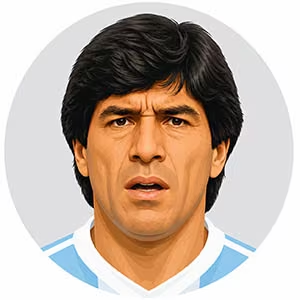
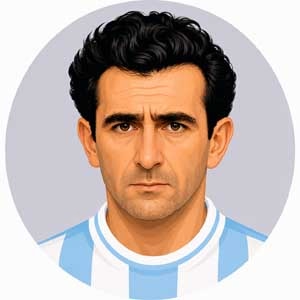
Argentina - Centre-backPerfumo, Roberto
Long before the modern game attempted to sanitize the brutal, back-alley art of South American defending, a majestic tactician known simply as El Mariscal (The Marshal) commanded the defensive lines of Racing Club, Cruzeiro, River Plate, and the Argentine national team. Roberto Alfredo Perfumo was the supreme embodiment of the classic Argentine primer zaguero: combining refined, aristocratic technical elegance with an underlying, ruthless violence that established instant territorial supremacy inside his own half. Technically, Perfumo was light years ahead of his contemporaries in the 1960s and 70s: a clean, press-resistant distributor of the ball with his right foot, he could step out of a crowded box with upright posture, sweeping 50-meter diagonal balls into the channels or initiating crisp build-up sequences under suffocating pressure. Yet, when the phase turned defensive, his spatial anticipation was lethal: razor-timed slide tackles on muddy surfaces, immaculate aerial duels, and a terrifying ability to step across the forward’s running lane to cleanly pinch the ball away. As the defensive general of Racing's iconic Equipo de José, he lifted the 1967 Copa Libertadores and the historic Intercontinental Cup against Celtic, later claiming four state championships in Brazil with Cruzeiro and three league titles with River Plate.
Mentally and emotionally, Perfumo carried the aura of a high-ranking military strategist who viewed the football pitch as a battlefield of psychological subjugation. His leadership was absolute, unyielding, and openly authoritative; a single sharp command or icy stare from him was enough to pull an entire defensive block five meters up the pitch in unison. Inside the locker room, he commanded reverence across generations—a fiercely intelligent, articulate character who understood the emotional mechanics of high-stakes Latin American football better than anyone, acting as a tactical mentor to younger defenders while maintaining an iron standard of discipline. Under peak high-stakes pressure—from the blood-soaked, volcanic atmospheres of 1960s Intercontinental ties to the tension of captaining Argentina at the 1974 World Cup—his emotional state was combative, cold, and calculated; he never panicked, converting environmental hostility into sharpened tactical aggression. Toward referees and opposition strikers, Perfumo played on the absolute outer boundary of psychological warfare: he was notorious for delivering a crushing, bone-shivering tackle in the opening minutes of a match to mentally break the opposing center-forward, yet he did so with an aristocratic, nonchalant composure that rarely resulted in expulsions, leaving an eternal legacy as the benchmark of the commanding, elegant South American defender