We use Google Analytics to understand how visitors use this site. Analytics cookies are only activated with your consent. For details, read our Privacy Policy.
Profile lensThe same player, read from a different angle.
Athletic84
Acceleration
80
Pace
83
Agility
81
Strength
86
Balance
85
Jumping
91
Stamina
85
Fitness
84
Technical81
Dribbling
77
Short Passing
78
Long Passing
78
Finishing
57
Shot Accuracy
66
Shot Power
82
Shooting Technique
69
Heading
87
Tackling
93
Crossing
72
Free Kick
65
Penalties
67
First Touch
79
Mental87
Composure
86
Aggression
87
Consistency
91
Creativity
69
Leadership
84
Work Rate
90
Tactical88
Vision
75
Off the Ball
68
Defensive Positioning
94
Teamwork
87
Anticipation
93
Marking
93
Player Traits
Attacking70
Crossing
72
Finishing
57
Heading Accuracy
87
Shot Accuracy
66
Off the Ball
68
Technique74
Dribbling
77
Free Kick
65
Short Passing
78
Long Passing
78
First Touch
79
Shot Technique
69
Movement82
Acceleration
80
Pace
83
Agility
81
Balance
85
Physicality86
Shot Power
82
Jumping
91
Stamina
85
Strength
86
Fitness
84
Defending93
Marking
93
Tackling
93
Def. Positioning
94
Mentality & Game Reading83
Aggression
87
Composure
86
Penalties
67
Vision
75
Leadership
84
Work Rate
90
Teamwork
87
Anticipation
93
Consistency
91
Creativity
69
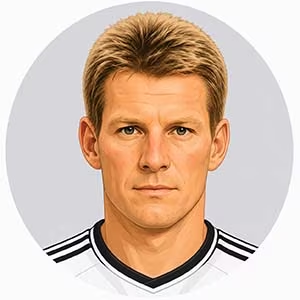
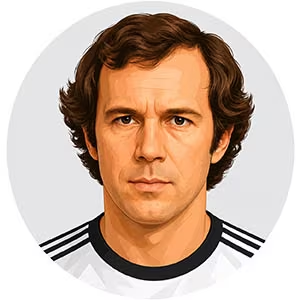
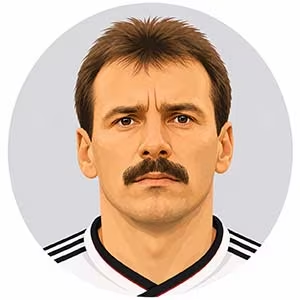
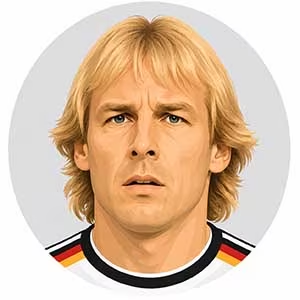
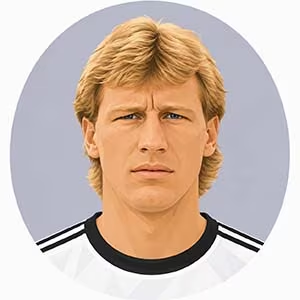
Germany - Centre-backFörster, Karlheinz
An relentless, sharp-tackling specialist of man-marking perfection, Karlheinz Förster was the defensive rock of VfB Stuttgart, Marseille, and the West German national team throughout the late 1970s and 1980s. Operating as a classic stopper in an era of terrifying central forwards, Förster combined short-space explosive agility, broad-shouldered core strength, and an uncanny ability to anticipate an attacker's first touch. His technical signature was entirely focused on defensive neutralization: tight, physical marking, relentless tracking across the pitch, and razor-sharp ground tackles that dispossessed opponents clean before launching rapid transitions. While he provided minimal creative value in deep playmaking, his flawless positional discipline allowed West Germany to win the 1980 European Championship and reach consecutive World Cup finals in 1982 and 1986. On the pitch, Förster exercised a quiet, fiercely dedicated leadership, guiding his defensive unit through relentless focus and total tactical compliance. Within the dressing room, he maintained a humble, unpretentious demeanor alongside his brother Bernd, earning deep respect through his absolute reliability rather than vocal grandstanding. Under high-stakes pressure, his response was purely resolute; tasked with neutralizing the world's most gifted attacking playmakers, he maintained an intense, meditative focus that rarely faltered across ninety minutes. Toward opponents and match officials, Förster maintained an impeccably fair and gentlemanly posture; despite playing one of the most physically demanding, confrontational roles in world football, he rarely engaged in cheap fouls, never retaliated against provocation, and avoided referee arguments, earning the German Footballer of the Year award in 1982 as a defender. Highly disciplined in his physical preparation and training routines, he carried collective successes and failures with quiet, dignified responsibility throughout his career.