We use Google Analytics to understand how visitors use this site. Analytics cookies are only activated with your consent. For details, read our Privacy Policy.
Profile lensThe same player, read from a different angle.
Athletic81
Acceleration
75
Pace
75
Agility
76
Strength
87
Balance
82
Jumping
85
Stamina
81
Fitness
85
Technical78
Dribbling
74
Short Passing
77
Long Passing
74
Finishing
55
Shot Accuracy
60
Shot Power
85
Shooting Technique
62
Heading
83
Tackling
86
Crossing
61
Free Kick
60
Penalties
62
First Touch
76
Mental84
Composure
78
Aggression
87
Consistency
86
Creativity
66
Leadership
88
Work Rate
89
Tactical81
Vision
73
Off the Ball
60
Defensive Positioning
86
Teamwork
83
Anticipation
83
Marking
87
Player Traits
Attacking64
Crossing
61
Finishing
55
Heading Accuracy
83
Shot Accuracy
60
Off the Ball
60
Technique71
Dribbling
74
Free Kick
60
Short Passing
77
Long Passing
74
First Touch
76
Shot Technique
62
Movement77
Acceleration
75
Pace
75
Agility
76
Balance
82
Physicality85
Shot Power
85
Jumping
85
Stamina
81
Strength
87
Fitness
85
Defending86
Marking
87
Tackling
86
Def. Positioning
86
Mentality & Game Reading80
Aggression
87
Composure
78
Penalties
62
Vision
73
Leadership
88
Work Rate
89
Teamwork
83
Anticipation
83
Consistency
86
Creativity
66
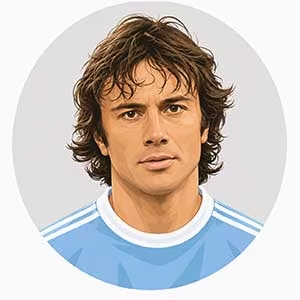
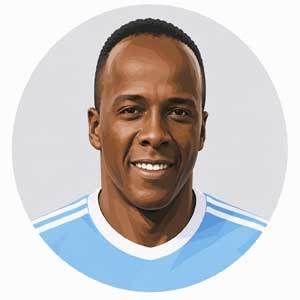
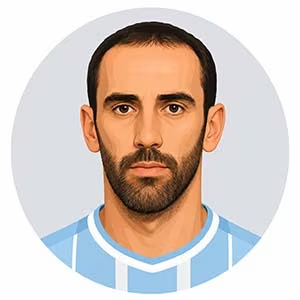
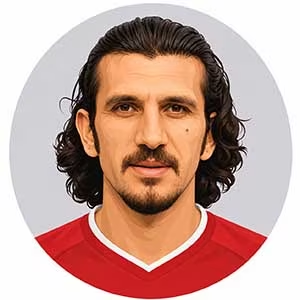
Uruguay - Centre-backLugano, Diego
If modern football has steadily sanitized the art of central defending into an exercise of sterile positional metrics, Diego Alfredo Lugano Moreno stood as the ferocious, blood-and-iron antidote—the definitive 21st-century reincarnation of the ancestral Uruguayan caudillo. Emerging from Plaza Colonia before achieving near-mythical deity status at São Paulo FC and Fenerbahçe, La Tota was the undisputed spiritual guardian of Óscar Washington Tabárez’s national team renaissance. Built like a heavyweight pugilist with broad shoulders and an intimidating physical silhouette, Lugano’s craft was stripped of all aesthetic vanity: towering aerial supremacy inside both penalty boxes, suffocating tight-to-the-back man-marking that denied opposing center-forwards a single pocket of turning space, and an uncompromising tackling technique executed with bone-shattering force. As the defensive rock of São Paulo, he conquered the 2005 Copa Libertadores and the FIFA Club World Cup—completely neutralizing Liverpool's attack in Yokohama—before claiming two Turkish Süper Lig titles in Istanbul. Wearing the captain’s armband across 95 caps for La Celeste, he led Uruguay to a historic fourth-place finish at the 2010 World Cup in South Africa and hoisted the 2011 Copa América trophy in Buenos Aires, restoring his nation to global footballing royalty. Psychologically, Lugano was a figure of volcanic pride, monastic warrior discipline, and an absolute, non-negotiable devotion to the sacred creed of garra chárrua. He did not merely captain teams; he was the moral conscience of every dressing room he entered, demanding total physical self-sacrifice and setting an uncompromising standard of collective humility that forbade any trace of individual ego. On the pitch, his leadership was visceral, electrifying, and intensely demanding: directing the backline with a booming voice, throwing his head into flying boots without a microsecond of hesitation, and transforming defensive blocks into impenetrable fortresses through sheer force of will. Inside the locker room, he was the revered patriarch and protective older brother to superstar talents like Luis Suárez and Diego Forlán, creating an iron-clad cultural cohesion that made Uruguay punch far above its demographic weight. Under maximum high-friction tournament pressure, his mental composure was combative and ice-cold; he actively relished hostile away cauldrons, viewing terrace fury and opposition aggression as personal fuel for his defensive dominance. Toward referees and opposing attackers, Lugano operated right on the razor-sharp frontier of physical legality: an intimidating, relentless psychological storm who weaponized his physical mass and commanding aura to establish immediate territorial supremacy, leaving an eternal legacy as one of the fiercest, most noble warrior-captains in South American football history.