We use Google Analytics to understand how visitors use this site. Analytics cookies are only activated with your consent. For details, read our Privacy Policy.
Profile lensThe same player, read from a different angle.
Athletic80
Acceleration
82
Pace
79
Agility
86
Strength
76
Balance
75
Jumping
75
Stamina
87
Fitness
78
Technical88
Dribbling
88
Short Passing
91
Long Passing
91
Finishing
83
Shot Accuracy
76
Shot Power
88
Shooting Technique
84
Heading
72
Tackling
52
Crossing
86
Free Kick
88
Penalties
88
First Touch
88
Mental81
Composure
87
Aggression
74
Consistency
77
Creativity
87
Leadership
77
Work Rate
82
Tactical85
Vision
88
Off the Ball
84
Defensive Positioning
40
Teamwork
88
Anticipation
78
Marking
52
Player Traits
Attacking80
Crossing
86
Finishing
83
Heading Accuracy
72
Shot Accuracy
76
Off the Ball
84
Technique88
Dribbling
88
Free Kick
88
Short Passing
91
Long Passing
91
First Touch
88
Shot Technique
84
Movement81
Acceleration
82
Pace
79
Agility
86
Balance
75
Physicality81
Shot Power
88
Jumping
75
Stamina
87
Strength
76
Fitness
78
Defending48
Marking
52
Tackling
52
Def. Positioning
40
Mentality & Game Reading83
Aggression
74
Composure
87
Penalties
88
Vision
88
Leadership
77
Work Rate
82
Teamwork
88
Anticipation
78
Consistency
77
Creativity
87
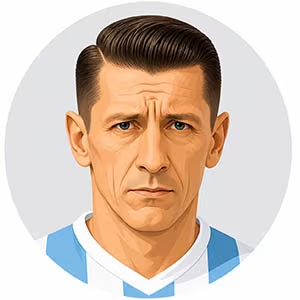
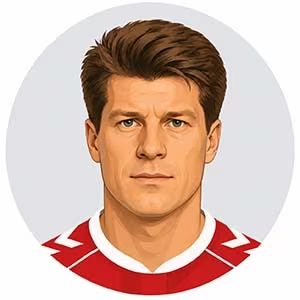
Bulgaria - Attacking MidfielderBalakov, Krasimir
New Jersey, 5 July 1994, the World Cup quarter-final against Germany, the defending champions. Bulgaria are level at 1-1 and it is Krasimir Balakov, not Hristo Stoichkov, who steps up in the second half to curl a free-kick over the wall and put his country ahead in a match they would go on to win 2-1, the greatest result in Bulgarian football history. Stoichkov scored the equalizer and took the headlines, as he always did. Balakov had spent the entire tournament doing the quieter work that made Stoichkov's finishing possible, and on the day it mattered most he did the spectacular part himself, then returned to being the least discussed player in the country's greatest generation.
Born in Sliven in 1966, Balakov was an attacking midfielder of exceptional vision and set-piece quality, operating just behind the forward line or drifting to the flanks to create overloads. He was not physically dominant or especially quick, and his game was built on reading passing lanes early, delivering the ball with precise weight into space teammates had not yet reached, and striking free kicks with a technique regarded as among the finest of his generation in Eastern Europe. He came through Sliven and Levski Sofia, winning Bulgarian championships domestically, before moving to Sporting CP in Portugal in 1990, where he spent four productive seasons, and then to VfB Stuttgart in 1994, becoming a fixture of German football into his mid-thirties and winning the 1997 DFB-Pokal as club captain. For Bulgaria he won 92 caps and was the creative fulcrum of the side that reached the 1994 World Cup semi-final, the country's only appearance at that stage of the tournament, playing every minute of the run and finishing among the competition's most influential midfielders alongside more celebrated teammates.
His limitations were largely physical and became more pronounced with age. Balakov offered modest pace and limited defensive tracking, depending on midfield partners to cover ground behind him, and against sides that pressed him aggressively and denied him time on the ball in central areas, his influence could be significantly reduced. He was not a natural dribbler in tight one-on-one situations, relying on positioning and distribution rather than individual penetration, and his goal output away from set pieces was modest for a player operating so centrally in the final third. As his career extended into his late thirties in Germany, his role narrowed toward a more restricted, deep-lying function.
Temperamentally he was calm, understated and notably free of the confrontational instincts that characterized several of his more famous Bulgarian contemporaries. Balakov organized play through positioning and passing rather than vocal instruction, rarely arguing with referees or engaging in disputes with opponents, and built a reputation across two decades in Portuguese and German football as a consummate professional with an unusually clean disciplinary record for a creative midfielder subjected to persistent physical attention. He accepted a supporting role within a Bulgarian squad containing a genuine global superstar in Stoichkov without visible friction, contributing consistently to the collective without requiring individual recognition to remain motivated. He adapted fully to two different football cultures in succession, learning Portuguese and then German, and was respected in both countries as a reliable, low-controversy professional long after his playing days. Away from the pitch he later moved into coaching, including a spell in charge of the Bulgarian national team, carrying the same measured, technically oriented approach into the dugout. Composed, precise and content in a secondary role within a celebrated generation, Balakov built a career of sustained quality that history has largely filed under someone else's name.