We use Google Analytics to understand how visitors use this site. Analytics cookies are only activated with your consent. For details, read our Privacy Policy.
Profile lensThe same player, read from a different angle.
Athletic80
Acceleration
76
Pace
77
Agility
75
Strength
81
Balance
80
Jumping
84
Stamina
82
Fitness
85
Technical78
Dribbling
75
Short Passing
76
Long Passing
77
Finishing
60
Shot Accuracy
60
Shot Power
77
Shooting Technique
62
Heading
79
Tackling
86
Crossing
61
Free Kick
60
Penalties
60
First Touch
77
Mental84
Composure
86
Aggression
82
Consistency
81
Creativity
70
Leadership
85
Work Rate
85
Tactical82
Vision
76
Off the Ball
59
Defensive Positioning
86
Teamwork
83
Anticipation
87
Marking
86
Attacking64
Crossing
61
Finishing
60
Heading Accuracy
79
Shot Accuracy
60
Off the Ball
59
Technique71
Dribbling
75
Free Kick
60
Short Passing
76
Long Passing
77
First Touch
77
Shot Technique
62
Movement77
Acceleration
76
Pace
77
Agility
75
Balance
80
Physicality82
Shot Power
77
Jumping
84
Stamina
82
Strength
81
Fitness
85
Defending86
Marking
86
Tackling
86
Def. Positioning
86
Mentality & Game Reading80
Aggression
82
Composure
86
Penalties
60
Vision
76
Leadership
85
Work Rate
85
Teamwork
83
Anticipation
87
Consistency
81
Creativity
70
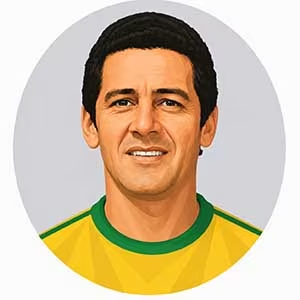
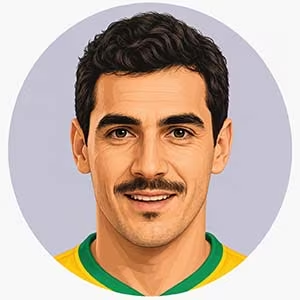
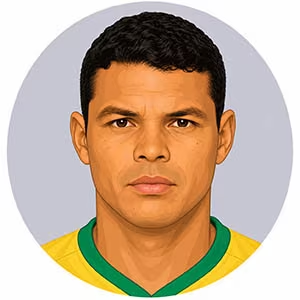
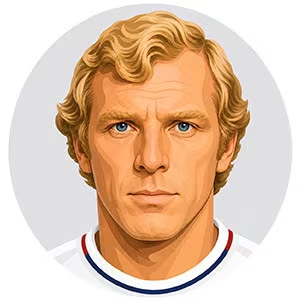
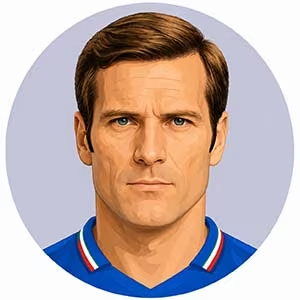
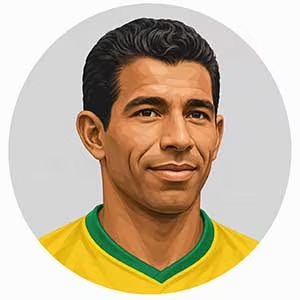
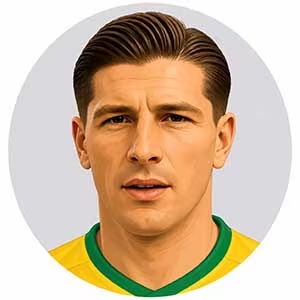
Brazil - Centre-backOrlando
Impeccable timing in the slide tackle, razor-sharp anticipatory instincts, and an uncanny ability to cover wide spaces behind aggressive full-backs made Orlando Peçanha de Carvalho the quintessential quarto zagueiro (left-sided central defender) of Brazil’s golden generation. Emerging through the youth ranks of Vasco da Gama to anchor the backline alongside Hideraldo Bellini, Orlando was the technical, agile counterpart to Bellini’s raw physical brawn. Standing five-foot-eleven with exceptional lateral mobility and a lean frame, he did not rely on brute force to dispossess forwards; instead, he specialized in reading the passing lane early, stepping across the attacker with clean standing interceptions, and executing precise, risk-free first-time distributions out of danger. With Vasco, he won the 1956 and 1958 Campeonato Carioca and the 1957 Torneio Rio-São Paulo before embarking on a trophy-laden Argentine adventure with Boca Juniors, where he captained the Xeneizes to three Primera División titles (1962, 1964, 1965) and became an idol at the Bombonera. He capped his club career back in Brazil with Santos, winning the 1965 Taça Brasil alongside Pelé. For the Seleção across 31 caps, his crowning achievement arrived at the 1958 World Cup in Sweden: starting every single match without conceding a goal until the semi-finals, his flawless positional synergy with Bellini and Nilton Santos formed the defensive bedrock of Brazil's maiden world championship. He returned to the global stage at the 1966 World Cup in England, starting against Portugal. On the technical downside, Orlando lacked the aerial dominance and vertical power of orthodox stoppers against towering physical target men, possessed minimal long-range passing vision to initiate direct vertical breaks, and his strict adherence to domestic defensive duties in Argentina in 1962 cost him a second consecutive World Cup medal due to the CBF's policy of excluding foreign-based players.
Serene, highly articulate, and endowed with natural aristocratic dignity, Orlando was a leader who led by quiet example, surgical efficiency, and tactical poise. He did not need to shout, posture, or provoke confrontation to command authority; his composure on the pitch exerted an immediate calming effect across the entire back four, acting as the silent guardian behind Nilton Santos’s adventurous attacking forays. Inside the dressing rooms of Vasco, Boca Juniors, and the national team, he was universally revered as a consummate professional—punctual, impeccably disciplined in his physical preparation, and an essential peacemaker who neutralized tensions between fiery personalities. In the intense, hostile cauldron of Argentine football—where foreign defenders were often targeted with extreme physical aggression—Orlando won over the demanding Boca faithful through unyielding courage and pure, clean tackling technique rather than dirty retaliation. When facing explosive, direct wingers and inside-forwards who tried to isolate him in space, he remained patient, jockeying with textbook body orientation and stripping the ball cleanly without committing tactical fouls. Referees found him remarkably easy to officiate, and opponents respected his spotless sporting conduct, cementing his legacy as one of the most refined, reliable, and intellectually gifted central defenders in the history of South American football.