We use Google Analytics to understand how visitors use this site. Analytics cookies are only activated with your consent. For details, read our Privacy Policy.
Profile lensThe same player, read from a different angle.
Athletic78
Acceleration
73
Pace
76
Agility
72
Strength
83
Balance
81
Jumping
81
Stamina
83
Fitness
78
Technical80
Dribbling
75
Short Passing
77
Long Passing
82
Finishing
51
Shot Accuracy
57
Shot Power
74
Shooting Technique
71
Heading
82
Tackling
90
Crossing
74
Free Kick
56
Penalties
58
First Touch
78
Mental83
Composure
86
Aggression
82
Consistency
81
Creativity
66
Leadership
82
Work Rate
85
Tactical83
Vision
75
Off the Ball
54
Defensive Positioning
89
Teamwork
81
Anticipation
87
Marking
89
Attacking64
Crossing
74
Finishing
51
Heading Accuracy
82
Shot Accuracy
57
Off the Ball
54
Technique73
Dribbling
75
Free Kick
56
Short Passing
77
Long Passing
82
First Touch
78
Shot Technique
71
Movement76
Acceleration
73
Pace
76
Agility
72
Balance
81
Physicality80
Shot Power
74
Jumping
81
Stamina
83
Strength
83
Fitness
78
Defending89
Marking
89
Tackling
90
Def. Positioning
89
Mentality & Game Reading78
Aggression
82
Composure
86
Penalties
58
Vision
75
Leadership
82
Work Rate
85
Teamwork
81
Anticipation
87
Consistency
81
Creativity
66
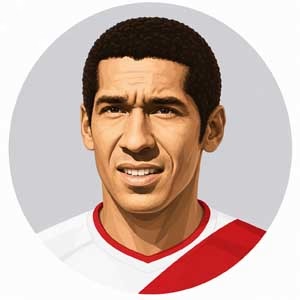
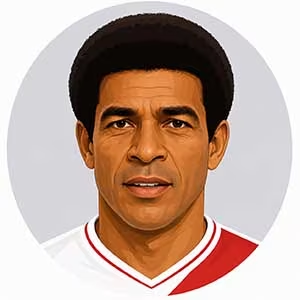
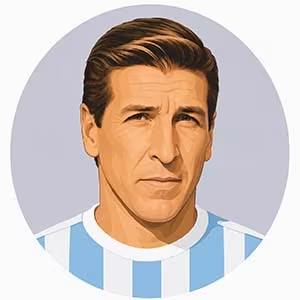
Peru - Centre-backMeléndez, Julio
In a Superclásico at the Monumental, Julio Meléndez mistimed one of the few interventions for which he would be remembered negatively. Boca were trailing River, Meléndez was the last defender, and his sliding challenge produced a red card. He did not surround the referee or turn the dismissal into theatre. He walked off. Then something unusual happened: supporters from both sides applauded him, while River players accompanied him toward the tunnel. Meléndez later remembered the episode with amusement rather than grievance. For a defender playing in an era of brutal marking and constant physical confrontation, the respect was revealing. His authority had been built less through intimidation than through the precision with which he usually avoided needing it.
Meléndez was a central defender whose style was strikingly progressive for late-1960s Argentine football. Quick, technically accomplished and unusually clean in the tackle, he preferred anticipation to collision. He stepped ahead of forwards to intercept, controlled the ball rather than simply clearing it, and looked immediately for a constructive pass. Boca’s own historical description stresses his speed, elegance and ability to recover possession without excessive contact, while Meléndez himself later insisted that even he cleared the ball when danger demanded it: elegance was never an excuse for recklessness. He began in Peru with Defensor Lima and also played for KDT Nacional, Sport Boys and Defensor Arica before Boca signed him in 1968. The cultural adjustment was substantial. Boca had traditionally celebrated harder, more intimidating centre-backs, and Meléndez recalled being told early on that a defender needed to look fierce; he responded that such theatre simply was not his way. Instead, his football won over the Bombonera. Supporters created the chant “es el peruano y su ballet,” an extraordinary recognition for a foreign central defender. He formed an effective partnership with the more physical Roberto Rogel and became central to Boca’s Nacional titles of 1969 and 1970, as well as the 1969 Copa Argentina. After returning to Peru, Meléndez extended his career through several clubs and later helped Peru win the 1975 Copa América. He also captained the national team during qualification for the 1978 World Cup after Héctor Chumpitaz voluntarily ceded him the armband.
His elegance had real boundaries. Meléndez’s instinct was to solve danger through reading, anticipation and control, but an incorrect step could expose him because he was willing to defend proactively rather than remain permanently deep. Against powerful forwards he needed timing more than brute force, and repeated aerial or direct battles reduced the advantage provided by his technique. His preference for playing out also carried risk in areas where a simpler clearance was occasionally necessary, something he himself later emphasised when discussing younger defenders. Most importantly, his career shows that technical quality did not make him tactically independent. At Boca he benefited from a complementary partner and a disciplined collective structure; without adequate cover, stepping forward to intercept could leave space behind him. His international career was also narrower than his talent suggested. He missed the 1970 World Cup after accepting Alfredo Di Stéfano’s advice not to leave Boca during qualification, a decision that protected his club status but cost him the greatest international stage of his prime.
Psychologically, Meléndez combined visible confidence with remarkably little need to prove toughness through aggression. He has repeatedly described Boca as an environment of daily pressure, where losing one’s place was a genuine threat and training discipline was severe. His response was to train more carefully, protect his physical condition and allow performance to justify his presence. That is particularly important because he arrived as a foreign defender in a culture that expected central defenders to intimidate. Rather than imitate that behaviour, he maintained his own method and eventually became an idol precisely for it. Physical confrontation therefore appears to have increased concentration more than hostility. He could play Superclásicos described by himself as intensely physical without becoming a habitual retaliator, and even his famous dismissal ended without protest or escalation. Status mattered, however. When Di Stéfano warned that leaving Boca for Peru’s 1970 World Cup qualifying campaign might cost him his starting place and create suspicions if Argentina were involved, Meléndez chose club security and remained in Buenos Aires. The decision shows pragmatism but also a strong sensitivity to professional standing: he was prepared to sacrifice international opportunity rather than expose a hard-earned position at Boca. Leadership developed differently. Later, when Chumpitaz offered him Peru’s captaincy, Meléndez initially attempted to return it, then accepted after being asked to continue. He subsequently described captaincy in practical terms — negotiating bonuses, equipment and team arrangements — rather than as symbolic prestige. At Boca he similarly taught younger defenders how to anticipate opponents, with Roberto Mouzo among those who sought his advice. His authority therefore appears instructional and technical rather than coercive. Recognition affected him, but he repeatedly framed it through humility; even decades later he emphasised being remembered for simplicity rather than superiority. There is little evidence that hostile crowds degraded his level. If anything, the Bombonera’s pressure became a source of responsibility, while even rival supporters could acknowledge his conduct. Meléndez therefore offers an unusual defensive profile: high self-belief without performative aggression, strong status awareness without obvious vanity, and leadership exercised by demonstrating and explaining how to solve problems cleanly.