We use Google Analytics to understand how visitors use this site. Analytics cookies are only activated with your consent. For details, read our Privacy Policy.
Profile lensThe same player, read from a different angle.
Athletic79
Acceleration
75
Pace
78
Agility
77
Strength
81
Balance
80
Jumping
83
Stamina
80
Fitness
78
Technical78
Dribbling
75
Short Passing
76
Long Passing
78
Finishing
52
Shot Accuracy
60
Shot Power
78
Shooting Technique
70
Heading
78
Tackling
89
Crossing
72
Free Kick
62
Penalties
61
First Touch
77
Mental82
Composure
87
Aggression
85
Consistency
75
Creativity
66
Leadership
87
Work Rate
85
Tactical82
Vision
72
Off the Ball
58
Defensive Positioning
87
Teamwork
82
Anticipation
86
Marking
90
Attacking64
Crossing
72
Finishing
52
Heading Accuracy
78
Shot Accuracy
60
Off the Ball
58
Technique73
Dribbling
75
Free Kick
62
Short Passing
76
Long Passing
78
First Touch
77
Shot Technique
70
Movement78
Acceleration
75
Pace
78
Agility
77
Balance
80
Physicality80
Shot Power
78
Jumping
83
Stamina
80
Strength
81
Fitness
78
Defending89
Marking
90
Tackling
89
Def. Positioning
87
Mentality & Game Reading79
Aggression
85
Composure
87
Penalties
61
Vision
72
Leadership
87
Work Rate
85
Teamwork
82
Anticipation
86
Consistency
75
Creativity
66
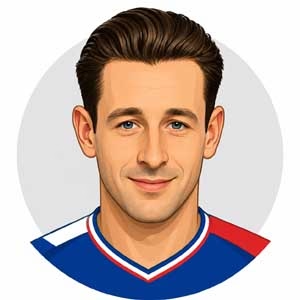
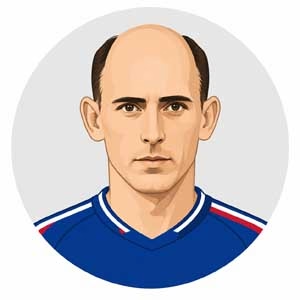
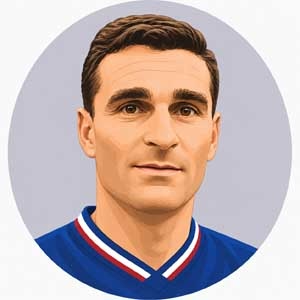
France - Centre-backJonquet, Robert
The brutal mud of Solna on June 24, 1958, etched the ultimate profile of competitive martyrdom when France's defensive general suffered a fractured fibula after thirty minutes against Pelé's Brazil, yet remained on the pitch for an hour because substitutions did not exist. Robert Jonquet was the sweeping defensive pillar, intellectual captain, and tactical architect of Albert Batteux’s revolutionary Stade de Reims side and the historic French team of the 1950s. Operating as a center-half or sweeping libero, Jonquet was a master of anticipatory defending: reading passing trajectories two steps ahead, executing immaculate slide tackles without committing fouls, and immediately launching attacks with cultured, 40-yard passes with either foot. Across 502 matches for Reims between 1946 and 1960, he claimed five Division 1 championships, two Coupes de France, the 1953 Latin Cup, and captained Reims to two European Cup finals against Real Madrid (1956, 1959). For France, across 58 caps, he wore the captain's armband through their historic run to the bronze medal at the 1958 World Cup in Sweden.
Tactically, however, Jonquet’s classical game was built for positional containment rather than explosive transitional footraces. He lacked the raw sprinting speed to recover against lightning-fast wide forwards who broke behind him in wide-open expanses, relying heavily on the physical cover of his defensive partners. Furthermore, his preference for elegant, clean interception over aggressive aerial dogfights left him vulnerable against hyper-physical, direct British center-forwards who pinned him inside his own six-yard box under heavy aerial bombardments.
Aristocratic, calm, and commanding immense natural authority, Jonquet was the definitive gentleman of French post-war football. He led not through loud screams or aggressive histrionics, but through immaculate positioning, moral courage, and serene composure under relentless pressure. On the pitch, his posture was upright and noble, organizing his defensive line with precise hand gestures and stepping out of his own box with casual elegance. Inside the legendary Reims and French national team locker rooms, his word was absolute law—earning the deep reverence of attacking superstars like Raymond Kopa, Just Fontaine, and Jean Vincent. Match officials viewed him as a paragon of spotless sportsmanship, cementing an immortal legacy as the finest, most cerebral central defender in early French football history.