We use Google Analytics to understand how visitors use this site. Analytics cookies are only activated with your consent. For details, read our Privacy Policy.
Profile lensThe same player, read from a different angle.
Athletic82
Acceleration
89
Pace
87
Agility
86
Strength
72
Balance
79
Jumping
78
Stamina
77
Fitness
85
Technical87
Dribbling
87
Short Passing
81
Long Passing
80
Finishing
94
Shot Accuracy
93
Shot Power
80
Shooting Technique
80
Heading
76
Tackling
30
Crossing
76
Free Kick
75
Penalties
88
First Touch
87
Mental83
Composure
89
Aggression
77
Consistency
84
Creativity
82
Leadership
78
Work Rate
76
Tactical83
Vision
78
Off the Ball
94
Defensive Positioning
30
Teamwork
68
Anticipation
87
Marking
33
Player Traits
Attacking87
Crossing
76
Finishing
94
Heading Accuracy
76
Shot Accuracy
93
Off the Ball
94
Technique82
Dribbling
87
Free Kick
75
Short Passing
81
Long Passing
80
First Touch
87
Shot Technique
80
Movement85
Acceleration
89
Pace
87
Agility
86
Balance
79
Physicality78
Shot Power
80
Jumping
78
Stamina
77
Strength
72
Fitness
85
Defending31
Marking
33
Tackling
30
Def. Positioning
30
Mentality & Game Reading81
Aggression
77
Composure
89
Penalties
88
Vision
78
Leadership
78
Work Rate
76
Teamwork
68
Anticipation
87
Consistency
84
Creativity
82
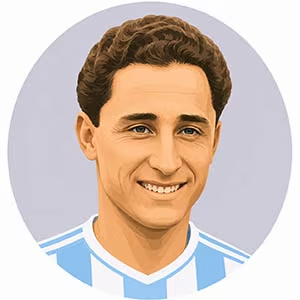
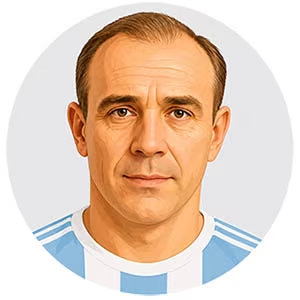
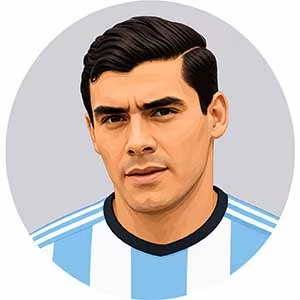
Argentina - StrikerSanfilippo, José
There is a particular kind of striker who does not participate in a football match so much as wait inside it, motionless for eighty seconds at a time, then explode into half a yard of space and end the argument. José Sanfilippo built an entire career on that half yard. Short, compact, and permanently coiled, he specialized in the shot nobody else had seen: struck early, struck from angles that offered no obvious opening, often on the turn before the defender had finished shifting his weight. Goalkeepers of the Argentine golden age remembered him less for power than for timing — the ball leaving his boot roughly a beat before anyone in the stadium expected it.
Born in Buenos Aires in 1935 and known throughout his life as El Nene, Sanfilippo was the purest penalty-box predator Argentine football has produced. He operated in a narrow strip of grass, reading defensive lines rather than dribbling through them, and finished with both feet and with his head despite standing barely 1.72m, compensating with an exceptional leap and a talent for attacking the ball at the precise moment a marker was static. He was also a devastating dead-ball specialist, a discipline he treated with almost clinical seriousness, drilling free-kicks alone after sessions long after his teammates had left. His decade at San Lorenzo de Almagro between 1953 and 1963 produced 226 goals in 328 appearances, still the club record, and he remains the only man to finish as Argentine Primera División top scorer in four consecutive seasons, from 1958 to 1961 — a run that included the goals which delivered the Ciclón's celebrated 1959 championship. He later played for Boca Juniors, Nacional in Montevideo, Bangu and Banfield. For Argentina he scored 21 goals in 29 caps, a ratio matched by very few, appeared at the 1958 and 1962 World Cups, and won the 1959 South American Championship on home soil.
His specialization was also his ceiling. Sanfilippo contributed almost nothing outside the eighteen-yard box: he did not press, did not track back, and had no interest in dropping deep to construct play, which meant that in matches where his team was penned into its own half he could go entire periods without touching the ball. Against very compact low blocks with a spare defender doubling him, and in sides that failed to deliver crosses or through balls, his output collapsed rather than degraded gracefully. Coaches who asked him to modify his game for the collective good generally discovered that the request was not negotiable.
Because his self-belief was total, and he saw no reason to disguise it. Sanfilippo announced his own superiority openly, to journalists, to teammates, and to the defenders marking him, and he backed the claim often enough that it hardened into identity rather than bluster. On the pitch he used his voice constantly — demanding the ball with both arms raised, berating any teammate who chose a different pass, exchanging remarks with goalkeepers before free-kicks that were part psychology and part theatre. He argued with referees as a matter of course and with his own coaches as a matter of principle, most famously fracturing his relationship with the Argentina staff around the 1962 World Cup in Chile, and leaving San Lorenzo two years later in an acrimonious dispute that ended a decade of adoration in a matter of weeks. He carried those feuds for the rest of his life; forty years later, working as one of Argentine television's most combative pundits, he was still relitigating them with undimmed conviction. Away from the game he was pure porteño showman: immaculately dressed, drawn to the nightlife and tango clubs of downtown Buenos Aires, comfortable in the spotlight and visibly restless outside it, a man who enjoyed being recognized as much as he enjoyed scoring. Adored, provocative, and impossible to ignore, he treated the goal as a personal property right and everyone else on the pitch as staff.