We use Google Analytics to understand how visitors use this site. Analytics cookies are only activated with your consent. For details, read our Privacy Policy.
Profile lensThe same player, read from a different angle.
Athletic81
Acceleration
87
Pace
81
Agility
86
Strength
69
Balance
74
Jumping
77
Stamina
91
Fitness
80
Technical83
Dribbling
85
Short Passing
87
Long Passing
85
Finishing
77
Shot Accuracy
74
Shot Power
85
Shooting Technique
79
Heading
76
Tackling
62
Crossing
81
Free Kick
73
Penalties
73
First Touch
85
Mental82
Composure
77
Aggression
78
Consistency
82
Creativity
81
Leadership
86
Work Rate
88
Tactical83
Vision
85
Off the Ball
79
Defensive Positioning
66
Teamwork
90
Anticipation
85
Marking
62
Player Traits
Attacking77
Crossing
81
Finishing
77
Heading Accuracy
76
Shot Accuracy
74
Off the Ball
79
Technique82
Dribbling
85
Free Kick
73
Short Passing
87
Long Passing
85
First Touch
85
Shot Technique
79
Movement82
Acceleration
87
Pace
81
Agility
86
Balance
74
Physicality80
Shot Power
85
Jumping
77
Stamina
91
Strength
69
Fitness
80
Defending63
Marking
62
Tackling
62
Def. Positioning
66
Mentality & Game Reading83
Aggression
78
Composure
77
Penalties
73
Vision
85
Leadership
86
Work Rate
88
Teamwork
90
Anticipation
85
Consistency
82
Creativity
81
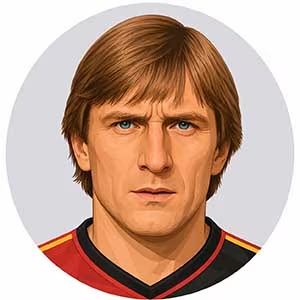
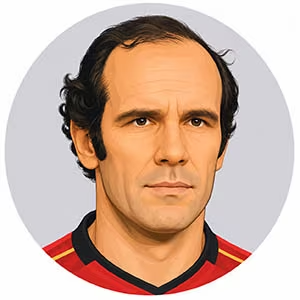
Belgium - Centre MidfielderVan Moer, Wilfried
Wilfried Van Moer built a reputation across more than two decades in Belgian football almost entirely on things opponents felt rather than things a casual spectator would notice watching a highlight reel — the pass that arrived a half-second before a marker had recovered position, the tempo of a match quietly slowing or accelerating because he had decided it should. Belgium's footballing memory treats him as close to a national institution, and outside the country he remains one of the more underrated European midfielders of his generation, largely because his best individual tournament ended in an injury nobody outside Belgium remembers.
Born in Kapellen in 1945, Van Moer was a deep-lying playmaker whose game rested on vision, passing range and game intelligence rather than physical attributes — he was not big, not especially quick, and won very little through direct confrontation. What he offered instead was control: a first touch that oriented him instantly, the ability to switch play with precision over long distances, and a reading of matches that let him dictate rhythm from deep positions in an era when Belgian football rarely produced players capable of that kind of central authority. He spent the bulk of his career at Royal Antwerp and then Standard Liège, winning Belgian championships with the latter and becoming one of the dominant midfield figures in the country through the late 1960s and 1970s. He was voted Belgian Footballer of the Year multiple times, a rare distinction for a player operating so far from goal. For Belgium he won 61 caps across sixteen years, and his defining tournament arrived at the 1970 World Cup, where his performances drew wide praise before a serious injury forced him off in the final group match against Peru, ending Belgium's tournament ambitions along with his own involvement in it.
His limitations were largely physical rather than technical. Van Moer offered little defensively in a purely destructive sense, depending on positioning and anticipation rather than physical duels to disrupt opposition play, which made him vulnerable to sides that pressed him directly and denied him the time his passing game required. He was not a goal threat in any significant volume, his influence expressed almost entirely through distribution rather than direct contribution to the scoreline, and injuries recurred across his career in a way that periodically interrupted stretches of top form — the 1970 World Cup injury the most costly, but not the only one.
Temperamentally he was measured and understated, a playmaker who directed matches through positioning and passing choices rather than through vocal instruction or visible emotional display. Van Moer rarely argued with referees and built a career largely free of disciplinary incident, consistent with a player whose value depended on control and precision rather than physical assertion. He was respected within Belgian football as a technically gifted, quietly authoritative figure rather than an emotionally demonstrative one, and teammates across both of his major clubs described a player who led by the quality and calm of his decision-making rather than by any attempt to dominate a dressing room through personality. The 1970 World Cup injury, arriving at what many considered the peak of his international recognition, appears to have been absorbed with the same equanimity that characterized the rest of his career — there is little record of him publicly dwelling on the setback or using it as a grievance in the years that followed, in contrast to players whose defining international disappointment became a lasting part of their public narrative. Away from the pitch he remained closely associated with Belgian football long after retiring, moving into coaching and staying a respected, low-controversy figure in the game's domestic institutions. Composed, cerebral and rarely given to public complaint, Van Moer built a career of sustained technical authority that history has been kinder to inside Belgium than beyond it.


 All Time BelgiumNT