We use Google Analytics to understand how visitors use this site. Analytics cookies are only activated with your consent. For details, read our Privacy Policy.
Profile lensThe same player, read from a different angle.
Athletic82
Acceleration
83
Pace
78
Agility
81
Strength
82
Balance
79
Jumping
83
Stamina
85
Fitness
84
Technical77
Dribbling
81
Short Passing
76
Long Passing
75
Finishing
60
Shot Accuracy
58
Shot Power
80
Shooting Technique
74
Heading
81
Tackling
83
Crossing
72
Free Kick
65
Penalties
66
First Touch
79
Mental83
Composure
79
Aggression
82
Consistency
88
Creativity
68
Leadership
85
Work Rate
85
Tactical80
Vision
74
Off the Ball
66
Defensive Positioning
83
Teamwork
86
Anticipation
84
Marking
85
Attacking67
Crossing
72
Finishing
60
Heading Accuracy
81
Shot Accuracy
58
Off the Ball
66
Technique75
Dribbling
81
Free Kick
65
Short Passing
76
Long Passing
75
First Touch
79
Shot Technique
74
Movement80
Acceleration
83
Pace
78
Agility
81
Balance
79
Physicality83
Shot Power
80
Jumping
83
Stamina
85
Strength
82
Fitness
84
Defending84
Marking
85
Tackling
83
Def. Positioning
83
Mentality & Game Reading80
Aggression
82
Composure
79
Penalties
66
Vision
74
Leadership
85
Work Rate
85
Teamwork
86
Anticipation
84
Consistency
88
Creativity
68
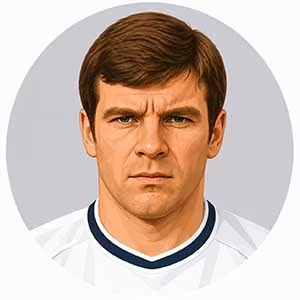
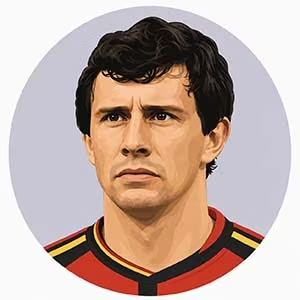
Belgium - Left BackRenquin, Michel
Cologne, 10 March 1981, a UEFA Cup quarter-final Standard Liège were losing on the night. Michel Renquin, sent off after disputing a refereeing decision, responded by making a Hitler salute on his way off the pitch. The gesture cost him a heavy six-match European suspension, wrecked a move to Bayern Munich that had reportedly been close to completion, forced him to sign for Anderlecht instead, and pushed him down the Belgian national team's pecking order through the entire 1982 World Cup. It remains, by any honest account, one of the ugliest moments of his career, and one he has never been able to separate from what came after.
Born in Bastogne, in Belgium's Ardennes region, in 1955, Renquin was a genuinely gifted defender — by contemporary assessment, one of the finest in the world at his position for a period of his career — who came through Standard Liège from 1974, later playing a single season at Anderlecht before three years with Servette in Switzerland, where he won a Swiss Cup and league title, and a return to Standard from 1985 to 1988. He closed his playing career at FC Sion. For Belgium he won 55 caps between 1976 and 1987, played in the Euro 1980 final defeat to West Germany, and was part of the celebrated 1986 World Cup squad that reached the semifinals in Mexico. His own path back into that squad's starting eleven was itself a story of redemption: after five years of what teammates and observers described as an unjustly compromised international career following the Cologne suspension, Renquin returned to form with an acrobatic goal-line clearance against Paraguay that helped rescue Belgium's tournament and is remembered as the moment that side truly came together.
His limitations were directly tied to the same combustible temperament that produced the Cologne incident. Renquin's reaction to refereeing decisions he disagreed with was, on at least that one occasion, catastrophically disproportionate, and the professional cost — a major transfer lost, a lengthy suspension, years of diminished trust from national team selectors — fell entirely on his own career rather than on anyone else's, a self-inflicted wound of unusual severity even within a sport not short of disciplinary incidents. He also, by his own account, declined selection for Euro 1984 for personal reasons he has kept largely private, a further sign of a player willing to act on his own terms even at cost to his international career.
Temperamentally he is still described, decades later and by his own hometown press, as an Ardennais with a strongly tempered character — someone whose intensity was never in doubt, for better and for worse across his career. His comeback from the Cologne suspension, culminating in that Paraguay clearance in 1986, suggests a capacity to compete his way back from a genuinely self-created disaster rather than let it define him permanently, even if the incident itself was never something he could undo. After retiring he built a long coaching career, mostly in Switzerland — Servette, Renens, a brief spell at Nice, Chênois, Delémont, Virton, and eventually back to Standard as an assistant and to lower-league Belgian sides — known specifically for the same rigor and discipline that had, in a different context, once produced his worst moment as a player. He settled in retirement near Liège rather than closer to his children in Switzerland, a choice he has attributed candidly to the modesty of his pension. Fiery, unapologetically direct about his own history when asked, and defined by a career that contains both one of Belgian football's most serious disciplinary disgraces and one of its most memorable redemptive comebacks, Renquin remains a genuinely complicated figure in his country's football history.


 All Time BelgiumNT