We use Google Analytics to understand how visitors use this site. Analytics cookies are only activated with your consent. For details, read our Privacy Policy.
Profile lensThe same player, read from a different angle.
Athletic74
Acceleration
66
Pace
63
Agility
74
Strength
76
Balance
76
Jumping
81
Stamina
60
Fitness
94
Technical42
Dribbling
47
Short Passing
52
Long Passing
57
Shot Accuracy
41
Shot Power
83
Shooting Technique
41
Heading
45
Free Kick
49
Penalties
44
First Touch
42
Mental86
Composure
90
Consistency
80
Leadership
86
Goalkeeping90
Reflexes
91
Positioning
93
Handling
88
Kicking
87
Goalkeeping90
Reflexes
91
Positioning
93
Handling
88
Kicking
87
Attacking43
Heading Accuracy
45
Shot Accuracy
41
Technique48
Dribbling
47
Free Kick
49
Short Passing
52
Long Passing
57
First Touch
42
Shot Technique
41
Physicality79
Shot Power
83
Jumping
81
Stamina
60
Strength
76
Fitness
94
Movement70
Acceleration
66
Pace
63
Agility
74
Balance
76
Mentality & Game Reading75
Composure
90
Penalties
44
Leadership
86
Consistency
80
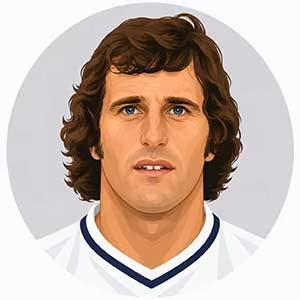
England - GoalkeeperClemence, Ray
Bill Shankly parted with a modest £18,000 in 1967 to bring an agile teenager from Scunthorpe United to Anfield, unknowingly securing the most reliable, decorated goalkeeper in British football history. Raymond Neal Clemence was the immaculate shot-stopping foundation of Liverpool’s dominant 1970s juggernaut before prolonging his masterclasses at Tottenham Hotspur. Operating with razor-sharp positional sense rather than chaotic acrobatics, Clemence made world-class saves look routine: narrowing angles with rapid footwork, holding onto fierce drives in wet conditions, and orchestrating his back four with steady authority. Across 665 matches for Liverpool and over 330 for Tottenham, his trophy cabinet was staggering: five First Division titles, three European Cups (1977, 1978, 1981), two UEFA Cups, two FA Cups, and a League Cup, notably conceding just 16 league goals across the entire 42-game 1978–79 league season. For England, across 61 caps, he engaged in a mythic, decade-long duel with Peter Shilton for the national team’s number one shirt, captaining his country on multiple occasions.
Underneath the remarkable consistency, however, Clemence’s classical style had clear physical constraints. He was not a modern sweeping shot-stopper who sprinted 30 yards off his line to slide-tackle forwards in open space, preferring to remain connected to his penalty area. Against hyper-physical, aerial bombardment setups that crowded his six-yard box on set pieces, his lean frame occasionally required strong physical shielding from center-halves like Tommy Smith or Larry Lloyd to ensure clean punches through traffic.
Serene, gentlemanly, and radiating steady concentration, Clemence was the ultimate psychological anchor for a championship backline. He never indulged in frantic histrionics, finger-pointing, or theatrical despair after conceding; his immediate focus was always on resetting the defensive block and demanding total concentration. On the pitch, his body language was tidy and dignified, commanding his penalty area through precise, calm communication rather than hysterical screaming. Inside the Liverpool and Tottenham dressing rooms, he was an indispensable elder statesman—universally respected by teammates like Kenny Dalglish and Glenn Hoddle for his modesty and unshakeable consistency. Referees found him a consummate professional who never engaged in gamesmanship or time-wasting theatrics, leaving behind an immortal legacy as one of the greatest, most dependable, and successful goalkeepers to ever grace the game.