We use Google Analytics to understand how visitors use this site. Analytics cookies are only activated with your consent. For details, read our Privacy Policy.
Profile lensThe same player, read from a different angle.
Athletic80
Acceleration
77
Pace
76
Agility
82
Strength
75
Balance
80
Jumping
78
Stamina
85
Fitness
90
Technical87
Dribbling
88
Short Passing
90
Long Passing
94
Finishing
75
Shot Accuracy
77
Shot Power
85
Shooting Technique
85
Heading
74
Tackling
79
Crossing
90
Free Kick
78
Penalties
78
First Touch
90
Mental88
Composure
92
Aggression
76
Consistency
88
Creativity
87
Leadership
83
Work Rate
86
Tactical85
Vision
93
Off the Ball
80
Defensive Positioning
78
Teamwork
95
Anticipation
82
Marking
70
Player Traits
Attacking79
Crossing
90
Finishing
75
Heading Accuracy
74
Shot Accuracy
77
Off the Ball
80
Technique88
Dribbling
88
Free Kick
78
Short Passing
90
Long Passing
94
First Touch
90
Shot Technique
85
Movement79
Acceleration
77
Pace
76
Agility
82
Balance
80
Physicality83
Shot Power
85
Jumping
78
Stamina
85
Strength
75
Fitness
90
Defending76
Marking
70
Tackling
79
Def. Positioning
78
Mentality & Game Reading86
Aggression
76
Composure
92
Penalties
78
Vision
93
Leadership
83
Work Rate
86
Teamwork
95
Anticipation
82
Consistency
88
Creativity
87
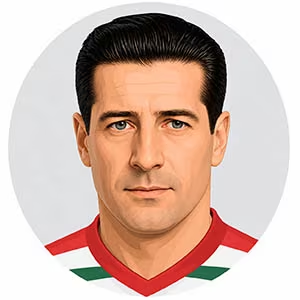
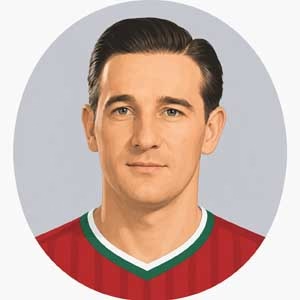
Hungary - Defensive MidfielderBozsik, József
The deep-lying architect of Hungary’s legendary Mighty Magyars and the beating heart of Budapest Honvéd during the 1950s, József Bozsik was the original prototype for the modern half-back and deep playmaking midfielder. Operating in the revolutionary W-M variation deployed by Gusztáv Sebes, Bozsik transformed the traditional central defender-half-back role into a strategic command center. He did not rely on blistering speed or physical intimidation; instead, his game was defined by flawless spatial reading, exceptional long-range passing accuracy, and an uncanny ability to dictate the precise speed of his team's attacks. His laser-guided diagonal switches to Nándor Hidegkuti and Ferenc Puskás shredded traditional defensive lines, most famously during Hungary's historic 6-3 dismantling of England at Wembley in 1953, where his distribution completely exposed the rigid marking systems of the era.
On the field, Bozsik led through sheer intellectual authority, positioning himself as the calm, steadying axis around which his country's fluid, position-swapping system rotated. Within the squad, he held immense personal respect as a quiet, thoughtful, and deeply principled figure, serving as the trusted link between the players, the coaching staff, and the political apparatus of 1950s Hungary. Under intense matchday scrutiny—including navigating the political pressures surrounding the national team—his focus remained completely stoic, executing complex passing patterns under pressure with mathematical consistency. Against referees and opponents, Bozsik stood as a model of fair play and dignity; he rarely engaged in heated arguments or cynical fouls, relying on clean spatial positioning and pristine tackle timing to break up opposition movements. Spending his entire senior career with Honvéd and earning over one hundred caps for his country, Bozsik left an eternal mark on tactical history as football's first true deep-lying playmaker.