We use Google Analytics to understand how visitors use this site. Analytics cookies are only activated with your consent. For details, read our Privacy Policy.
Profile lensThe same player, read from a different angle.
Athletic81
Acceleration
83
Pace
83
Agility
83
Strength
76
Balance
77
Jumping
77
Stamina
86
Fitness
80
Technical80
Dribbling
83
Short Passing
78
Long Passing
83
Finishing
57
Shot Accuracy
62
Shot Power
76
Shooting Technique
76
Heading
74
Tackling
80
Crossing
80
Free Kick
63
Penalties
66
First Touch
82
Mental79
Composure
82
Aggression
78
Consistency
85
Creativity
82
Leadership
70
Work Rate
76
Tactical78
Vision
77
Off the Ball
75
Defensive Positioning
79
Teamwork
82
Anticipation
80
Marking
77
Attacking70
Crossing
80
Finishing
57
Heading Accuracy
74
Shot Accuracy
62
Off the Ball
75
Technique78
Dribbling
83
Free Kick
63
Short Passing
78
Long Passing
83
First Touch
82
Shot Technique
76
Movement82
Acceleration
83
Pace
83
Agility
83
Balance
77
Physicality79
Shot Power
76
Jumping
77
Stamina
86
Strength
76
Fitness
80
Defending79
Marking
77
Tackling
80
Def. Positioning
79
Mentality & Game Reading78
Aggression
78
Composure
82
Penalties
66
Vision
77
Leadership
70
Work Rate
76
Teamwork
82
Anticipation
80
Consistency
85
Creativity
82
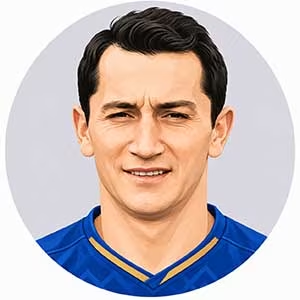
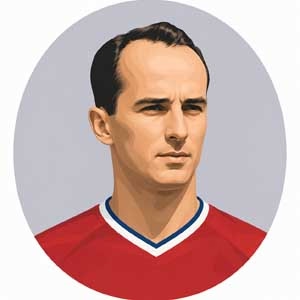
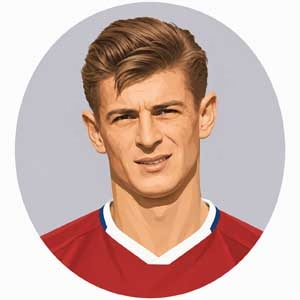
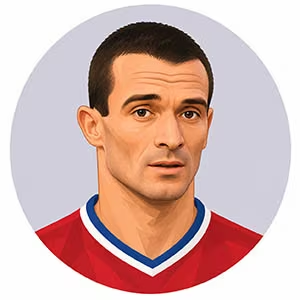
Serbia - Right BackJusufi, Fahrudin
Tough, lean, and possessing an astonishing turn of pace that allowed him to turn defense into instantaneous offense, the Gorani-born defender from Dragaš was the definitive prototype of the modern dynamic full-back across European football in the 1960s. Fahrudin Jusufi—known to teammates and opponents simply as Julka—was an electric, tenacious left-back and right-back whose game fused fierce, close-quarter tackling with lung-bursting overlapping surges that dismantled rigid marking systems.
Operating down the flanks with equal fluency on either side of the pitch, Jusufi was an immovable obstacle in one-on-one isolations. He paired low-center-of-gravity balance with immaculate timing on sliding challenges, dispossessing opposing wingers and immediately initiating counter-attacks through crisp, progressive ground passes. A foundational pillar of FK Partizan's legendary Partizanove Bebe between 1957 and 1966, he made 259 official appearances, capturing four Yugoslav First League championships (including three consecutive titles from 1961 to 1963) and anchoring the defensive line on the run to the 1966 European Cup final in Brussels. He later crossed into West Germany to become an indispensable defensive stalwart for Eintracht Frankfurt across 111 Bundesliga matches. For Yugoslavia, across 55 caps, he was a key figure during their international golden era, capturing the Gold Medal at the 1960 Rome Olympics, finishing as runner-up at the 1960 European Nations' Cup in Paris, and starting every match during the historic run to fourth place at the 1962 World Cup in Chile. In 1963, he was selected as starting full-back for the Rest of the World XI against England at Wembley.
His aggressive, forward-leaning mindset, however, carried inherent structural risks. Jusufi was an explosive, front-foot defender who loved hunting for interceptions high up the pitch; if an elusive wide forward bypassed his initial challenge on a quick one-two, significant territory was vacated behind him. Furthermore, his delivery from wide areas in the final third was driven with direct power rather than delicate curve, prioritizing speed of transition over refined crossing variety.
Psychologically, Jusufi carried the unbreakable pride and quiet resilience of his Gorani mountain heritage. He did not seek the theatrical spotlight, approaching professional football with the deadly focus of an artisan who viewed the touchline as his exclusive territory. On the pitch, his body language was all coiled, kinetic intensity: staring down wingers with an unblinking, predatory focus, rising instantly to his feet after heavy collisions, and barking sharp tactical adjustments to keep the defensive unit compressed. Inside the Partizan, Frankfurt, and Yugoslav dressing rooms, he was an untouchable, respected enforcer whose spotless work ethic, fearless physical commitment, and refusal to be intimidated by global superstars made him an immortal cornerstone of European full-back history.