We use Google Analytics to understand how visitors use this site. Analytics cookies are only activated with your consent. For details, read our Privacy Policy.
Profile lensThe same player, read from a different angle.
Athletic80
Acceleration
84
Pace
77
Agility
79
Strength
83
Balance
81
Jumping
78
Stamina
79
Fitness
78
Technical86
Dribbling
85
Short Passing
77
Long Passing
77
Finishing
91
Shot Accuracy
93
Shot Power
83
Shooting Technique
91
Heading
84
Tackling
40
Crossing
71
Free Kick
79
Penalties
90
First Touch
89
Mental81
Composure
88
Aggression
76
Consistency
78
Creativity
82
Leadership
78
Work Rate
78
Tactical85
Vision
78
Off the Ball
92
Defensive Positioning
38
Teamwork
77
Anticipation
91
Marking
37
Player Traits
Attacking86
Crossing
71
Finishing
91
Heading Accuracy
84
Shot Accuracy
93
Off the Ball
92
Technique83
Dribbling
85
Free Kick
79
Short Passing
77
Long Passing
77
First Touch
89
Shot Technique
91
Movement80
Acceleration
84
Pace
77
Agility
79
Balance
81
Physicality80
Shot Power
83
Jumping
78
Stamina
79
Strength
83
Fitness
78
Defending38
Marking
37
Tackling
40
Def. Positioning
38
Mentality & Game Reading82
Aggression
76
Composure
88
Penalties
90
Vision
78
Leadership
78
Work Rate
78
Teamwork
77
Anticipation
91
Consistency
78
Creativity
82
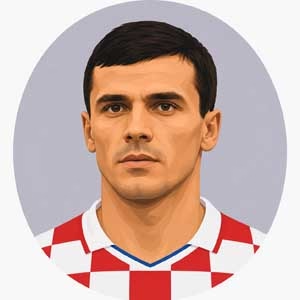
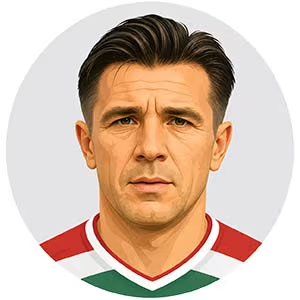
Croatia - StrikerŠuker, Davor
Ask any Croatian football fan to name the goal that mattered most in the country's short football history and most will point to the same one: a chip over Peter Schmeichel from an impossible angle at the 1998 World Cup, scored by a lean, unassuming striker whose finishing looked almost effortless even when the situation demanded anything but ease. Davor Šuker turned that tournament into the best of his life at a moment when Croatia itself was barely five years old as an independent footballing nation, and the two things — his career and his country's early football identity — remain difficult to discuss separately.
Born in Osijek in 1968, in what was then still Yugoslavia, Šuker was a classical poacher with an unusually elegant technical range for the role, blessed with excellent movement inside the box, composure in one-on-one situations with goalkeepers, and a striking, almost delicate finishing touch with either foot that made him look understated even in matches where he was directly deciding the outcome. He was not physically dominant and relied on positioning and anticipation rather than strength, reading defensive gaps before they opened rather than forcing his way through them. He came through Dinamo Zagreb before a move to Sevilla in 1991, then to Real Madrid in 1996, where he won a Champions League title in 1998 as part of a squad still built primarily around other names, and later closed his career with spells at Arsenal, West Ham and 1860 Munich. He was Croatia's all-time leading scorer for years and won the World Cup Golden Boot in 1998 with six goals as Croatia reached the semi-finals in the country's first major tournament as an independent nation, finishing third overall — still by some distance the greatest result in Croatian football history. He earned 69 caps for Croatia across a decade.
His limitations were fairly narrow but genuine. Šuker offered little outside the penalty area, contributing minimally to build-up play or pressing, and his effectiveness depended almost entirely on service arriving into dangerous zones — against compact defenses that denied him space to move into, his influence could shrink considerably. He was not a physically commanding presence in aerial duels relative to some contemporaries, and as his career extended into his thirties at increasingly peripheral clubs, his finishing instincts remained sharper than his overall contribution to matches.
Temperamentally he carried the specific weight of representing a newly independent country with what appears, from the available record, to have been considerable personal investment rather than simple professional obligation. Šuker was not an especially demonstrative or vocal figure by nature, playing with quiet composure rather than visible intensity, but the 1998 World Cup performances suggested a player capable of raising his level specifically for occasions tied to Croatian national significance, distinct from a simple response to stakes or crowd hostility. He was reported to maintain good relationships with teammates and coaches across a well-traveled career spanning several countries and football cultures, without significant documented conflict at any of his major clubs, and his disciplinary record remained clean throughout — consistent with a poacher whose game required minimal physical confrontation to begin with. He later moved into football administration, serving as president of the Croatian Football Federation for nearly a decade, a role that placed him at the center of considerable public controversy over corruption allegations within Croatian football, a markedly different kind of institutional friction than anything documented during his playing career itself. Away from the pitch during his active years he maintained a relatively modest public profile relative to his sporting significance in Croatia, a contrast to the far more contested and public figure he became in football administration afterward. Quietly clinical as a player and considerably more embattled as an administrator, Šuker's two football lives sit almost in tension with each other — the calm, understated finisher giving way, decades later, to a figure at the center of exactly the kind of institutional conflict his playing career had never produced.