We use Google Analytics to understand how visitors use this site. Analytics cookies are only activated with your consent. For details, read our Privacy Policy.
Profile lensThe same player, read from a different angle.
Athletic81
Acceleration
87
Pace
83
Agility
86
Strength
77
Balance
77
Jumping
81
Stamina
79
Fitness
78
Technical85
Dribbling
88
Short Passing
83
Long Passing
82
Finishing
88
Shot Accuracy
88
Shot Power
78
Shooting Technique
91
Heading
79
Tackling
33
Crossing
78
Free Kick
82
Penalties
87
First Touch
91
Mental77
Composure
83
Aggression
79
Consistency
76
Creativity
87
Leadership
70
Work Rate
76
Tactical82
Vision
82
Off the Ball
88
Defensive Positioning
34
Teamwork
76
Anticipation
85
Marking
42
Attacking84
Crossing
78
Finishing
88
Heading Accuracy
79
Shot Accuracy
88
Off the Ball
88
Technique86
Dribbling
88
Free Kick
82
Short Passing
83
Long Passing
82
First Touch
91
Shot Technique
91
Movement83
Acceleration
87
Pace
83
Agility
86
Balance
77
Physicality79
Shot Power
78
Jumping
81
Stamina
79
Strength
77
Fitness
78
Defending36
Marking
42
Tackling
33
Def. Positioning
34
Mentality & Game Reading80
Aggression
79
Composure
83
Penalties
87
Vision
82
Leadership
70
Work Rate
76
Teamwork
76
Anticipation
85
Consistency
76
Creativity
87
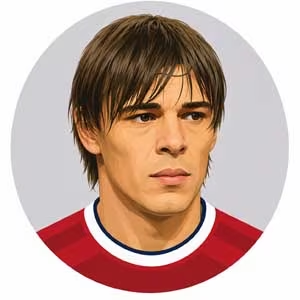
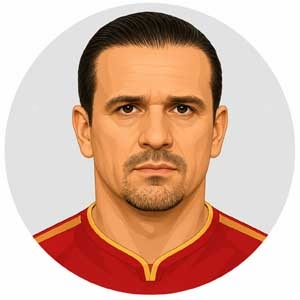
Serbia - ForwardMijatović, Predrag
Predrag Mijatović scored the goal that won Real Madrid its first Champions League in thirty-two years and then spent much of the following decade being remembered for that single moment more than for the considerable body of technically gifted, occasionally maddening football that surrounded it — a career defined by real elegance and equally real inconsistency, unusually blunt in how openly that inconsistency was discussed even at the time.
Born in Titograd — now Podgorica, Montenegro — in 1969, Mijatović was a technically refined forward with genuine dribbling ability, a delicate first touch and a clinical finishing instinct when fully engaged, capable of playing centrally or drifting wide to create space for himself in tight areas. He was not physically imposing and depended on close control and quick changes of direction rather than power or aerial ability, a profile that made him dangerous in isolated attacking situations but less reliable as a all-around focal point for a team's attack. He emerged in Yugoslav football at Budućnost and Partizan before moving to Spain with Valencia in 1990, where his consistent scoring across five seasons earned a transfer to Real Madrid in 1996. There he scored the decisive, curling finish against Juventus in the 1998 Champions League final, ending the club's long wait for a seventh European Cup, before later spells at Fiorentina, Valencia again, and Levante closed a well-traveled career. For the various national teams representing the dissolving and then dissolved Yugoslavia — including a period for FR Yugoslavia and later Montenegro's early independent football setup — he remained a key attacking figure through a politically turbulent period for the region his football represented.
His limitations were considerable and were discussed with unusual frankness by Mijatović himself as well as by coaches and observers throughout his career. He was notoriously inconsistent match to match, capable of decisive brilliance in one game and near-total anonymity in the next, a pattern that several coaches, including at Real Madrid, found difficult to plan around despite his obvious individual quality. He offered essentially nothing defensively, contributed little to team structure outside his immediate attacking contribution, and his effectiveness depended heavily on confidence and rhythm rather than remaining stable regardless of recent form — a mentally and emotionally contingent kind of talent rather than a mechanically reliable one.
Temperamentally he was expressive, self-critical and unusually candid about his own shortcomings for an elite professional athlete. Mijatović spoke openly in interviews throughout his career about his own inconsistency, rarely defending himself when criticized and often anticipating the criticism before journalists raised it, a self-awareness that some read as admirable honesty and others as a lack of the unshakeable self-belief that sustains more consistently prolific forwards. He was demonstrative in celebration and visibly affected by both good and poor form, his confidence appearing to genuinely fluctuate with recent results rather than remaining constant underneath a professional exterior. He maintained good relationships with teammates and coaches across a well-traveled career without significant documented conflict, and his disciplinary record remained largely clean, consistent with a player whose struggles were performative and emotional rather than confrontational. His identity remained closely tied to the political and national transformation of the region he represented, playing for a national team whose name and composition changed repeatedly across his international career as Yugoslavia fractured, a context he navigated as a footballer without becoming a particularly political public figure himself. Away from the pitch he later moved into football administration, including a period as Real Madrid's sporting director, and maintained a public profile as a football pundit known for direct, occasionally blunt analysis consistent with the same candor he had shown discussing his own playing career. Gifted, emotionally transparent and unusually honest about his own unevenness, Mijatović built a career whose defining moment of total composure sits somewhat at odds with a broader body of work he himself rarely described as anything other than inconsistent.


 All Time SerbiaNT