We use Google Analytics to understand how visitors use this site. Analytics cookies are only activated with your consent. For details, read our Privacy Policy.
Profile lensThe same player, read from a different angle.
Athletic84
Acceleration
91
Pace
92
Agility
85
Strength
76
Balance
80
Jumping
75
Stamina
88
Fitness
88
Technical83
Dribbling
85
Short Passing
79
Long Passing
77
Finishing
88
Shot Accuracy
87
Shot Power
85
Shooting Technique
85
Heading
73
Tackling
42
Crossing
78
Free Kick
73
Penalties
74
First Touch
84
Mental82
Composure
86
Aggression
78
Consistency
80
Creativity
77
Leadership
80
Work Rate
81
Tactical82
Vision
82
Off the Ball
87
Defensive Positioning
38
Teamwork
78
Anticipation
85
Marking
38
Player Traits
Attacking83
Crossing
78
Finishing
88
Heading Accuracy
73
Shot Accuracy
87
Off the Ball
87
Technique81
Dribbling
85
Free Kick
73
Short Passing
79
Long Passing
77
First Touch
84
Shot Technique
85
Movement87
Acceleration
91
Pace
92
Agility
85
Balance
80
Physicality82
Shot Power
85
Jumping
75
Stamina
88
Strength
76
Fitness
88
Defending39
Marking
38
Tackling
42
Def. Positioning
38
Mentality & Game Reading80
Aggression
78
Composure
86
Penalties
74
Vision
82
Leadership
80
Work Rate
81
Teamwork
78
Anticipation
85
Consistency
80
Creativity
77
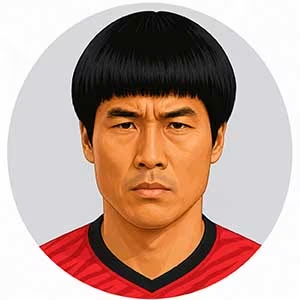
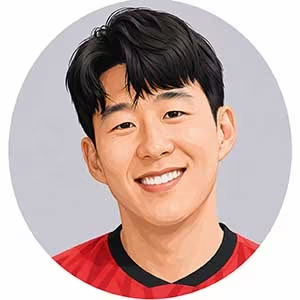
South Korea - ForwardSon, Heung-min
Son Heung-min could make a full sprint look technically quiet. Starting from the left, he would accelerate diagonally behind the defensive line without needing several touches to stabilise the ball, then finish before the goalkeeper could close the angle. The unusual part was that the same movement remained dangerous regardless of which foot received the final action. Son’s right foot was nominally dominant, but his left became sufficiently reliable that defenders could not simply show him towards one side and wait for the advantage to disappear. Under Mauricio Pochettino and later José Mourinho and Antonio Conte, that bilateral finishing turned transition space into an unusually efficient scoring environment. Son could begin outside the penalty area, attack the gap without the ball and complete the move with very little possession. His game therefore looked simple only after an exceptional amount of movement had already solved the difficult part.
Son developed from a wide forward into an attacker capable of operating across the front line. Acceleration over medium and long distances was one of his greatest weapons, but his off-ball timing mattered equally: he delayed runs until defenders had committed their body orientation and then attacked the blind side at speed. He could carry directly in transition, combine quickly around the box and finish from distance, while two-footed shooting dramatically increased the number of viable angles available after a run. At Tottenham his relationship with Harry Kane demonstrated that he could function both as scorer and runner around another attacking reference rather than demanding permanent central occupation. In 2021–22 he scored 23 Premier League goals without a penalty to share the Golden Boot. With South Korea his responsibility was broader: captain, principal scorer and attacking reference across multiple major tournaments. His game remained most destructive when movement could precede possession; static orchestration against a settled defensive block was a less distinctive part of his repertoire.
There were genuine limitations. Son was technically clean at speed but not an elite low-space playmaker whose close control could repeatedly reorganise a dense defence through prolonged possession. Deep blocks that removed the space behind them could therefore reduce his most destructive mechanism. His first touch under heavy back-to-goal contact was less reliable than his finishing once facing forward, and he was not naturally suited to functioning as a physical reference striker for long periods. Defensive work varied according to coach and role: he could press and recover diligently, but heavy defensive running reduced the acceleration available for attacking transitions. Form could also become streaky when finishing efficiency declined, because his contribution was less capable of migrating into possession control than that of a specialist creator. As athletic explosiveness diminishes with age, maintaining value requires increasingly precise movement and finishing because fewer opportunities can be generated through separation alone.
Psychologically, Son is best defined by **failure-directed self-punishment combined with rapid responsibility re-entry**. The Everton match in November 2019 provides unusually visible evidence. After Son fouled André Gomes, the subsequent collision produced a horrific ankle injury. Son immediately became distraught and was initially sent off, although the red card was later overturned because his challenge itself was not judged to constitute serious foul play. The distinction matters: his emotional reaction was enormous even though responsibility for the eventual injury was mechanically indirect. Days later Son played against Red Star Belgrade, scored twice and responded to the first goal with a subdued gesture rather than normal celebration. He had not erased the previous event before returning to competitive responsibility. Similar self-directed reactions have followed his own missed chances and South Korean defeats, where tears and explicit personal responsibility recur more consistently than public blame of teammates. Yet this emotional intensity should not be mistaken for reliable performance degradation. At the 2018 Asian Games, where failure carried unusually significant personal consequences, Son accepted captaincy and creative responsibility while South Korea won the tournament; in later international disappointments he continued returning as the team’s central figure. Evidence for chronic referee conflict or teammate-directed blame is weak, while retaliatory aggression exists in isolated disciplinary incidents and should not be erased by his public image. The stronger contradiction is that **Son can experience perceived failure with unusually visible self-directed intensity, yet that intensity does not reliably make him avoid the next exposed action in which he might fail again**.


 All-Time AsiaAsia