We use Google Analytics to understand how visitors use this site. Analytics cookies are only activated with your consent. For details, read our Privacy Policy.
Profile lensThe same player, read from a different angle.
Athletic85
Acceleration
85
Pace
91
Agility
86
Strength
84
Balance
79
Jumping
87
Stamina
85
Fitness
85
Technical84
Dribbling
85
Short Passing
76
Long Passing
75
Finishing
89
Shot Accuracy
85
Shot Power
86
Shooting Technique
78
Heading
84
Tackling
44
Crossing
68
Free Kick
63
Penalties
77
First Touch
82
Mental82
Composure
85
Aggression
88
Consistency
86
Creativity
76
Leadership
70
Work Rate
85
Tactical82
Vision
77
Off the Ball
87
Defensive Positioning
44
Teamwork
80
Anticipation
85
Marking
44
Player Traits
Attacking83
Crossing
68
Finishing
89
Heading Accuracy
84
Shot Accuracy
85
Off the Ball
87
Technique77
Dribbling
85
Free Kick
63
Short Passing
76
Long Passing
75
First Touch
82
Shot Technique
78
Movement85
Acceleration
85
Pace
91
Agility
86
Balance
79
Physicality85
Shot Power
86
Jumping
87
Stamina
85
Strength
84
Fitness
85
Defending44
Marking
44
Tackling
44
Def. Positioning
44
Mentality & Game Reading81
Aggression
88
Composure
85
Penalties
77
Vision
77
Leadership
70
Work Rate
85
Teamwork
80
Anticipation
85
Consistency
86
Creativity
76
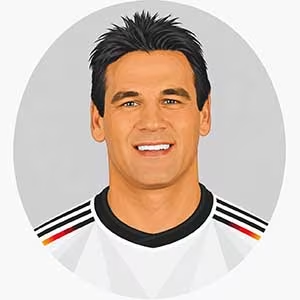
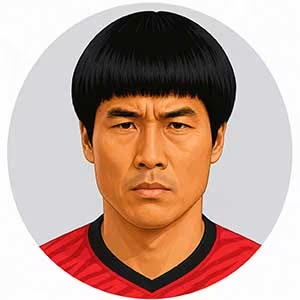
South Korea - StrikerCha, Bum-kun
German defenders in the late 1970s did not know what hit them when a powerhouse forward fresh out of the South Korean Air Force landed in the Bundesliga and started steamrolling backlines like an armored tank. Cha Bum-kun—immortalized across West Germany simply as Cha Bum—was an absolute athletic anomaly in European football, arriving at Eintracht Frankfurt in 1979 before becoming the attacking focal point of Bayer Leverkusen. Standing five-foot-eleven with tree-trunk thighs, terrifying 100-meter acceleration, and explosive heading power, Cha was an unstoppable direct battering ram: tearing through physical stoppers on the counter, blasting thunderous strikes from 25 yards off either foot, and dominating aerial duels through sheer vertical leap. Over a legendary decade in the Bundesliga, he notched 98 league goals without taking a single penalty, lifting the 1979–80 UEFA Cup and the 1980–81 DFB-Pokal with Frankfurt, followed by a second UEFA Cup triumph with Bayer Leverkusen in 1988 (scoring the dramatic late equalizer in the final against Espanyol). For South Korea, he remains the all-time leading scorer with 58 goals in 136 caps, dragging his nation to the 1986 World Cup in Mexico after a thirty-two-year absence.
Yet Cha’s explosive, direct game had clear technical boundaries. He was not an intricate playmaker designed for tight, static triangles in crowded central boxes; his combination passing was strictly functional, and his efficacy dropped when confronted by ultra-deep, packed defenses that denied him a runway to build forward sprinting momentum. Furthermore, opposing defenders routinely targeted his lower legs with brutal, career-threatening tackles—most notoriously a horrific back injury inflicted by Jürgen Gelsdorf in 1980 that almost ended his career.
Disciplined to a monastic degree, deeply humble, and carrying an unshakeable work ethic rooted in military precision, Cha approached professional football as a cultural mission. He had zero interest in the nightlife or celebrity perks of Frankfurt and Leverkusen, preferring grueling extra training sessions to maintain physical supremacy over his peers. On the pitch, his body language was fearless and honest: he never feigned injury or retaliated against the violent hacks aimed at his calves, picking himself up instantly to hunt down the next loose ball. Inside the dressing rooms of Frankfurt and Leverkusen, he commanded god-like respect from teammates and managers alike through his pristine conduct and devastating match-winning output. Opposing center-backs universally dreaded his freight-train surges on transition, while match officials viewed him as a model of fair play, leaving behind an immortal legacy as the trailblazing pioneer and greatest Asian footballer of the 20th century.


 All-Time AsiaAsia