We use Google Analytics to understand how visitors use this site. Analytics cookies are only activated with your consent. For details, read our Privacy Policy.
Profile lensThe same player, read from a different angle.
Athletic81
Acceleration
82
Pace
76
Agility
82
Strength
79
Balance
87
Jumping
87
Stamina
78
Fitness
80
Technical82
Dribbling
77
Short Passing
70
Long Passing
69
Finishing
92
Shot Accuracy
91
Shot Power
78
Shooting Technique
87
Heading
92
Tackling
35
Crossing
68
Free Kick
60
Penalties
75
First Touch
76
Mental83
Composure
87
Aggression
74
Consistency
76
Creativity
72
Leadership
85
Work Rate
86
Tactical85
Vision
76
Off the Ball
92
Defensive Positioning
33
Teamwork
78
Anticipation
95
Marking
33
Player Traits
Attacking87
Crossing
68
Finishing
92
Heading Accuracy
92
Shot Accuracy
91
Off the Ball
92
Technique73
Dribbling
77
Free Kick
60
Short Passing
70
Long Passing
69
First Touch
76
Shot Technique
87
Movement82
Acceleration
82
Pace
76
Agility
82
Balance
87
Physicality80
Shot Power
78
Jumping
87
Stamina
78
Strength
79
Fitness
80
Defending34
Marking
33
Tackling
35
Def. Positioning
33
Mentality & Game Reading80
Aggression
74
Composure
87
Penalties
75
Vision
76
Leadership
85
Work Rate
86
Teamwork
78
Anticipation
95
Consistency
76
Creativity
72
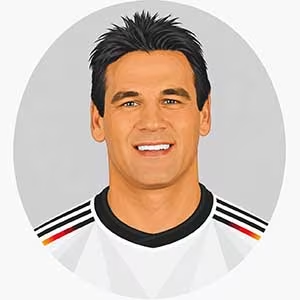
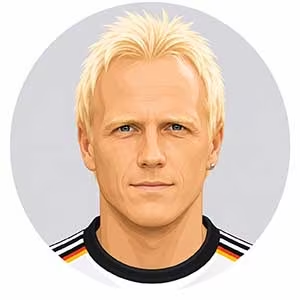
Germany - StrikerKirsten, Ulf
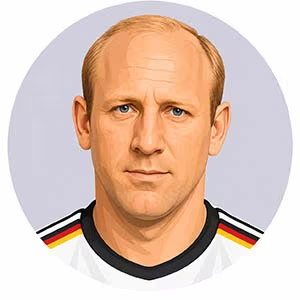
In the congested real estate of the six-yard box, few strikers in Bundesliga history operated with the combative ferocity and predatory spatial timing of Ulf Kirsten. Emerging from the formidable Dynamo Dresden system—where he secured two DDR-Oberliga titles and two FDGB-Pokals before German reunification—Der Schwatte (The Black One) spent an iconic thirteen-year tenure as the undisputed offensive totem of Bayer Leverkusen. Standing just five-foot-eight with a stocky, thick-set build and a low center of gravity, Kirsten turned close-range finishing into a lethal craft: possessing an explosive three-yard dart across the near post, exceptional vertical spring that allowed him to out-jump towering central defenders, and a ruthless, one-touch repertoire off either foot. With 182 Bundesliga goals in 350 matches for Leverkusen, he captured the 1992–93 DFB-Pokal, finished as the Bundesliga top scorer three separate times (1993, 1997, 1998), and anchored Klaus Toppmöller’s side through their heartbreaking "Neverkusen" treble-runner-up campaign in 2001–02. Internationally, he achieved the rare milestone of earning 100 combined caps (49 for East Germany, 51 for unified Germany) across two World Cups (1994, 1998) and Euro 2000, scoring 34 total goals.
Nevertheless, Kirsten’s game had glaring structural boundaries. He was almost entirely reliant on quality wide deliveries and playmaking feeds from maestros like Bernd Schneider and Emerson; if isolated in open-field transitions, he offered negligible contribution to buildup play, possessed limited long-range sprint pace, and lacked the technical range to threaten from outside the eighteen-yard box. Furthermore, his hyper-aggressive temperament on the pitch made him an endless target for disciplinary sanctions.
Volcanic, combative, and driven by an intense, street-fighter edge, Kirsten lived on the psychological borderline of every match. He thrived in hostile environments, actively seeking out verbal and physical confrontations with opposition defenders to fire up his own adrenaline. On the pitch, his body language was a masterclass in controlled hostility: he used subtle elbows, shirt tugs, and constant movement to mentally exhaust markers, reacting to tight man-marking not by retreating into midfield, but by attacking the box with even greater physical violence. Inside the Leverkusen dressing room, he was the indisputable emotional patriarch—demanding, vocal, and fiercely protective of his teammates, setting a standard of competitive aggression that transformed Leverkusen from a provincial outfit into a regular Champions League contender. Confronted by towering, intimidating center-backs like Jürgen Kohler or Thomas Helmer, Kirsten never backed down an inch, attacking aerial crosses with reckless disregard for personal safety. Referees found him an exhausting, sharp-tongued competitor who contested every single offside call, while defenders universally dreaded his relentless near-post darts, cementing an enduring legacy as one of the most ferocious, clinical, and combative penalty-box predators in European football history.