We use Google Analytics to understand how visitors use this site. Analytics cookies are only activated with your consent. For details, read our Privacy Policy.
Profile lensThe same player, read from a different angle.
Athletic79
Acceleration
88
Pace
83
Agility
86
Strength
68
Balance
76
Jumping
80
Stamina
75
Fitness
75
Technical84
Dribbling
88
Short Passing
86
Long Passing
83
Finishing
83
Shot Accuracy
82
Shot Power
77
Shooting Technique
84
Heading
70
Tackling
35
Crossing
79
Free Kick
79
Penalties
76
First Touch
90
Mental74
Composure
78
Aggression
66
Consistency
70
Creativity
91
Leadership
74
Work Rate
68
Tactical78
Vision
83
Off the Ball
85
Defensive Positioning
35
Teamwork
73
Anticipation
75
Marking
38
Player Traits
Attacking80
Crossing
79
Finishing
83
Heading Accuracy
70
Shot Accuracy
82
Off the Ball
85
Technique85
Dribbling
88
Free Kick
79
Short Passing
86
Long Passing
83
First Touch
90
Shot Technique
84
Movement83
Acceleration
88
Pace
83
Agility
86
Balance
76
Physicality75
Shot Power
77
Jumping
80
Stamina
75
Strength
68
Fitness
75
Defending36
Marking
38
Tackling
35
Def. Positioning
35
Mentality & Game Reading75
Aggression
66
Composure
78
Penalties
76
Vision
83
Leadership
74
Work Rate
68
Teamwork
73
Anticipation
75
Consistency
70
Creativity
91
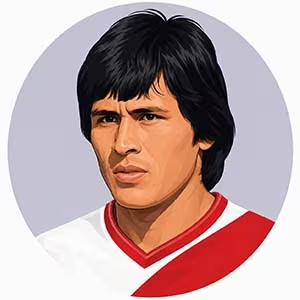
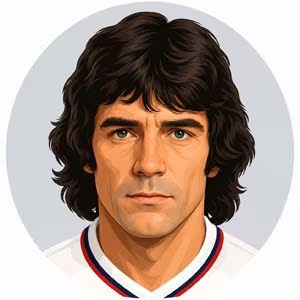
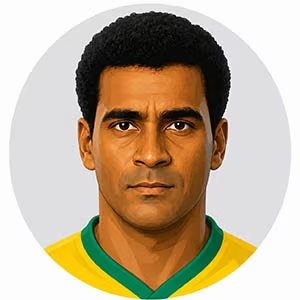
Peru - ForwardSotil, Hugo
Barcelona, 1974. The club had just signed Johan Cruyff and, alongside him, a small Peruvian forward who dribbled with an insolence Catalonia had not seen before. Hugo Sotil scored the winner in a Clásico at the Camp Nou that season, won a La Liga title in his first year, and was on his way to becoming one of the most beloved foreign players in the club's history. Then Peru called him up for a Copa América, Barcelona refused to release him, he went anyway, and the club responded by leaving him out for months. He was twenty-eight, and the greatest chapter of his career effectively ended before it had properly started.
Born in Ica in 1949, Sotil was the most naturally gifted attacking player Peru produced in its golden decade. Known as Cholo Sotil, he was small at 1.68m and built around close control, acceleration in the first three metres, and a dribbling style that relied on changes of direction inside tight spaces rather than pace in open ground. He played as a second striker or inside-forward, linking with the centre-forward, and he finished with a light, precise touch rather than power. He made his name at Deportivo Municipal in Lima before joining Barcelona in 1973, where he won La Liga in 1974 and made 61 appearances across four increasingly complicated seasons. For Peru he won 58 caps and 12 goals, and formed with Teófilo Cubillas and Hugo Sotil's contemporaries the attacking core of the side that won the 1975 Copa América — the country's second and last — and reached the 1970 World Cup quarter-finals, playing some of the most admired football of the tournament.
The gifts came with a professional profile that limited them severely. Sotil's fitness and conditioning were inconsistent throughout his career, and his commitment to training was, by the standards of European football in the seventies, insufficient for a player at Barcelona; the club's frustration with him was not solely about the Copa América. He offered nothing defensively, disappeared in physical matches where he was denied space, and his form fluctuated substantially between seasons. He returned to Peru at thirty and drifted through several clubs without ever recapturing the level.
He was warm, popular and fundamentally unsuited to the machinery around him. Sotil was cheerful and sociable, adored by teammates in both Barcelona and Lima, and entirely without the calculating instinct that a career at that level demanded — his decision to join Peru against his club's explicit instruction was made out of loyalty to his country and without any apparent consideration of the consequences. On the pitch he played with visible enjoyment, took the ball in difficult positions rather than avoiding them, and responded to heavy marking by trying to dribble past it again rather than by protesting or retaliating; he was fouled constantly and complained rarely. But he was easily discouraged by exclusion. During the long periods when Barcelona froze him out, his condition and sharpness declined rather than hardening into defiance, and he required the affection of a coach and a crowd to perform at his best. Away from football he was drawn to the social life of a famous young footballer in two countries that treated him as a celebrity, and he lived without much financial planning, later facing serious hardship in Peru before the football community there rallied around a man almost nobody had ever disliked. Brilliant, generous and professionally undisciplined, Sotil is remembered in Peru as the finest talent the country ever wasted.