We use Google Analytics to understand how visitors use this site. Analytics cookies are only activated with your consent. For details, read our Privacy Policy.
Profile lensThe same player, read from a different angle.
Athletic83
Acceleration
83
Pace
81
Agility
82
Strength
76
Balance
85
Jumping
95
Stamina
81
Fitness
80
Technical84
Dribbling
81
Short Passing
76
Long Passing
70
Finishing
93
Shot Accuracy
90
Shot Power
81
Shooting Technique
74
Heading
95
Tackling
38
Crossing
66
Free Kick
76
Penalties
88
First Touch
82
Mental82
Composure
88
Aggression
87
Consistency
85
Creativity
76
Leadership
73
Work Rate
78
Tactical85
Vision
77
Off the Ball
91
Defensive Positioning
34
Teamwork
77
Anticipation
93
Marking
41
Player Traits
Attacking87
Crossing
66
Finishing
93
Heading Accuracy
95
Shot Accuracy
90
Off the Ball
91
Technique77
Dribbling
81
Free Kick
76
Short Passing
76
Long Passing
70
First Touch
82
Shot Technique
74
Movement83
Acceleration
83
Pace
81
Agility
82
Balance
85
Physicality83
Shot Power
81
Jumping
95
Stamina
81
Strength
76
Fitness
80
Defending38
Marking
41
Tackling
38
Def. Positioning
34
Mentality & Game Reading82
Aggression
87
Composure
88
Penalties
88
Vision
77
Leadership
73
Work Rate
78
Teamwork
77
Anticipation
93
Consistency
85
Creativity
76
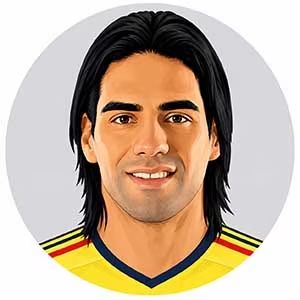
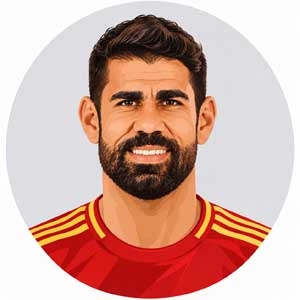
Colombia - StrikerFalcao, Radamel
El Tigre hunted inside the penalty box with an almost primeval hunger, turning the eighteen-yard territory into his personal abattoir between 2009 and 2013. Radamel Falcao García Zárate emerged from River Plate before taking European football by storm, first transforming FC Porto into an unstoppable continental juggernaut and subsequently becoming the lethal spearhead of Diego Simeone’s Atlético Madrid. An orthodox number nine of terrifying completeness, Falcao blended explosive spring with a freakish aerial leap, burying crosses past towering center-backs despite standing under six feet tall. His movement was a masterclass in deception: feinting toward the far post before snapping across the near stick with violent acceleration, finishing with equal venom on either foot. During his two-year apex in Madrid and Porto, he shattered UEFA Europa League records by scoring 17 goals in a single campaign (2010–11) and netting back-to-back final-winning masterclasses, crowned by an unforgettable first-half hat-trick against Chelsea in the 2012 UEFA Super Cup. For Colombia, across more than 100 appearances and 36 strikes, he stands as the nation's all-time top scorer.
That blistering trajectory was tragically derailed on January 22, 2014, when a catastrophic anterior cruciate ligament rupture in a Coupe de France fixture with AS Monaco stripped him of the World Cup in Brazil and permanently eroded his elite twitch-fiber explosiveness. His game was inherently dependent on rapid, violent changes of direction; once robbed of that razor-sharp initial burst, his ill-fated Premier League loan spells at Manchester United and Chelsea exposed his limitations when isolated against physical, deep-sitting English defenses where he could no longer separate from his markers.
Deeply devout, stoic, and driven by a relentless professional ethic, Falcao approached the craft of center-forward play with monastic focus. He did not engage in unnecessary showmanship or frivolous touchline roaming; every run, shield, and touch was calculated purely to maximize goal conversion. On the pitch, his presence was fiercely competitive yet thoroughly sporting, battling bruising center-halves with broad shoulders while avoiding theatrical simulation. Inside the dressing rooms of Porto, Madrid, and Monaco, he was a revered captain and moral anchor, earning universal affection for his quiet dignity and unselfish team-first mindset. Referees admired his honest conduct during high-stakes physical duels, while goalkeepers were left traumatized by his lethal, one-touch instincts, cementing his standing as one of the most devastating penalty-box predators of the 21st century.