We use Google Analytics to understand how visitors use this site. Analytics cookies are only activated with your consent. For details, read our Privacy Policy.
Profile lensThe same player, read from a different angle.
Athletic85
Acceleration
85
Pace
84
Agility
84
Strength
82
Balance
78
Jumping
92
Stamina
83
Fitness
88
Technical84
Dribbling
79
Short Passing
74
Long Passing
74
Finishing
92
Shot Accuracy
90
Shot Power
85
Shooting Technique
96
Heading
91
Tackling
39
Crossing
69
Free Kick
69
Penalties
87
First Touch
82
Mental81
Composure
88
Aggression
87
Consistency
81
Creativity
74
Leadership
70
Work Rate
86
Tactical85
Vision
74
Off the Ball
92
Defensive Positioning
40
Teamwork
80
Anticipation
93
Marking
38
Player Traits
Attacking87
Crossing
69
Finishing
92
Heading Accuracy
91
Shot Accuracy
90
Off the Ball
92
Technique79
Dribbling
79
Free Kick
69
Short Passing
74
Long Passing
74
First Touch
82
Shot Technique
96
Movement83
Acceleration
85
Pace
84
Agility
84
Balance
78
Physicality86
Shot Power
85
Jumping
92
Stamina
83
Strength
82
Fitness
88
Defending39
Marking
38
Tackling
39
Def. Positioning
40
Mentality & Game Reading82
Aggression
87
Composure
88
Penalties
87
Vision
74
Leadership
70
Work Rate
86
Teamwork
80
Anticipation
93
Consistency
81
Creativity
74
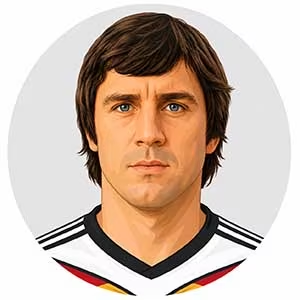
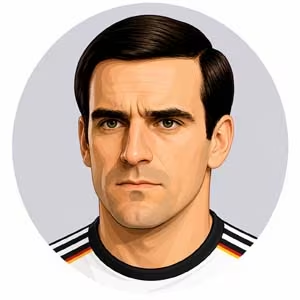
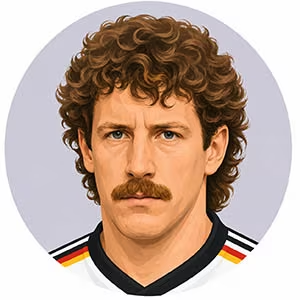
Germany - StrikerFischer, Klaus
The ball came in from the left, behind him, at head height and slightly too far. Klaus Fischer turned his back to goal, threw his legs above the level of his own shoulders, and struck it clean into the top corner from twelve yards. The bicycle kick against Switzerland in November 1977 was voted the German Goal of the Century, and it was not an aberration: he scored that way repeatedly, over fifteen seasons, in a period when the technique was considered an act of showmanship rather than a repeatable skill. Fischer treated it as a normal finishing option, which is precisely what made him abnormal.
Born in Kreuzstraßl in Bavaria in 1949, Fischer was a centre-forward of severe specialisation. At 1.79m he was a superb athlete with an extraordinary leap and unusual body control in the air, and almost everything he did happened inside the penalty area: near-post headers, volleys, overhead kicks, and finishes from awkward heights that other forwards would have controlled first. On the ground he was quick over five metres rather than fast, an ordinary dribbler, and a limited passer. He spent eleven seasons at Schalke 04, where he became the club's all-time leading scorer and its defining figure of the seventies, then moved to 1. FC Köln and later VfL Bochum. His 268 Bundesliga goals remain the second-highest total in the competition's history behind Gerd Müller, a record he built almost entirely in mid-table sides rather than dominant ones. Club honours were consequently thin — a DFB-Pokal with Schalke in 1972 — and his fulfilment came with West Germany: 45 caps, 32 goals, the 1980 European Championship, and the 1982 World Cup final, where he scored the last German goal of the tournament against Italy after equalising in the semi-final against France with, inevitably, an overhead kick in the final seconds of extra time. His career carried a permanent shadow: he was implicated in the 1971 Bundesliga match-fixing scandal as a young player and served a suspension, an episode he spent decades acknowledging rather than contesting.
His limitations were as sharp as his specialism. Fischer contributed almost nothing outside the box — no pressing, no link play, no involvement in build-up — and against deep defences that denied crosses, he could pass entire matches without a meaningful touch. He was dependent on service to an unusual degree even by centre-forward standards, and in teams that could not deliver balls into the area he was close to invisible rather than merely quiet.
Temperamentally he was the plainest man in the set. Fischer was quiet, unassuming and almost entirely without theatre: he did not argue with referees, rarely fouled, never simulated, and celebrated goals with a brief raised arm before jogging back. He led by nothing at all in the vocal sense, and Schalke teammates described a professional who trained diligently, said little, and took correction without defensiveness. The 1971 scandal marked him early and produced a career of conspicuous carefulness afterwards, as though visibility itself had become a risk. He was resilient rather than reactive: missed chances did not visibly affect him, and hostile stadiums registered no measurable change in his behaviour, which made him an unusually stable performer for a striker whose output was otherwise so dependent on circumstance. Away from football he was a private Bavarian with no interest in celebrity, no nightlife, and no public life beyond the game. Spectacular in the air and entirely undramatic on the ground, Fischer scored some of the most extravagant goals in German history with the manner of a man filing paperwork.