We use Google Analytics to understand how visitors use this site. Analytics cookies are only activated with your consent. For details, read our Privacy Policy.
Profile lensThe same player, read from a different angle.
Athletic74
Acceleration
72
Pace
70
Agility
66
Strength
85
Balance
77
Jumping
65
Stamina
77
Fitness
80
Technical87
Dribbling
87
Short Passing
90
Long Passing
88
Finishing
84
Shot Accuracy
77
Shot Power
80
Shooting Technique
83
Heading
81
Tackling
52
Crossing
84
Free Kick
84
Penalties
84
First Touch
91
Mental79
Composure
85
Aggression
66
Consistency
74
Creativity
87
Leadership
78
Work Rate
77
Tactical85
Vision
87
Off the Ball
84
Defensive Positioning
50
Teamwork
90
Anticipation
78
Marking
49
Attacking82
Crossing
84
Finishing
84
Heading Accuracy
81
Shot Accuracy
77
Off the Ball
84
Technique87
Dribbling
87
Free Kick
84
Short Passing
90
Long Passing
88
First Touch
91
Shot Technique
83
Movement71
Acceleration
72
Pace
70
Agility
66
Balance
77
Physicality77
Shot Power
80
Jumping
65
Stamina
77
Strength
85
Fitness
80
Defending50
Marking
49
Tackling
52
Def. Positioning
50
Mentality & Game Reading81
Aggression
66
Composure
85
Penalties
84
Vision
87
Leadership
78
Work Rate
77
Teamwork
90
Anticipation
78
Consistency
74
Creativity
87
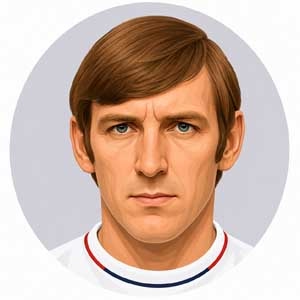
England - Attacking MidfielderBrooking, Trevor
In an era when English football celebrated bone-crunching midfield collisions and blood-and-thunder aerial warfare, a cerebral artist in claret and blue strolled through the mud of Upton Park as if navigating an afternoon chess match in a botanical garden. Sir Trevor David Brooking CBE was the supreme aesthetic aristocrat of modern English midfield play: a playmaker whose game was defined by flawless balance on either foot, effortless spatial economy, and a pristine passing geometry that bypassed physical friction altogether.
Operating as a central attacking midfielder, deep-lying orchestrator, or roving inside-left, Brooking made the frantic pace of the First Division slow down to his personal cadence. He possessed a majestic first touch, an immaculate ability to glide past lunging tacklers with subtle shoulder drops, and an ambidextrous passing repertoire that allowed him to thread disguise through-balls or float inch-perfect crosses from either flank. A legendary one-club icon at West Ham United between 1966 and 1984, he made 643 official appearances and scored 102 goals, serving as the ideological custodian of the Academy of Football under Ron Greenwood and John Lyall. In East London, he lifted two FA Cups (1975 and 1980)—famously scoring the iconic, rare diving header in the 1980 final at Wembley to defeat Arsenal as a Second Division side—alongside reaching the 1975–76 European Cup Winners' Cup final. For England, across 47 caps and five goals, his international pedigree was undeniable across Euro 1980 and the 1982 World Cup in Spain, where, despite suffering from severe groin injuries, he came off the bench against Spain to nearly unlock the tournament with a fierce drive into the side netting.
That sublime, velvet elegance, however, operated within clear physical parameters. Brooking was completely devoid of explosive linear sprint speed and possessed an open aversion to crude defensive dirty work; he rarely slid into muddy tackles or tracked opposing runners deep into his own six-yard box, relying on combative midfield enforcers like Billy Bonds to provide physical cover and win back possession. When confronted by hyper-aggressive, cynical man-markers who crowded his turning radius and turned the match into an attritional, fragmented battle on heavy winter pitches, his passing influence could be contained if his teammates failed to provide dynamic forward runs.
Psychologically, Brooking was an island of monastic calm, spotless sporting integrity, and quiet intellectual nobility. He was utterly immune to terrace hostility, intimidation tactics, or the frantic chaos of British cup derbies, never once receiving a red card and barely collecting a handful of bookings across nearly two decades of top-flight warfare. He approached football not as a gladiatorial blood sport, but as an intellectual craft of space, angles, and technical respect. On the pitch, his posture was upright, aristocratic, and unflappable: surveying the pitch with his head held high, gliding away from flying boots without breaking stride, and releasing the ball with effortless, unhurried grace. Inside the Boleyn Ground and England dressing rooms, he was an adored, quietly authoritative figure whose technical purism, loyalty to a single shirt, and gentlemanly soul cemented an eternal legacy as the definitive symbol of West Ham’s romantic identity.