We use Google Analytics to understand how visitors use this site. Analytics cookies are only activated with your consent. For details, read our Privacy Policy.
Profile lensThe same player, read from a different angle.
Athletic78
Acceleration
73
Pace
76
Agility
69
Strength
91
Balance
79
Jumping
84
Stamina
76
Fitness
77
Technical83
Dribbling
76
Short Passing
73
Long Passing
69
Finishing
92
Shot Accuracy
91
Shot Power
85
Shooting Technique
74
Heading
95
Tackling
38
Crossing
61
Free Kick
65
Penalties
73
First Touch
78
Mental82
Composure
84
Aggression
86
Consistency
80
Creativity
66
Leadership
84
Work Rate
82
Tactical82
Vision
70
Off the Ball
91
Defensive Positioning
33
Teamwork
74
Anticipation
89
Marking
37
Player Traits
Attacking86
Crossing
61
Finishing
92
Heading Accuracy
95
Shot Accuracy
91
Off the Ball
91
Technique73
Dribbling
76
Free Kick
65
Short Passing
73
Long Passing
69
First Touch
78
Shot Technique
74
Movement74
Acceleration
73
Pace
76
Agility
69
Balance
79
Physicality83
Shot Power
85
Jumping
84
Stamina
76
Strength
91
Fitness
77
Defending36
Marking
37
Tackling
38
Def. Positioning
33
Mentality & Game Reading79
Aggression
86
Composure
84
Penalties
73
Vision
70
Leadership
84
Work Rate
82
Teamwork
74
Anticipation
89
Consistency
80
Creativity
66
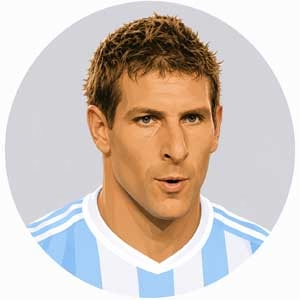
Argentina - StrikerPalermo, Martín
Three penalties in a single match, three misses: one over the bar, one against the post, one saved. It happened to Martín Palermo against Colombia at the 1999 Copa América, in front of a continent, and it remains a record no other footballer has ever approached. What defines him is not the record but the aftermath — he asked to take the third one, and he spent the following decade behaving as though none of it had ever happened. That was the whole man in miniature: a striker built almost entirely out of belief, playing a game that repeatedly gave him reasons to abandon it.
Born in La Plata in 1973 and known universally as El Loco, Palermo was a classic centre-forward of a type Europe had largely stopped producing. Standing 1.85m with a leap that suspended him above defenders for what looked like an extra half-second, he was one of the finest headers of a ball in the modern game, attacking crosses at the near post with his eyes open and his neck muscles doing the work. On the ground he was a pure penalty-box operator: strong in the shoulder, ruthless with either foot inside twelve yards, and capable of finishing chances that arrived at awkward heights and impossible angles. He came through Estudiantes, won the 1998 Copa Libertadores… his first titles at Boca Juniors, and became the club's all-time leading scorer with 236 goals in 404 appearances, a record that had stood in Roberto Cherro's name since 1938. With Boca he won eight domestic championships, three Copa Libertadores (2000, 2003, 2007) and two Intercontinental Cups, scoring both goals in the 2–1 victory over Real Madrid in Tokyo in 2000. His Spanish years brought a personal catastrophe that became legend: celebrating a goal for Villarreal in 2001, he climbed a perimeter wall that collapsed under him, fracturing his tibia and fibula and costing him nearly a year. For Argentina he scored 9 goals in just 15 caps, including a 93rd-minute winner against Peru in torrential rain in 2009 that rescued World Cup qualification, and a goal against Greece in South Africa at the age of 36.
He was, by elite standards, a technically limited footballer, and never pretended otherwise. His first touch was heavy, his dribbling functional at best, and he offered almost nothing in build-up play or pressing. In systems that asked the forward to drop between the lines, rotate, or link with midfielders, he was close to useless; against deep blocks defending with two centre-backs and no crosses arriving, he could disappear for long stretches. He also lost his temper often enough to matter, collecting red cards for retaliation and dissent in matches his team could not afford to play with ten men.
None of it dented him, and that immunity was his genuine superpower. Palermo missed chances with a frequency that would have destroyed most strikers and simply demanded the next one, arms already raised, and it made him the most trusted man in Argentine football in the eighty-ninth minute. He was ferociously superstitious, wedded to rituals about kit and pre-match routine that he defended without embarrassment. On the pitch he was loud, theatrical and openly emotional: berating defenders who fouled him, arguing with referees, roaring at teammates who failed to cross, then weeping without shame after decisive goals and pointing to the Bombonera stands as though addressing family. He fed on that crowd more directly than almost any player of his era, and his form visibly rose with noise and hostility, which made him more dangerous in a Superclásico than in a routine league fixture. Away from football he was conventional and grounded — a devoted family man, uninterested in nightlife, who spoke about his profession with the earnestness of a supporter. El Loco was a nickname earned through recklessness and eccentricity, not chaos: the madness was simply that he never once considered the possibility of failing.