We use Google Analytics to understand how visitors use this site. Analytics cookies are only activated with your consent. For details, read our Privacy Policy.
Profile lensThe same player, read from a different angle.
Athletic77
Acceleration
69
Pace
75
Agility
68
Strength
92
Balance
77
Jumping
78
Stamina
77
Fitness
78
Technical81
Dribbling
74
Short Passing
71
Long Passing
67
Finishing
92
Shot Accuracy
86
Shot Power
83
Shooting Technique
72
Heading
93
Tackling
38
Crossing
60
Free Kick
62
Penalties
71
First Touch
78
Mental77
Composure
81
Aggression
72
Consistency
78
Creativity
66
Leadership
76
Work Rate
74
Tactical83
Vision
72
Off the Ball
92
Defensive Positioning
32
Teamwork
74
Anticipation
90
Marking
38
Player Traits
Attacking85
Crossing
60
Finishing
92
Heading Accuracy
93
Shot Accuracy
86
Off the Ball
92
Technique71
Dribbling
74
Free Kick
62
Short Passing
71
Long Passing
67
First Touch
78
Shot Technique
72
Movement72
Acceleration
69
Pace
75
Agility
68
Balance
77
Physicality82
Shot Power
83
Jumping
78
Stamina
77
Strength
92
Fitness
78
Defending36
Marking
38
Tackling
38
Def. Positioning
32
Mentality & Game Reading75
Aggression
72
Composure
81
Penalties
71
Vision
72
Leadership
76
Work Rate
74
Teamwork
74
Anticipation
90
Consistency
78
Creativity
66
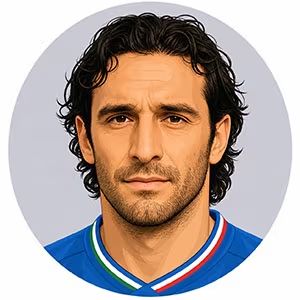
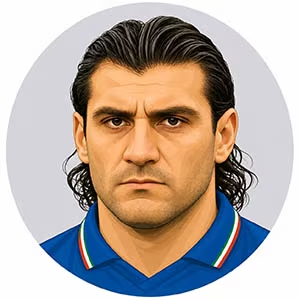
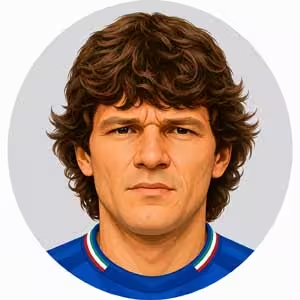
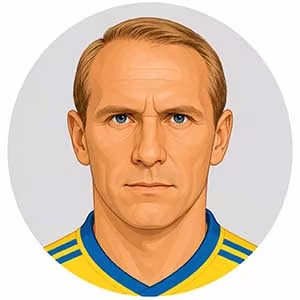
Italy - StrikerToni, Luca
Luca Toni was twenty-seven years old, playing his ninth different club in a career that had wandered through Serie C and Serie B for the better part of a decade, when Palermo finally gave him a regular Serie A shirt and the goals started arriving in numbers nobody expected from a player everyone had assumed had missed his window. Two years later he was Europe's top scorer with 31 goals for Fiorentina, and four months after that he was starting up front for Italy in a World Cup final. Almost nothing about his career happened on the timeline careers like his are supposed to follow.
Born in Pavullo nel Frignano, in Emilia-Romagna, in 1977, Toni was a classical, old-fashioned centre-forward at 1.93 metres — a target man built for the penalty box, exceptional in the air, strong enough to hold off defenders and bring others into play, and less interested in the movement and interchange increasingly demanded of forwards elsewhere in Europe. He spent eight seasons and eight clubs working through Italy's lower divisions before Palermo's promotion to Serie A in 2004 finally gave him a stage, and Fiorentina signed him a year later, where his 2005–06 season produced the first 30-goal Serie A campaign in nearly fifty years and the first European Golden Shoe won by an Italian. He was a key figure in Italy's 2006 World Cup win, scoring twice in the quarter-final against Ukraine and starting the final, before a club-record move to Bayern Munich in 2007 produced a Bundesliga and cup double in his first German season, 39 goals in all competitions. Later spells at Roma, Genoa, Juventus, a brief stint in the UAE, and a return to Fiorentina preceded an improbable late renaissance at Hellas Verona, where at thirty-eight he shared the Serie A top scorer title again and reached 300 professional goals. For Italy he won 47 caps and 16 goals.
His limitations were the predictable cost of a game built entirely around the eighteen-yard box. Toni offered essentially nothing in build-up play, pressed sparingly, and depended completely on service arriving from wide areas or through the middle; against compact defenses that denied him crosses and through balls, or that doubled him aerially, his influence could shrink to almost nothing across ninety minutes. He was not a natural dribbler and contributed little away from direct goal involvement, and the long apprenticeship in Italy's lower leagues meant his prime years at the very top were compressed into a shorter window than more conventionally developed strikers enjoyed.
Temperamentally he was warm, straightforward and unusually loyal for a player who changed clubs as often as his early career required. When Fiorentina were relegated in the Calciopoli scandal, Toni publicly considered leaving but was talked into staying by club president Andrea Della Valle, and honored a personal promise not to sign for an Italian rival when he eventually departed — choosing Bayern Munich specifically to keep his word. He credited an early coach, Guido Attardi, with being more a father figure than a manager and with giving him the decisive break in his career, a debt he mentioned readily in later interviews. He approached his own late-career longevity with visible pride rather than surprise, training harder as retirement approached rather than easing off, and spoke about competing against younger athletes as something he actively enjoyed rather than resented. Bayern's supporters nicknamed him Tori, treating the name as a synonym for goals, and he remained a welcome, recurring guest at the club's Legends events for years after leaving. After retiring in 2016 he built a second public identity as a blunt, well-liked television pundit, known for frank opinions delivered with humor, and stayed visibly close to former teammates and to football generally rather than withdrawing from the game. Good-humored, physically committed to the very end of a long career, and consistently described — by opponents, teammates and fans alike — as a gentle giant off the pitch, Toni built an unlikely path to the top by simply refusing to accept that his moment had passed him by.