We use Google Analytics to understand how visitors use this site. Analytics cookies are only activated with your consent. For details, read our Privacy Policy.
Profile lensThe same player, read from a different angle.
Athletic79
Acceleration
80
Pace
82
Agility
77
Strength
79
Balance
77
Jumping
82
Stamina
77
Fitness
77
Technical84
Dribbling
78
Short Passing
74
Long Passing
70
Finishing
90
Shot Accuracy
90
Shot Power
90
Shooting Technique
77
Heading
91
Tackling
42
Crossing
62
Free Kick
83
Penalties
88
First Touch
81
Mental80
Composure
87
Aggression
76
Consistency
74
Creativity
73
Leadership
80
Work Rate
78
Tactical84
Vision
74
Off the Ball
90
Defensive Positioning
40
Teamwork
77
Anticipation
95
Marking
38
Player Traits
Attacking85
Crossing
62
Finishing
90
Heading Accuracy
91
Shot Accuracy
90
Off the Ball
90
Technique77
Dribbling
78
Free Kick
83
Short Passing
74
Long Passing
70
First Touch
81
Shot Technique
77
Movement79
Acceleration
80
Pace
82
Agility
77
Balance
77
Physicality81
Shot Power
90
Jumping
82
Stamina
77
Strength
79
Fitness
77
Defending40
Marking
38
Tackling
42
Def. Positioning
40
Mentality & Game Reading80
Aggression
76
Composure
87
Penalties
88
Vision
74
Leadership
80
Work Rate
78
Teamwork
77
Anticipation
95
Consistency
74
Creativity
73
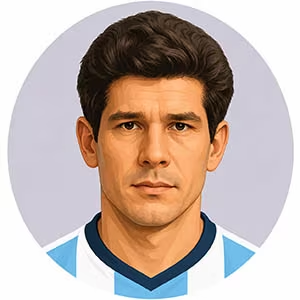
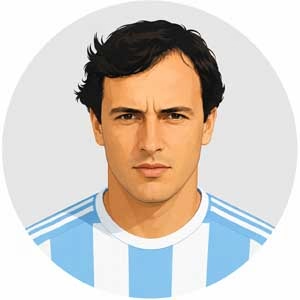
Argentina - StrikerBalbo, Abel
Roma in the mid-nineties was a club that consumed strikers. The Curva Sud demanded, the press dissected, and the shadow of Pruzzo hung over every centre-forward who arrived. Abel Balbo scored 87 goals in five seasons there, quietly, without ever raising his voice or generating a headline that was not about football, and left with the affection of a support that had spent a decade being difficult to please. In a stadium built for drama, his entire professional identity was the refusal to supply any.
Born in Villa Cañás, Santa Fe, in 1966, Balbo emerged at Newell's Old Boys and River Plate, where he won the 1989–90 Argentine championship, before moving to Italy with Udinese in 1990. He scored consistently enough there to earn a transfer to Roma in 1993, and became the club's most reliable forward of the decade. He was a modern centre-forward rather than a classical one: 1.80m, genuinely quick, and a specialist in movement — attacking the space between and behind centre-backs, timing runs off the shoulder of the last defender, and finishing at speed with either foot. He was also an intelligent link player who dropped short and held the ball for arriving midfielders, which made him valuable in systems that wanted verticality. He is one of the few players to have scored more than 100 Serie A goals as a foreigner, across spells at Udinese, Roma, Parma — where he won the 1999 Coppa Italia and UEFA Cup — Fiorentina and Boca Juniors. For Argentina he collected 37 caps and 11 goals, played at the 1994 and 1998 World Cups, and won the 1993 Copa América.
His ceiling was real and he never pretended otherwise. Balbo was not a decisive match-winner in the biggest games, and his goals came in volume rather than in moments — a striker who converted the chances a good team created rather than one who generated them alone. He was ordinary in the air for his height, offered limited hold-up play against physically dominant centre-backs, and depended heavily on space to run into, becoming markedly less effective against deep, compact defences that gave him nothing behind. In an Argentina attack containing Batistuta and Caniggia, he was never more than a valuable alternative.
Temperamentally he was the model professional, and it was a deliberate ethic rather than an absence of personality. Balbo was calm, courteous and undemonstrative on the pitch — he rarely protested to referees, almost never simulated, fouled infrequently, and reacted to missed chances by repositioning rather than by visible frustration. He was not a vocal leader and did not attempt to be, contributing instead through preparation, availability and a consistency that made him the striker coaches picked when they needed reliability rather than inspiration. Roma's volatile environment, with its cycles of adoration and abuse, appeared not to move him in either direction; his output was almost unchanged between periods when the crowd was with him and periods when it was not, a stability rare among foreign players in that city. He was intelligent and articulate away from the game, spoke Italian fluently within a year, integrated completely, and later settled in Italy, working in coaching and television without controversy. His private life across a fifteen-year career produced nothing for the papers. Steady, unspectacular and entirely dependable, Balbo was the striker a difficult club could count on precisely because nothing about him was ever difficult.


 All Time RomaClub