We use Google Analytics to understand how visitors use this site. Analytics cookies are only activated with your consent. For details, read our Privacy Policy.
Profile lensThe same player, read from a different angle.
Athletic81
Acceleration
72
Pace
77
Agility
68
Strength
93
Balance
89
Jumping
88
Stamina
82
Fitness
80
Technical83
Dribbling
76
Short Passing
77
Long Passing
69
Finishing
91
Shot Accuracy
85
Shot Power
87
Shooting Technique
73
Heading
97
Tackling
52
Crossing
64
Free Kick
65
Penalties
66
First Touch
80
Mental79
Composure
84
Aggression
83
Consistency
79
Creativity
65
Leadership
70
Work Rate
83
Tactical83
Vision
74
Off the Ball
91
Defensive Positioning
52
Teamwork
80
Anticipation
85
Marking
48
Player Traits
Attacking86
Crossing
64
Finishing
91
Heading Accuracy
97
Shot Accuracy
85
Off the Ball
91
Technique73
Dribbling
76
Free Kick
65
Short Passing
77
Long Passing
69
First Touch
80
Shot Technique
73
Movement77
Acceleration
72
Pace
77
Agility
68
Balance
89
Physicality86
Shot Power
87
Jumping
88
Stamina
82
Strength
93
Fitness
80
Defending51
Marking
48
Tackling
52
Def. Positioning
52
Mentality & Game Reading77
Aggression
83
Composure
84
Penalties
66
Vision
74
Leadership
70
Work Rate
83
Teamwork
80
Anticipation
85
Consistency
79
Creativity
65
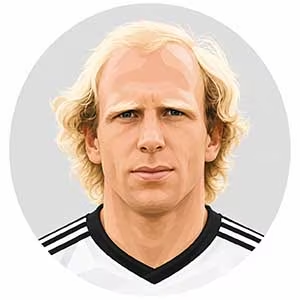
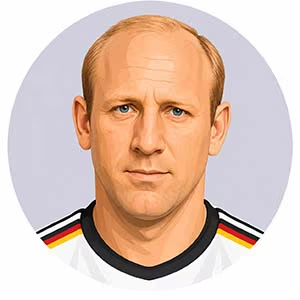
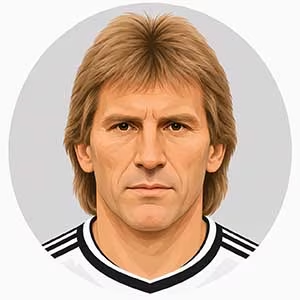
Germany - StrikerHrubesch, Horst
Hrubesch was a centre-forward whose effectiveness came from reducing the game to actions he could repeat better than almost anyone else. At around 1.88 metres, heavily built but possessing an excellent vertical leap, he attacked crosses with exceptional timing and generated power without needing elaborate movement. He later recalled scoring 81 of his 136 Bundesliga goals with his head, an extraordinary indication of how specialised his finishing became. He did not merely wait underneath high balls: he established contact with centre-backs, protected possession, created a reference point for teammates and then attacked the area again. His combination play was uncomplicated, usually involving layoffs, short exchanges or balls redirected into the paths of runners. He lacked the close control and improvisational range of a forward expected to build attacks independently, but understood his own strengths unusually well and repeatedly described his approach as playing as simply as possible. His rise was late. Still in lower-league football at 23, he reached the Bundesliga with Rot-Weiss Essen before joining Hamburg in 1978. There he became one of the central figures of the club’s greatest period, winning Bundesliga titles in 1979, 1982 and 1983 and the European Cup in 1983, when Hamburg defeated Juventus in Athens. He later played for Standard Liège and Borussia Dortmund. His international career was compressed into only a few years: he debuted for West Germany at 28, received his decisive Euro 1980 opportunity partly because Klaus Fischer was injured, scored both goals in the final, and was also part of the side that reached the 1982 World Cup final. He finished with 21 caps and six international goals.
His limitations were substantial whenever opponents removed the conditions his game required. Hrubesch offered little threat by dribbling past defenders, attacking repeatedly from deep or creating shooting positions through acceleration. If wide service deteriorated, crosses were prevented at source or opponents crowded the central aerial zones with enough physical strength, his influence could fall sharply. His size helped him protect the ball but did not make him mobile across every attacking zone, and teams asking their centre-forward to interchange constantly or participate in intricate possession would receive less from him. Even at Euro 1980 he went through all three group matches without scoring and entered the final with his starting place legitimately under question. His physical game also demanded significant energy; Hrubesch later admitted that the heat of the final left him so exhausted that extra time might have been beyond Germany. His peak was therefore highly productive but tactically specific rather than universally transferable.
What distinguishes Hrubesch psychologically is how rarely uncertainty about his status appears to have become resentment. Before the Euro 1980 final he knew that three scoreless matches had placed his position at risk, yet later said plainly that if Jupp Derwall had left him out, he could not have complained. That reaction matters because it came immediately before the defining performance of his career: selection insecurity did not require indignation to activate him. Once retained, he scored twice. His path to that moment had already demanded unusual tolerance for delayed recognition. At 23 he was still outside elite football; at 28 he had still not played for his country. He spoke about that lateness without presenting it as an injustice, simply observing that he had always started things late. The same lack of theatrical self-importance appears in the way he discussed his own strengths. He did not describe his heading as instinctive genius, but as the result of jumping ability, timing and repeatedly exploiting what he could do well. Even his winning goal against Belgium was reconstructed in procedural terms: the corner had been prepared, Rummenigge signalled, Pfaff stayed deep, and the available space was attacked. This suggests a player whose confidence rested strongly on repeatable tasks rather than emotional momentum. Team hierarchy also seems to have produced little visible friction. Hrubesch recalled Euro 1980 as a side in which players ran for one another and explicitly said it did not matter whether he or Klaus Allofs scored. There is little evidence of habitual disputes with referees, retaliatory behaviour after fouls or public confrontations with coaches during his peak years. Physical aggression from defenders was intrinsic to the role he played and generally changed the difficulty of his actions more than his emotional state. Major occasions, meanwhile, did not appear to increase hesitation: his first international goals arrived in a European final, and he remained functional enough under extreme fatigue to execute the decisive rehearsed movement in the closing minutes. His leadership was therefore behavioural rather than commanding. He offered a target, worked within predetermined structures, accepted selection decisions and allowed teammates to receive credit without apparently needing to dominate the group socially. The potential weakness inside that stability was dependence on usefulness: because his identity was so closely tied to executing a narrow role efficiently, tactical environments that made those actions irrelevant could reduce his influence without providing many alternative ways of imposing himself. Emotionally, however, exclusion, late recognition and physical confrontation appear to have generated remarkably little destabilisation. Hrubesch’s competitive confidence was quiet, procedural and unusually resistant to wounded status.