We use Google Analytics to understand how visitors use this site. Analytics cookies are only activated with your consent. For details, read our Privacy Policy.
Profile lensThe same player, read from a different angle.
Athletic80
Acceleration
74
Pace
77
Agility
71
Strength
91
Balance
82
Jumping
90
Stamina
76
Fitness
77
Technical80
Dribbling
71
Short Passing
74
Long Passing
66
Finishing
89
Shot Accuracy
85
Shot Power
85
Shooting Technique
66
Heading
95
Tackling
44
Crossing
59
Free Kick
64
Penalties
72
First Touch
73
Mental76
Composure
80
Aggression
74
Consistency
71
Creativity
66
Leadership
70
Work Rate
91
Tactical81
Vision
71
Off the Ball
87
Defensive Positioning
33
Teamwork
69
Anticipation
93
Marking
38
Player Traits
Attacking83
Crossing
59
Finishing
89
Heading Accuracy
95
Shot Accuracy
85
Off the Ball
87
Technique69
Dribbling
71
Free Kick
64
Short Passing
74
Long Passing
66
First Touch
73
Shot Technique
66
Movement76
Acceleration
74
Pace
77
Agility
71
Balance
82
Physicality84
Shot Power
85
Jumping
90
Stamina
76
Strength
91
Fitness
77
Defending38
Marking
38
Tackling
44
Def. Positioning
33
Mentality & Game Reading76
Aggression
74
Composure
80
Penalties
72
Vision
71
Leadership
70
Work Rate
91
Teamwork
69
Anticipation
93
Consistency
71
Creativity
66
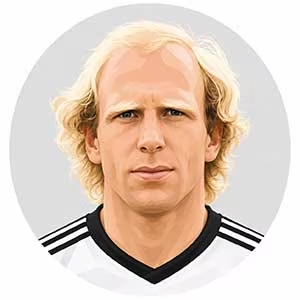
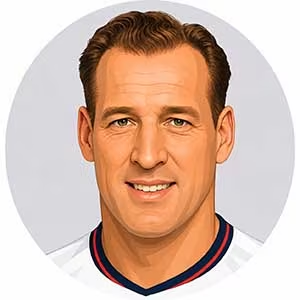
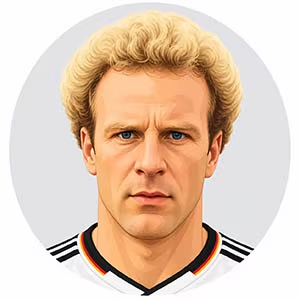
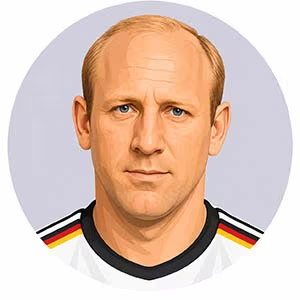
Germany - StrikerHoeneß, Dieter
On 1 May 1982, Bayern Munich were 2–0 down to Nürnberg in the DFB-Pokal final when Dieter Hoeneß suffered a deep cut to the head in an aerial collision. He returned heavily bandaged, the dressing gradually turning red as the match continued. Bayern recovered to 3–2. With minutes remaining, Hoeneß attacked another high ball — precisely the kind of action that had already injured him — and headed in the fourth goal. He later required stitches, but Bayern had completed the comeback. The image became inseparable from his career because it condensed his particular form of competitiveness: physical commitment without visible self-protection, and an apparent willingness to treat pain as secondary once the match still required something from him.
At 1.88 metres, Hoeneß was a powerful centre-forward whose greatest advantages were aerial strength, physical presence and direct movement toward goal. He could establish position against centre-backs, protect long passes and provide a reference point for teammates before turning toward the penalty area. His heading was particularly dangerous because he attacked deliveries aggressively rather than waiting for them, combining size with timing and a willingness to accept contact. He was also more mobile and technically competent than the image of a purely traditional target man suggests, capable of combining with nearby attackers and finishing firmly with his feet. Hoeneß emerged at VfB Stuttgart, helping the club win promotion to the Bundesliga in 1977 before scoring heavily in the top division. Bayern Munich signed him in 1979, and he remained there until retirement in 1987. Across eight seasons he scored 102 Bundesliga goals for Bayern and won five league titles, three DFB-Pokals and the 1985–86 Bundesliga top-scorer award. He also reached two European Cup finals, losing to Aston Villa in 1982 and Porto in 1987. His international career developed comparatively late. Hoeneß made his West Germany debut in 1979, won 6 caps and scored 4 goals, and belonged to the squad that finished runners-up at the 1986 World Cup. His limited international total contrasts sharply with his club importance, partly because his career overlapped with intense competition for attacking places and because his strongest qualities fitted some structures better than others.
His physical commitment was also a source of limitation. Hoeneß was most dangerous when matches allowed him to establish himself centrally and attack service into the box; defenders who prevented crosses or forced him repeatedly away from goal reduced his threat. He lacked the acceleration and close-control repertoire to manufacture large numbers of chances independently against compact defences, while teams demanding constant positional interchange could make his movements predictable. His willingness to enter collisions also carried obvious physical cost. The 1982 final provides the heroic version, but repeatedly accepting contact is not inherently advantageous: injuries and accumulated wear reduced availability and eventually contributed to a relatively early retirement at 34. His international record provides another corrective to his club reputation. Hoeneß could dominate within Bayern’s established attacking mechanisms without becoming equally indispensable when inserted into a national side with different combinations and hierarchy.
Psychologically, Hoeneß’s behaviour suggests unusually high tolerance for physical discomfort combined with a much less dramatic emotional baseline than the famous bloodied photographs imply. The 1982 cup final matters not because playing injured automatically proves courage, but because of what he did afterward: after sustaining the wound in an aerial challenge, he continued entering the same contested spaces and ultimately scored through another header. Pain did not produce avoidance. Major occasions similarly tended to increase rather than suppress his willingness to assume physical responsibility. Bayern repeatedly used him in domestic and European finals, and in 1986–87, his final season, he remained involved as the club reached another European Cup final despite knowing his career was approaching its end. His response to status was comparatively controlled. Internationally he spent much of his career outside the preferred West German attacking hierarchy despite prolific club production, yet there is little evidence of sustained public grievance against coaches or teammates. Selection disappointment did not become a defining conflict. Accounts of Hoeneß away from matches instead describe a thoughtful, articulate figure who prepared seriously for life beyond playing; after retirement he moved successfully into football administration rather than attempting to preserve a playing identity indefinitely. This matters because it separates competitive aggression from general impulsiveness. On the pitch he willingly initiated physical contests and accepted considerable bodily risk, but there is little evidence that provocation routinely turned those contests into retaliation or disciplinary loss of control. His aggression was primarily task-directed. Nor does the record suggest a striker dependent on crowd hostility or personal antagonism to activate himself. The scoreline itself could be sufficient: the 1982 comeback required urgency, and Hoeneß increased his involvement without needing to manufacture an enemy. His leadership was similarly functional rather than theatrical. He offered a physical reference, accepted difficult work and demonstrated standards through repeated actions more than public correction. The potential psychological cost lies precisely inside that reliability. A player so willing to subordinate discomfort to competitive usefulness may continue beyond sensible physical limits. Hoeneß therefore presents an important contradiction: high behavioural control did not make him cautious. Emotionally he could remain composed while making extremely aggressive decisions about his own body.