We use Google Analytics to understand how visitors use this site. Analytics cookies are only activated with your consent. For details, read our Privacy Policy.
Profile lensThe same player, read from a different angle.
Athletic83
Acceleration
83
Pace
79
Agility
77
Strength
85
Balance
83
Jumping
86
Stamina
91
Fitness
78
Technical80
Dribbling
80
Short Passing
80
Long Passing
80
Finishing
73
Shot Accuracy
72
Shot Power
85
Shooting Technique
76
Heading
81
Tackling
88
Crossing
77
Free Kick
68
Penalties
75
First Touch
80
Mental85
Composure
83
Aggression
90
Consistency
78
Creativity
71
Leadership
91
Work Rate
95
Tactical85
Vision
85
Off the Ball
75
Defensive Positioning
85
Teamwork
92
Anticipation
86
Marking
87
Player Traits
Attacking76
Crossing
77
Finishing
73
Heading Accuracy
81
Shot Accuracy
72
Off the Ball
75
Technique77
Dribbling
80
Free Kick
68
Short Passing
80
Long Passing
80
First Touch
80
Shot Technique
76
Movement81
Acceleration
83
Pace
79
Agility
77
Balance
83
Physicality85
Shot Power
85
Jumping
86
Stamina
91
Strength
85
Fitness
78
Defending87
Marking
87
Tackling
88
Def. Positioning
85
Mentality & Game Reading85
Aggression
90
Composure
83
Penalties
75
Vision
85
Leadership
91
Work Rate
95
Teamwork
92
Anticipation
86
Consistency
78
Creativity
71
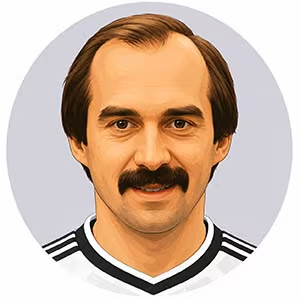
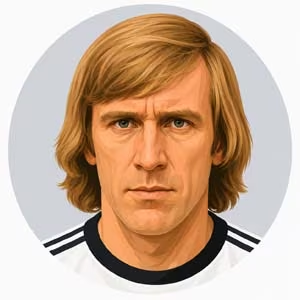
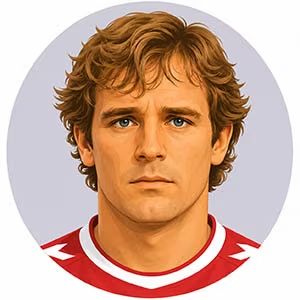
Germany - Centre MidfielderStielike, Uli
Rhenish obstinacy, positional versatility, and an unforgiving tactical discipline defined the career of Ulrich Stielike, the German defensive metronome who dominated the central corridors of European football for both Borussia Mönchengladbach and Real Madrid. Handpicked by Hennes Weisweiler as the natural ball-winning successor to Berti Vogts and Rainer Bonhof at Gladbach, Stielike was equally comfortable deployed as an aggressive vorstopper, a deep-lying sweeper, or a destructive central midfielder. Standing at five-foot-ten with a sturdy, broad-shouldered build, his game was built around unrelenting territorial pressure: he snapped into challenges with bone-jarring authority, dominated the second-ball phase through spatial anticipation, and launched immediate, vertical transitions with crisp passing off either foot. Across eight intense seasons at the Santiago Bernabéu (1977–1985), he became one of the most celebrated foreign imports in Real Madrid history, winning three consecutive La Liga titles, the 1985 UEFA Cup, and a record four Don Balón awards as the best foreign player in the Spanish top flight. For West Germany, he earned 42 caps, functioning as the defensive cornerstone of the Euro 1980 championship side and the 1982 World Cup final run, though his international narrative carries the distinct scar of missing his spot-kick in the historic 1982 Seville semi-final shootout.
Mentally and emotionally, Stielike was a relentless, uncompromising perfectionist whose sharp tongue and combustible pride often generated friction with managers and federations alike. He had no patience for tactical complacency or soft performances, holding teammates to the same Spartan, working-class standard he demanded of himself—a trait that occasionally rubbed Spanish stars the wrong way before his indisputable matchday commitment won them over completely. On the pitch, his emotional baseline was explosive and combative; he relished high-friction environments, barking commands, organizing defensive traps, and thriving under the hostile whistling of rival away cauldrons. The singular crack in his iron facade occurred in Seville in 1982, where his missed penalty left him collapsed in tears on the turf, only for teammate Toni Schumacher to drag him up—a human moment of vulnerability that only underscored the immense pressure he shouldered throughout his prime. Inside the locker room, he was a direct, serious professional who avoided superficial small talk, demanding absolute accountability from the hierarchy. Toward referees and opposing playmakers, Stielike was tough, intimidating, and cynical when the tactical situation required it, leaving an enduring legacy as an indomitable, iron-willed titan of German and Spanish football.