We use Google Analytics to understand how visitors use this site. Analytics cookies are only activated with your consent. For details, read our Privacy Policy.
Profile lensThe same player, read from a different angle.
Athletic73
Acceleration
64
Pace
63
Agility
71
Strength
84
Balance
81
Jumping
82
Stamina
62
Fitness
80
Technical43
Dribbling
49
Short Passing
58
Long Passing
58
Shot Accuracy
42
Shot Power
83
Shooting Technique
40
Heading
47
Free Kick
44
Penalties
44
First Touch
50
Mental86
Composure
89
Consistency
82
Leadership
84
Goalkeeping89
Reflexes
88
Positioning
93
Handling
88
Kicking
85
Goalkeeping89
Reflexes
88
Positioning
93
Handling
88
Kicking
85
Attacking45
Heading Accuracy
47
Shot Accuracy
42
Technique50
Dribbling
49
Free Kick
44
Short Passing
58
Long Passing
58
First Touch
50
Shot Technique
40
Physicality78
Shot Power
83
Jumping
82
Stamina
62
Strength
84
Fitness
80
Movement70
Acceleration
64
Pace
63
Agility
71
Balance
81
Mentality & Game Reading75
Composure
89
Penalties
44
Leadership
84
Consistency
82
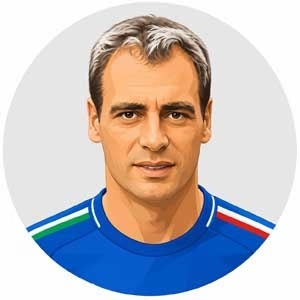
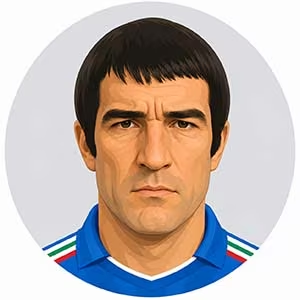
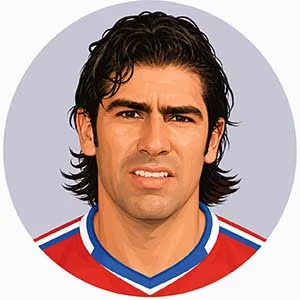
Italy - GoalkeeperMarchegiani, Luca
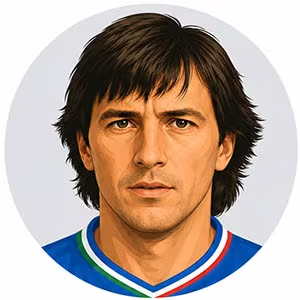
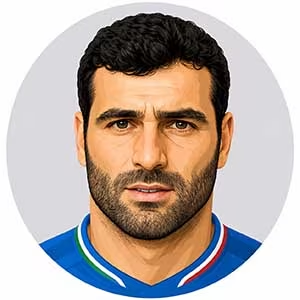
The 1993–94 Serie A campaign saw an unflappable, intellectual goalkeeper from Ancona keep his net untouched for an extraordinary 745 consecutive minutes, establishing a domestic standard for ice-cold consistency. Luca Marchegiani was the elegant, positional shot-stopping bedrock of Sven-Göran Eriksson’s glittering Lazio dynasty and a defining figure of Serie A’s golden era. Standing six-foot-two, Marchegiani was the archetype of the cerebral, low-risk goalkeeper: dominating through immaculate angle cutting, clean handling without conceding rebounds, and exceptional spatial anticipation on low through-balls. After breaking out at Torino (winning the 1992–93 Coppa Italia and reaching the 1992 UEFA Cup final), his then-world-record £6 million move to Lazio in 1993 yielded a historic haul across 339 matches: the 1999–2000 Scudetto, two Copas Italia, the 1998–99 European Cup Winners' Cup in Birmingham, and the 1999 UEFA Super Cup against Manchester United. For Italy, across nine caps, he was a pivotal contributor at the 1994 World Cup in the United States, taking over after Gianluca Pagliuca’s red card against Norway and starting three knockout matches on the run to the final.
Underneath that refined reliability, however, Marchegiani’s classical style had clear structural boundaries. He was not an explosive, hyper-athletic sweeper who sprinted far beyond his area to challenge forwards in open turf, preferring to maintain tight connection with his eighteen-yard box. Furthermore, while his hands were secure on ground-level drives, his explosive spring on high, curling crosses toward the back post occasionally lacked the dominant physical violence of more aggressive contemporaries like Angelo Peruzzi.
Articulate, composed, and radiating natural gentlemanly gravitas, Marchegiani approached goalkeeping with the analytical precision of a scholar. He abhorred theatrical diving for the photographers and hysterical screaming matches with his defenders; his leadership was defined by calm, measured positional adjustments that settled entire defensive lines during chaotic European nights. On the pitch, his body language was upright, disciplined, and reassuring, eliminating danger before it could escalate into a scramble. Inside the Lazio and Azzurri dressing rooms, he was an immensely respected elder statesman—capable of navigating the volcanic egos of Sinisa Mihajlović, Fernando Couto, and Marcelo Salas with quiet diplomacy. Match officials admired his spotless conduct and total absence of gamesmanship, cementing an enduring legacy as one of the most intelligent, consistent, and technically sound Italian goalkeepers of the modern era.