We use Google Analytics to understand how visitors use this site. Analytics cookies are only activated with your consent. For details, read our Privacy Policy.
Profile lensThe same player, read from a different angle.
Athletic81
Acceleration
77
Pace
78
Agility
75
Strength
91
Balance
82
Jumping
83
Stamina
77
Fitness
85
Technical84
Dribbling
81
Short Passing
72
Long Passing
68
Finishing
93
Shot Accuracy
87
Shot Power
88
Shooting Technique
74
Heading
91
Tackling
40
Crossing
64
Free Kick
76
Penalties
88
First Touch
79
Mental84
Composure
85
Aggression
90
Consistency
87
Creativity
68
Leadership
84
Work Rate
82
Tactical82
Vision
71
Off the Ball
90
Defensive Positioning
33
Teamwork
73
Anticipation
92
Marking
38
Player Traits
Attacking85
Crossing
64
Finishing
93
Heading Accuracy
91
Shot Accuracy
87
Off the Ball
90
Technique75
Dribbling
81
Free Kick
76
Short Passing
72
Long Passing
68
First Touch
79
Shot Technique
74
Movement78
Acceleration
77
Pace
78
Agility
75
Balance
82
Physicality85
Shot Power
88
Jumping
83
Stamina
77
Strength
91
Fitness
85
Defending37
Marking
38
Tackling
40
Def. Positioning
33
Mentality & Game Reading82
Aggression
90
Composure
85
Penalties
88
Vision
71
Leadership
84
Work Rate
82
Teamwork
73
Anticipation
92
Consistency
87
Creativity
68
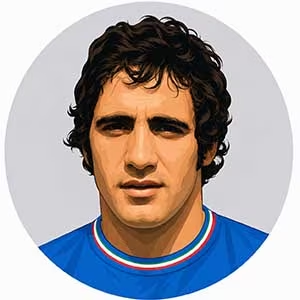
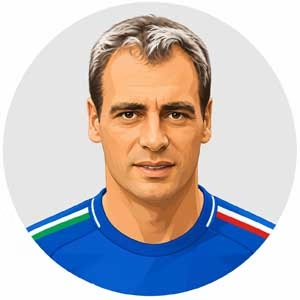
Italy - StrikerChinaglia, Giorgio
Giampiero Boniperti famously warned against his rebellious personality, yet on May 12, 1974, a ferocious, towering center-forward from Carrara buried a high-pressure penalty against Foggia at the Stadio Olimpico to secure SS Lazio’s historic, first-ever Scudetto. Giorgio Chinaglia—immortalized across Rome and the global football landscape simply as Long John—was the gladiatorial force of nature, psychological commander, and ruthless goalscoring spearhead of Tommaso Maestrelli’s wild, gun-toting Lazio of the early 1970s. Standing six-foot-one with an imposing frame, Chinaglia combined brute upper-body strength with an insatiable hunger for the eighteen-yard box, bull-dozing through defensive lines, winning physical aerial duels, and blasting shots with terrifying power off his right boot. Across 246 appearances and 122 goals for Lazio, he claimed the Serie A top scorer title (Capocannoniere) in 1973–74, before making an explosive transition to the North American Soccer League with the New York Cosmos in 1976. In the United States, he became a cultural phenomenon, scoring an astonishing 242 goals in 254 games alongside Pelé and Franz Beckenbauer to lift four Soccer Bowls. For Italy, across 14 caps and four goals, his international career was brief and stormy, defined by his explosive public gesture toward coach Ferruccio Valcareggi after being substituted at the 1974 World Cup.
His bulldozing game, however, was fundamentally anchored in raw, direct power rather than delicate technical nuance. Chinaglia was not an intricate combinator who dropped deep to orchestrate build-up play; his game was entirely vertical and selfish, relying on aggressive service and open space to run through defenders. When isolated against ultra-cynical Italian sweepers who denied him momentum and turned the match into a positional stalemate, his frustration often boiled over into erratic, aggressive fouls.
Volcanic, arrogant, and possessing an unyielding alpha-male personality, Chinaglia was a leader of men who thrived on conflict and high-voltage hostility. He actively courted opposition hatred: famously running across the pitch with his finger pointed at the entire Roma Curva Sud in the 1974 derby, and asserting absolute control over the Lazio dressing room with an iron fist. On the pitch, his body language was imposing and defiant: demanding every ball, berating teammates for misplaced passes, and celebrating goals with arms outstretched like a Roman emperor. Inside the Cosmos and Lazio locker rooms, his word was absolute law, commanding the total respect of global superstars and local enforcers alike, leaving behind an immortal legacy as the most ferocious, polarizing, and charismatic center-forward in Lazio history.