We use Google Analytics to understand how visitors use this site. Analytics cookies are only activated with your consent. For details, read our Privacy Policy.
Profile lensThe same player, read from a different angle.
Athletic82
Acceleration
86
Pace
83
Agility
85
Strength
77
Balance
79
Jumping
94
Stamina
80
Fitness
75
Technical84
Dribbling
83
Short Passing
77
Long Passing
76
Finishing
89
Shot Accuracy
87
Shot Power
81
Shooting Technique
89
Heading
93
Tackling
44
Crossing
70
Free Kick
76
Penalties
87
First Touch
85
Mental81
Composure
85
Aggression
83
Consistency
77
Creativity
76
Leadership
79
Work Rate
82
Tactical83
Vision
76
Off the Ball
89
Defensive Positioning
38
Teamwork
72
Anticipation
92
Marking
38
Player Traits
Attacking86
Crossing
70
Finishing
89
Heading Accuracy
93
Shot Accuracy
87
Off the Ball
89
Technique81
Dribbling
83
Free Kick
76
Short Passing
77
Long Passing
76
First Touch
85
Shot Technique
89
Movement83
Acceleration
86
Pace
83
Agility
85
Balance
79
Physicality81
Shot Power
81
Jumping
94
Stamina
80
Strength
77
Fitness
75
Defending40
Marking
38
Tackling
44
Def. Positioning
38
Mentality & Game Reading81
Aggression
83
Composure
85
Penalties
87
Vision
76
Leadership
79
Work Rate
82
Teamwork
72
Anticipation
92
Consistency
77
Creativity
76
Chile - StrikerSalas, Marcelo
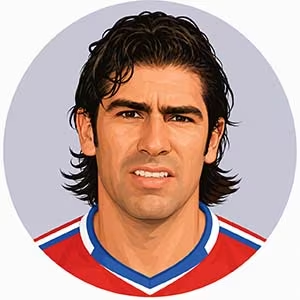
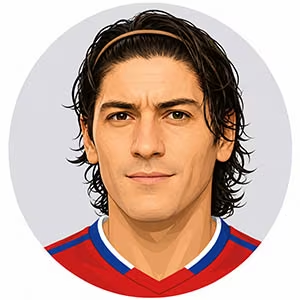
The penalty box in the late 1990s knew few predators as lethal off the half-turn as José Marcelo Salas Melinao. Compact at five-foot-eight with thick, powerful quadriceps and a low center of gravity, El Matador exploded out of Universidad de Chile before achieving mythic status at River Plate, where his razor-sharp diagonal runs and left-footed finishes secured the 1997 Supercopa Sudamericana and three domestic titles, earning him the 1997 South American Footballer of the Year award. Sven-Göran Eriksson brought him to Lazio in 1998 for a landmark Serie A era: Salas acted as the sharpest point of the attack, scoring the historic UEFA Super Cup winner against Manchester United in Monaco, capturing the 1999–2000 Scudetto, the Cup Winners' Cup, and a Coppa Italia. Technically, he was an absolute master of first-time executions, possessing an astonishing mid-air hang-time that allowed him to beat towering stoppers to near-post crosses despite his modest height. Yet his physical profile had distinct boundaries: he lacked long-distance sprint speed in open fields, was largely ineffective if isolated without creative delivery, and suffered a sharp athletic decline after a catastrophic anterior cruciate ligament tear at Juventus in 2001, which permanently robbed him of his sudden acceleration. Across 70 caps and 37 goals for Chile, his peak was the 1998 World Cup in France, netting four goals across four matches—including an iconic brace against Italy—to establish the devastating Za-Sa tandem alongside Iván Zamorano.
Cold, introverted, and intensely focused on the goalmouth, Salas played with a detached, clinical arrogance that contrasted sharply with Zamorano’s blue-collar emotionalism. He did not engage in performative displays for the crowd; his sole interest was the clean execution of his movement inside the eighteen-yard box. On the pitch, this icy focus made him lethal against elite man-markers like Fabio Cannavaro or Ciro Ferrara, but when the midfield supply dried up, his engagement could drop off noticeably, drifting out of matches and offering minimal defensive pressing or wide tracking. Inside the dressing room, he was a reserved, aristocratic presence who kept a small circle and commanded respect strictly through the weight of his scoring record rather than vocal speeches. His knee injury in Turin exposed a psychological vulnerability: struggling to adapt his game to diminished physical explosiveness, his subsequent years at Juventus and his return to South America were marked by chronic muscular problems and visible frustration. Toward referees and aggressive defenders, Salas was economical and dismissive: he rarely argued calls, avoided retaliatory clashes, and took a knee in his iconic, aristocratic celebration only after the ball had hit the back of the net.