We use Google Analytics to understand how visitors use this site. Analytics cookies are only activated with your consent. For details, read our Privacy Policy.
Profile lensThe same player, read from a different angle.
Athletic79
Acceleration
73
Pace
75
Agility
73
Strength
90
Balance
76
Jumping
88
Stamina
78
Fitness
77
Technical81
Dribbling
73
Short Passing
70
Long Passing
64
Finishing
90
Shot Accuracy
84
Shot Power
86
Shooting Technique
71
Heading
99
Tackling
36
Crossing
58
Free Kick
64
Penalties
73
First Touch
77
Mental79
Composure
84
Aggression
77
Consistency
77
Creativity
64
Leadership
75
Work Rate
82
Tactical82
Vision
69
Off the Ball
92
Defensive Positioning
36
Teamwork
72
Anticipation
90
Marking
36
Player Traits
Attacking85
Crossing
58
Finishing
90
Heading Accuracy
99
Shot Accuracy
84
Off the Ball
92
Technique70
Dribbling
73
Free Kick
64
Short Passing
70
Long Passing
64
First Touch
77
Shot Technique
71
Movement74
Acceleration
73
Pace
75
Agility
73
Balance
76
Physicality84
Shot Power
86
Jumping
88
Stamina
78
Strength
90
Fitness
77
Defending36
Marking
36
Tackling
36
Def. Positioning
36
Mentality & Game Reading76
Aggression
77
Composure
84
Penalties
73
Vision
69
Leadership
75
Work Rate
82
Teamwork
72
Anticipation
90
Consistency
77
Creativity
64
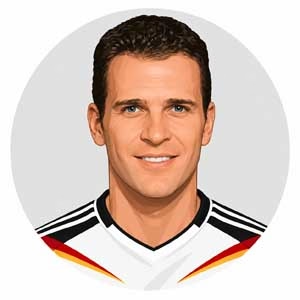
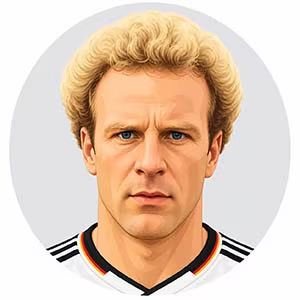
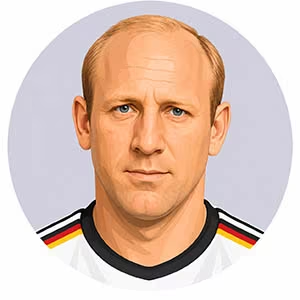
Germany - StrikerBierhoff, Oliver
On 30 June 1996, Oliver Bierhoff had spent sixty-nine minutes of the European Championship final watching from the Wembley bench. Germany were trailing the Czech Republic when Berti Vogts sent him on. Four minutes later, Bierhoff rose to meet Christian Ziege’s free kick and headed the equaliser. Five minutes into extra time, with his back to goal, he held off his marker, turned and struck left-footed; the shot deflected slightly and escaped Petr Kouba for the first golden goal in a major international final. Bierhoff tore off his shirt, something he later said he had never done before or afterwards. A late international arrival had needed twenty-six minutes to decide a European Championship.
Bierhoff was a 1.91-metre centre-forward built around penalty-area occupation rather than elaborate participation in possession. His defining weapon was his heading: he generated power without requiring a long approach, attacked crosses aggressively and could redirect the ball accurately rather than merely winning aerial contests. He used his frame to establish position against centre-backs, received with his back to goal, laid balls off and then moved toward the box, while his off-ball runs created space for teammates arriving around him. His finishing with his feet was effective but less distinctive, and technically he was functional rather than inventive. His career developed unusually slowly. After Bayer Uerdingen, Hamburger SV and Borussia Mönchengladbach failed to establish him as a leading Bundesliga striker, 23 goals for Austria Salzburg in 1990–91 took him to Italy. He spent four seasons with Ascoli, much of them in Serie B, before joining Udinese in 1995. There his career accelerated dramatically: 57 league goals in 86 appearances culminated in 27 goals and the Serie A scoring title in 1997–98. Milan signed him that summer, and he scored 19 league goals in his first season as the club won the 1998–99 Scudetto, an extraordinary proportion of them coming with his head. Later spells at Monaco and Chievo preceded retirement in 2003. Germany did not give him his senior debut until February 1996, when he was already 27, yet he finished with 37 international goals and captained the national team after the 1998 World Cup. He played at two World Cups, two European Championships and ended his international career as a substitute in the 2002 World Cup final.
The same specialisation that made Bierhoff formidable also placed clear limits on him. He was not a forward who could routinely manufacture opportunities independently when service disappeared. Against opponents who denied crosses, defended the box with numerical superiority or forced the attack into intricate combinations through congested central areas, his influence could shrink sharply. His acceleration, close control and ability to eliminate defenders one-on-one were ordinary at elite level, and he could look cumbersome when dragged away from the penalty area. Aerial dominance sometimes disguised how dependent his scoring was on teammates supplying appropriate deliveries and territory. Nor was his career physically uninterrupted: injury removed him from most of Euro 2000 and his effectiveness declined as mobility diminished in his thirties. When a match demanded improvisation more than occupation, combination and finishing, Bierhoff was considerably easier to neutralise.
Psychologically, Bierhoff’s career is defined less by emotional volatility than by an unusual capacity to continue after rejection without demanding immediate vindication. His early Bundesliga career stalled, Germany ignored him throughout his early twenties, and moving through Austria and then Ascoli — including years in Serie B — offered little guarantee that elite recognition would ever arrive. He stayed in that route long enough to transform himself into a Serie A goalscorer rather than abandoning it for status elsewhere. Even football itself had not been treated as an entitlement: Bierhoff later explained that as a teenager he had expected to complete his education and study rather than assuming he would become a professional, and he continued his university studies during his playing career. That long horizon helps explain his behaviour at Wembley. Sitting on the bench in the biggest match he had ever reached frustrated him, and he recalled becoming nervous after the Czech goal and impatient to enter, but the rising activation did not produce frantic play once he came on. His first major intervention was the equaliser; when the golden-goal opportunity arrived, he protected the ball, registered roughly where the goal was, turned and shot. He later admitted the finish contained luck rather than retrospectively constructing it as perfect calculation. He also said that the historical significance of what he had done did not really register until breakfast the following morning. That separation between occasion and immediate task is important: enormous stakes raised his readiness without apparently overwhelming his decision-making. His leadership later followed a similarly conventional, responsibility-oriented pattern rather than a theatrical one. After Jürgen Klinsmann’s international retirement he accepted the German captaincy, represented the team publicly and remained integrated even when his playing status declined. There is little evidence of a player habitually seeking confrontation with referees, responding to physical provocation with retaliation or requiring hostility from crowds to activate himself; aggressive marking primarily challenged his technical and physical effectiveness rather than destabilising him emotionally. His behaviour after setbacks was generally persistence rather than escalation. This did not mean indifference to status. Bierhoff wanted to play, openly remembered being annoyed while waiting on the Wembley bench, and his career shows considerable ambition once opportunities became available. But frustration was normally channelled toward securing the next opportunity rather than toward opponents, officials or teammates. The strongest behavioural signal is therefore delayed gratification: repeated evidence that being overlooked could irritate him without persuading him that the environment owed him immediate correction.