We use Google Analytics to understand how visitors use this site. Analytics cookies are only activated with your consent. For details, read our Privacy Policy.
Profile lensThe same player, read from a different angle.
Athletic81
Acceleration
76
Pace
80
Agility
77
Strength
87
Balance
79
Jumping
86
Stamina
84
Fitness
76
Technical79
Dribbling
76
Short Passing
75
Long Passing
73
Finishing
66
Shot Accuracy
66
Shot Power
80
Shooting Technique
68
Heading
88
Tackling
91
Crossing
66
Free Kick
65
Penalties
60
First Touch
75
Mental83
Composure
85
Aggression
76
Consistency
81
Creativity
68
Leadership
82
Work Rate
85
Tactical83
Vision
73
Off the Ball
66
Defensive Positioning
87
Teamwork
82
Anticipation
87
Marking
88
Player Traits
Attacking70
Crossing
66
Finishing
66
Heading Accuracy
88
Shot Accuracy
66
Off the Ball
66
Technique72
Dribbling
76
Free Kick
65
Short Passing
75
Long Passing
73
First Touch
75
Shot Technique
68
Movement78
Acceleration
76
Pace
80
Agility
77
Balance
79
Physicality83
Shot Power
80
Jumping
86
Stamina
84
Strength
87
Fitness
76
Defending89
Marking
88
Tackling
91
Def. Positioning
87
Mentality & Game Reading78
Aggression
76
Composure
85
Penalties
60
Vision
73
Leadership
82
Work Rate
85
Teamwork
82
Anticipation
87
Consistency
81
Creativity
68
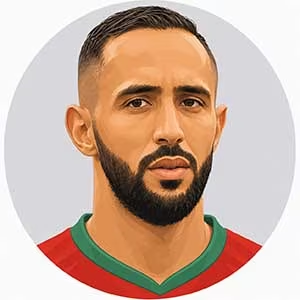
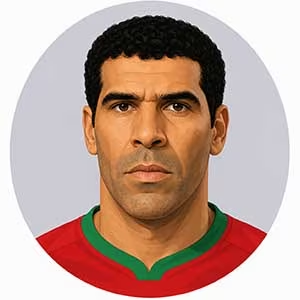
Morocco - Centre-backBenatia, Mehdi
On 11 November 2017, with Morocco protecting a lead in Abidjan and a place at the World Cup suddenly within reach, Medhi Benatia attacked a loose ball inside the Ivory Coast penalty area and drove it into the net. He celebrated with the urgency of a defender who understood exactly what the goal meant: Morocco had not reached a World Cup for twenty years, and their captain had helped put the return beyond doubt. Benatia later called the qualification the most beautiful moment of his career. It was an appropriate scene for him: physically committed, emotionally invested, willing to carry responsibility, and at his most convincing when defending something that mattered to him personally.
A tall, powerful centre-back, Benatia was most effective defending proactively rather than retreating passively toward his own goal. He liked to close the space in front of a striker, step out of the defensive line to intercept, and engage opponents before they could turn. Strong through his upper body and excellent in the air, he could dominate direct forwards and was an important target at attacking set pieces. His five league goals for Roma in 2013–14 reflected both his heading ability and his aggression in crowded areas. He was reasonably comfortable circulating possession and could break a line with a firm forward pass, although construction was a supporting skill rather than the organising principle of his game. His defending depended more on anticipation, assertive positioning and physical commitment. After developing in France and rebuilding his career through Tours and Clermont, he established himself in Serie A with Udinese before an outstanding 2013–14 season at Roma earned him a move to Bayern Munich. Injuries interrupted both seasons in Germany, but he still collected domestic honours before joining Juventus in 2016. There he initially rotated, then became an important starter during 2017–18, winning Serie A and the Coppa Italia and scoring twice against Milan in the cup final. He later moved to Al-Duhail and finished his playing career with Fatih Karagümrük. For Morocco he won 62 caps, captained the national side, played at four Africa Cup of Nations tournaments and led the team to the 2018 World Cup.
His assertiveness also created the conditions for his worst moments. Benatia could defend too close to the edge of the action, committing himself where a more patient defender might have delayed, and quick movement behind or across him could force hurried recovery challenges. The most famous example came in Madrid in 2018, when his intervention from behind on Lucas Vázquez produced the stoppage-time penalty that eliminated Juventus from the Champions League. Whether the decision was correct or not, the situation exposed the risk inherent in his style: once forced into emergency defending, his determination to reach the ball could become excessive. Availability was another substantial limitation. Recurrent physical problems prevented continuity at Bayern and periodically interrupted later seasons. His level was therefore more dependent on rhythm and match fitness than his reputation sometimes suggested; Benatia himself acknowledged this rather than pretending otherwise.
That admission reveals an unusual part of his competitive makeup. In March 2017, while captain of Morocco, Benatia asked not to be selected because he was not starting regularly for Juventus. He argued that arriving short of competitive rhythm and taking the place of a teammate playing every week would be unfair, explicitly stating that captaincy did not put him above the rules. Once he recovered his place, he returned and led the country to the World Cup. The episode suggests demanding standards applied inward as well as outward: status mattered to him, but he was prepared to surrender its privileges when he believed he had not earned them. Earlier in his life, expulsion from the Clairefontaine academy produced a similar response. Rather than publicly presenting himself as a victim, he later called the decision fair and described it as an electric shock that forced him to work differently. Setbacks could therefore activate him when he accepted their legitimacy. Perceived injustice produced another response entirely. After the penalty in Madrid, he immediately disputed the referee's judgement and continued attacking the decision publicly afterwards, insisting that his intervention had been legitimate. He did not lose control on the field to the extent of being dismissed, but neither did the grievance simply disappear. Benatia could absorb physical confrontation without becoming a habitual disciplinary liability; challenges and aggressive marking were part of the contest he expected. Institutional or reputational attacks penetrated more deeply. Years of criticism around the Moroccan national team, including accusations that he selected matches or exercised excessive influence, accumulated rather than bouncing off. When he retired internationally in 2019, he explicitly described being exhausted by repeatedly hearing those claims. Likewise, losing his place at Juventus affected him strongly: he later said that explaining to his children why he was not playing was eating at him, and he chose to leave rather than settle comfortably into reserve status. His leadership was consequently neither detached nor merely symbolic. He spoke for the group, accepted public responsibility and attached considerable emotional value to representing Morocco, while maintaining standards about who deserved to play. Yet the same pride that made responsibility attractive also made prolonged marginalisation and accusations of bad faith difficult for him to compartmentalise.