We use Google Analytics to understand how visitors use this site. Analytics cookies are only activated with your consent. For details, read our Privacy Policy.
Profile lensThe same player, read from a different angle.
Athletic75
Acceleration
78
Pace
75
Agility
81
Strength
74
Balance
78
Jumping
64
Stamina
76
Fitness
75
Technical84
Dribbling
85
Short Passing
83
Long Passing
87
Finishing
83
Shot Accuracy
82
Shot Power
93
Shooting Technique
81
Heading
64
Tackling
33
Crossing
84
Free Kick
87
Penalties
86
First Touch
84
Mental81
Composure
85
Aggression
71
Consistency
76
Creativity
82
Leadership
83
Work Rate
78
Tactical79
Vision
84
Off the Ball
84
Defensive Positioning
33
Teamwork
79
Anticipation
82
Marking
38
Player Traits
Attacking79
Crossing
84
Finishing
83
Heading Accuracy
64
Shot Accuracy
82
Off the Ball
84
Technique85
Dribbling
85
Free Kick
87
Short Passing
83
Long Passing
87
First Touch
84
Shot Technique
81
Movement78
Acceleration
78
Pace
75
Agility
81
Balance
78
Physicality76
Shot Power
93
Jumping
64
Stamina
76
Strength
74
Fitness
75
Defending35
Marking
38
Tackling
33
Def. Positioning
33
Mentality & Game Reading81
Aggression
71
Composure
85
Penalties
86
Vision
84
Leadership
83
Work Rate
78
Teamwork
79
Anticipation
82
Consistency
76
Creativity
82
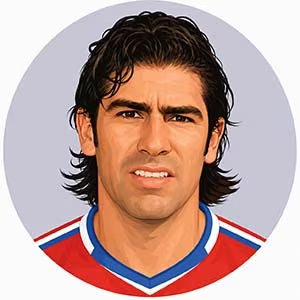
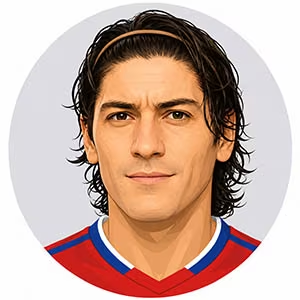
Chile - Left WingerSánchez, Leonel
At six years old, Leonel Sánchez put on boxing gloves for the first time and tried to hit his father, a former South American featherweight champion who trained fighters in a gym on the corner of Santa Isabel and Parque Bustamante in Santiago. He missed, of course. Decades later, on a World Cup pitch in front of his own country, he did not miss: a left hook that broke Humberto Maschio's nose, delivered so cleanly the referee never even saw it happen. The same afternoon he slapped another Italian player in the face and got away with that too. Chile called the match a matter of national dignity. Most of the world called it the dirtiest game ever played, and gave it a name that has outlived nearly everyone involved: the Battle of Santiago.
Born in Santiago in 1936, Sánchez joined Universidad de Chile's youth ranks at eleven and made his first-team debut at seventeen, never losing his place after that. He was a left-footed forward of rare technical range for Chilean football at the time — an accurate, powerful striker of the ball from distance, a winger who preferred drifting inside to combine with midfielders over hugging the touchline, and a crosser precise enough to vary delivery depending on exactly how tight his marker was standing, according to the strike partner who spent two decades reading those crosses. He became the on-field symbol of the Ballet Azul, the Universidad de Chile side that won six league titles between 1959 and 1969 playing football contemporaries described as choreographed rather than merely coached. He never seriously left the club during that period despite reported interest from Real Madrid, Juventus and Milan, departing only in 1969 when a contract-rule dispute forced the club to sell him to fierce rival Colo-Colo, where he won a further title before closing his career at Palestino and Ferroviarios. For Chile he won 85 caps, remains the country's second-highest all-time scorer, and was the joint top scorer of the 1962 World Cup on home soil, taking the tournament's Bronze Ball as Chile reached third place — still the nation's best finish. He captained the side again at the 1966 World Cup in England.
His limitations were modest relative to his standing but real. Sánchez was not physically dominant beyond his upper-body strength, and opponents who could deny him space to receive and turn — rather than engage him in direct contact, where his boxing background gave him a genuine advantage — occasionally limited his influence. His international career, extraordinary in its two peaks, produced only 24 goals across 13 years, reflecting a Chilean national side that rarely surrounded him with comparable quality outside 1962 and 1966. His decision to remain at a single Chilean club through his entire prime, admirable as loyalty, also meant he never tested himself against Europe's best on a weekly basis, a gap that later generations of Chilean stars did not share.
Psychologically the record contains two currents that his country never treated as contradictory, because to Chileans who watched him they were the same man. Sánchez's father had drilled footwork and hand positioning into him from early childhood, and a Universidad de Chile youth program that pioneered psychological testing for character and reaction time identified in him exactly the trait his boxing training had built: composure that could snap, precisely and without warning, into controlled violence when provoked past a threshold. He used that capacity exactly twice at a World Cup, both times against Italy, both times without retaliation from officials, and both times fully sanctioned by his own captain and country as justice rather than misconduct. Off the pitch, and in every other documented circumstance across a seventy-year public life, he was overwhelmingly remembered for the opposite quality: humility, warmth, and a closeness with ordinary fans that outlasted his career by decades. He served in leadership of Chile's players' union from 1960, an unusually early instance of organized labor consciousness among South American footballers of that generation. As Chile's captain at the 1966 World Cup, photographs show him consoling a devastated Rubén Marcos on the pitch after a draw with Italy, the same opponent from his most violent afternoon four years earlier — protective toward his own, unforgiving toward threats, and apparently untroubled by holding both postures at once. He was so widely loved that Colo-Colo, Universidad de Chile's most bitter rival, issued formal condolences on his death in 2022, and Colo-Colo's own greatest idol, Carlos Caszely, publicly called him a figure he had loved like an older brother since childhood. Away from football he coached his boyhood club three times in its most difficult stretches, including its lone relegation-adjacent season, and remained, in the words used by supporters of both major Chilean clubs at his funeral, humble, close, sincere and entirely unspoiled by fame. Capable of real violence under specific, self-selected provocation and beloved without qualification for everything else he ever did, Sánchez remains the rare footballer whose most notorious act and his most enduring reputation never had to be reconciled, because in Chile they were never seen as being in tension at all.