We use Google Analytics to understand how visitors use this site. Analytics cookies are only activated with your consent. For details, read our Privacy Policy.
Profile lensThe same player, read from a different angle.
Athletic76
Acceleration
75
Pace
77
Agility
76
Strength
81
Balance
74
Jumping
74
Stamina
79
Fitness
75
Technical83
Dribbling
85
Short Passing
77
Long Passing
85
Finishing
78
Shot Accuracy
80
Shot Power
93
Shooting Technique
80
Heading
74
Tackling
44
Crossing
80
Free Kick
90
Penalties
84
First Touch
86
Mental77
Composure
85
Aggression
74
Consistency
72
Creativity
82
Leadership
75
Work Rate
72
Tactical76
Vision
82
Off the Ball
82
Defensive Positioning
44
Teamwork
74
Anticipation
75
Marking
40
Player Traits
Attacking79
Crossing
80
Finishing
78
Heading Accuracy
74
Shot Accuracy
80
Off the Ball
82
Technique84
Dribbling
85
Free Kick
90
Short Passing
77
Long Passing
85
First Touch
86
Shot Technique
80
Movement76
Acceleration
75
Pace
77
Agility
76
Balance
74
Physicality80
Shot Power
93
Jumping
74
Stamina
79
Strength
81
Fitness
75
Defending43
Marking
40
Tackling
44
Def. Positioning
44
Mentality & Game Reading78
Aggression
74
Composure
85
Penalties
84
Vision
82
Leadership
75
Work Rate
72
Teamwork
74
Anticipation
75
Consistency
72
Creativity
82
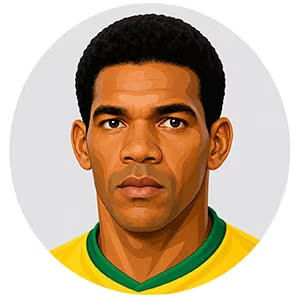
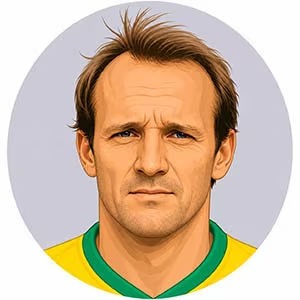
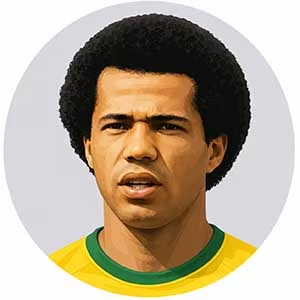
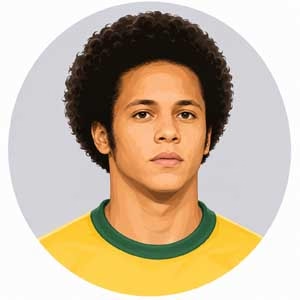
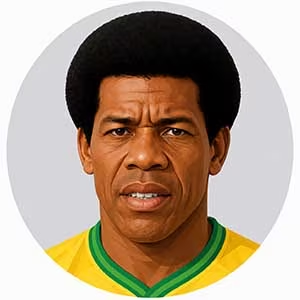
Brazil - Left WingerÉder
The sheer, concussive sound of a 35-yard trajectory exploding off the crossbar before nestling into the net against the Soviet Union at Espana '82 remains the definitive sensory memory of a mercurial Brazilian marksman. Éder Aleixo de Assis—known simply as O Bomba de Vespasiano—was the unpredictable, explosive weapon of Telê Santana’s iconic 1982 Brazil side, possessing arguably the most vicious and unpredictable left foot in South American football throughout the late 1970s and 1980s.
Operating as a wide forward or attacking left winger who loved cutting inside onto his favored foot, Éder combined explosive short-burst acceleration with an audacious shooting range, scoring directly from corner kicks, 40-yard free-kicks, and breathtaking half-volleys. He forged his domestic peak at Atlético Mineiro, scoring 122 goals across multiple spells, lifting six Campeonato Mineiro titles, and claiming the Bola de Prata in 1983, while also starring for Grêmio, Palmeiras, and Sport Recife. Across 52 caps and eight goals for the Seleção, his individual apex was the 1982 World Cup in Spain, where he dazzled the world with his chipped stunner against Scotland and his thunderbolt against the Soviets.
That explosive striking threat, however, was perpetually chained to an erratic work rate and a fiery, self-destructive temperament. Éder was an unapologetic luxury player who offered virtually zero defensive tracking, rarely tracking back into his own defensive third. Furthermore, his career was scarred by frequent red cards and disciplinary suspensions for physical retaliation and clashes with match officials—most disastrously in a 1986 warm-up match against Peru, where a red card for striking an opponent directly cost him his place in Brazil’s 1986 World Cup squad.
Rebellious, swaggering, and driven by raw emotional impulse, Éder played the game with pure rock-and-roll bravado. He had zero tolerance for rigid tactical systems, thriving in chaos and relying on pure instinct to pull off the impossible from distance. On the pitch, his body language alternated between languid strolling and sudden, violent strikes on goal. Inside the Atlético Mineiro and Seleção dressing rooms, he was a colorful, unpredictable force of nature—at once an administrative nightmare and a beloved match-winner whose sensational goals cemented an enduring legacy as one of Brazilian football's ultimate long-range gunslingers.