We use Google Analytics to understand how visitors use this site. Analytics cookies are only activated with your consent. For details, read our Privacy Policy.
Profile lensThe same player, read from a different angle.
Athletic81
Acceleration
82
Pace
75
Agility
77
Strength
84
Balance
82
Jumping
83
Stamina
76
Fitness
87
Technical81
Dribbling
75
Short Passing
71
Long Passing
69
Finishing
93
Shot Accuracy
93
Shot Power
77
Shooting Technique
89
Heading
86
Tackling
33
Crossing
62
Free Kick
66
Penalties
68
First Touch
76
Mental83
Composure
88
Aggression
76
Consistency
93
Creativity
68
Leadership
73
Work Rate
74
Tactical83
Vision
72
Off the Ball
91
Defensive Positioning
33
Teamwork
69
Anticipation
95
Marking
33
Player Traits
Attacking85
Crossing
62
Finishing
93
Heading Accuracy
86
Shot Accuracy
93
Off the Ball
91
Technique74
Dribbling
75
Free Kick
66
Short Passing
71
Long Passing
69
First Touch
76
Shot Technique
89
Movement79
Acceleration
82
Pace
75
Agility
77
Balance
82
Physicality81
Shot Power
77
Jumping
83
Stamina
76
Strength
84
Fitness
87
Defending33
Marking
33
Tackling
33
Def. Positioning
33
Mentality & Game Reading78
Aggression
76
Composure
88
Penalties
68
Vision
72
Leadership
73
Work Rate
74
Teamwork
69
Anticipation
95
Consistency
93
Creativity
68
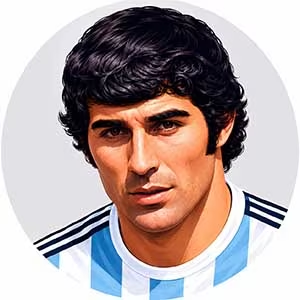
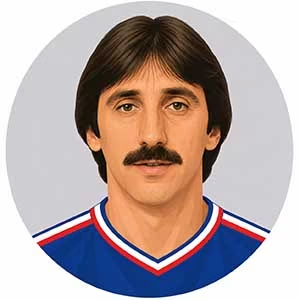
Argentina - StrikerOnnis, Delio
Onnis was a penalty-box centre-forward built around anticipation, positioning and finishing rather than speed or elaborate technique. At roughly 1.80 metres, he was strong enough to protect central territory and compete physically, but his decisive advantage was usually the fraction of space he created before the ball arrived. He watched defenders, adjusted his position, attacked rebounds and loose balls quickly, and finished with either foot or in the air. His first touch and dribbling were functional rather than exceptional, and he rarely needed to carry the ball through several opponents. Much of his game consisted of ensuring that when a move reached its final action, he was already where it would matter. After developing at Almagro and scoring 53 league goals in 95 appearances for Gimnasia La Plata, he moved to Reims in 1971 and scored 39 league goals in two seasons. Monaco signed him in 1973, and he became the defining scorer in the club’s history: 223 goals in 280 competitive appearances according to the club, remaining even when Monaco were relegated in 1976 and scoring heavily as they returned immediately to the top division. He then helped them win the 1977–78 league title and the Coupe de France in 1980. Rather than joining an established power afterward, he moved to newly promoted Tours and twice finished as the French league’s leading scorer. He later did it again with Toulon. Across Reims, Monaco, Tours and Toulon, Onnis scored 299 goals in the French top flight, still the competition’s all-time record, and finished as leading scorer five times. He was never selected by Argentina or Italy, leaving one of France’s most prolific careers without an international appearance.
His extraordinary totals did not make him a complete attacking system by himself. Onnis was considerably less dangerous when forced away from the penalty area, asked to create advantages through dribbling, or supplied with too few playable balls. His acceleration and general ball technique were ordinary beside his finishing instincts, so defenders who prevented him establishing position before delivery could reduce his involvement for long periods. He was also dependent on teammates capable of recognising his movement; Onnis himself has repeatedly named the passers who supplied him and treated their contribution as fundamental to his scoring. He could punish poor teams and elite teams alike, but a match that became stretched far from the box or demanded constant participation in construction removed him from his strongest territory. Injury also interrupted what might have been another outstanding scoring season at Monaco in 1979–80, when he had already scored 15 goals in 19 league matches before being hurt at Lyon.
Psychologically, Onnis appears to have built confidence around competence rather than recognition. He has repeatedly spoken about his scoring record without presenting himself as a neglected superstar, and when asked about individual honours he tends to redirect attention toward efficiency, teammates and the quality of the service he received. He once described his defining strength as having “cold blood” in the hottest areas of the pitch: pressure inside the penalty area did not seem to increase the emotional complexity of the task. The behaviour across his career supports that description. His first days in France provide a revealing example. Arriving at Reims with pain in his ribs, he refused the president’s request to play immediately rather than gambling on his condition to impress a new employer. Reims then faced unbeaten league leaders Nantes; Onnis played and scored both goals in a 2–0 victory. The sequence suggests neither submissiveness nor anxiety about first impressions: he protected his readiness, then trusted his finishing once fit enough to play. His reaction to changing status was similarly pragmatic. Monaco’s relegation did not prompt an immediate attempt to escape to a more prestigious club. He remained, scored 30 goals in the second division and helped them return before winning the championship the following season. Later, leaving a championship-level Monaco side for newly promoted Tours did not reduce his output or apparent motivation; he simply continued scoring and won two more top-scorer titles. That pattern makes prestige sensitivity unusually low for a player with such numbers. There is also little evidence of habitual referee confrontation, retaliation after fouls or a need to create emotional conflict with defenders. Onnis’s game required constant physical contact in crowded areas, yet surviving accounts emphasise patience and positioning rather than provocation. His confidence was not passive, however. He could be firm with authority when he believed a decision affected his ability to perform, as the Reims debut episode shows, and his comments about finishing reveal a strong sense of personal responsibility: creation could belong to others, but once the chance arrived, converting it was his job. He did not dilute that responsibility by blaming conditions. Repeated success for promoted or modest sides also suggests that hostile or low-status environments did not substantially lower his competitive activation. Onnis appears to have needed opportunity more than prestige, service more than emotional reassurance, and repetition more than spectacle.