We use Google Analytics to understand how visitors use this site. Analytics cookies are only activated with your consent. For details, read our Privacy Policy.
Profile lensThe same player, read from a different angle.
Athletic80
Acceleration
74
Pace
78
Agility
77
Strength
84
Balance
79
Jumping
86
Stamina
82
Fitness
82
Technical78
Dribbling
75
Short Passing
76
Long Passing
73
Finishing
63
Shot Accuracy
65
Shot Power
74
Shooting Technique
70
Heading
85
Tackling
88
Crossing
65
Free Kick
60
Penalties
60
First Touch
77
Mental83
Composure
91
Aggression
77
Consistency
85
Creativity
72
Leadership
77
Work Rate
78
Tactical82
Vision
73
Off the Ball
65
Defensive Positioning
87
Teamwork
76
Anticipation
88
Marking
87
Player Traits
Attacking69
Crossing
65
Finishing
63
Heading Accuracy
85
Shot Accuracy
65
Off the Ball
65
Technique72
Dribbling
75
Free Kick
60
Short Passing
76
Long Passing
73
First Touch
77
Shot Technique
70
Movement77
Acceleration
74
Pace
78
Agility
77
Balance
79
Physicality82
Shot Power
74
Jumping
86
Stamina
82
Strength
84
Fitness
82
Defending87
Marking
87
Tackling
88
Def. Positioning
87
Mentality & Game Reading78
Aggression
77
Composure
91
Penalties
60
Vision
73
Leadership
77
Work Rate
78
Teamwork
76
Anticipation
88
Consistency
85
Creativity
72
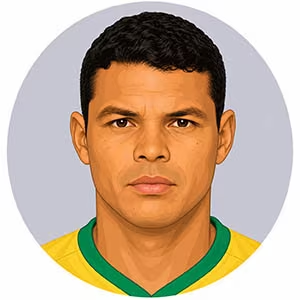
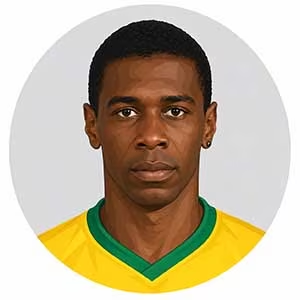
Brazil - Centre-backJuan
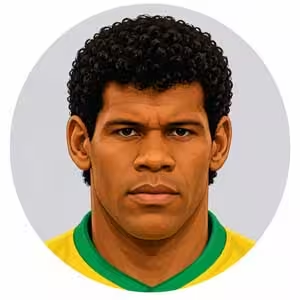
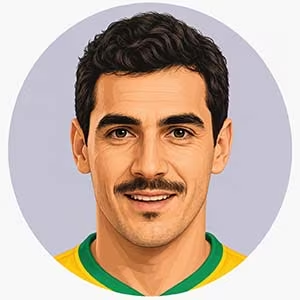
Juan was a central defender built around anticipation, positioning and technical cleanliness. Quick over the first few metres and exceptionally balanced, he preferred to reach the ball before the forward rather than dominate through repeated collisions. His tackling was precise, his body positioning allowed him to shepherd attackers away from dangerous areas, and he was comfortable stepping into midfield when an interception opened space. In possession he was distinctly Brazilian without being reckless: calm first touch, short combinations and the ability to advance the ball accurately rather than clearing automatically. He was also strong in the air despite not being an imposing giant. Flamengo developed him and gave him his senior debut as a teenager before Bayer Leverkusen brought him to Germany in 2002. Five Bundesliga seasons expanded his tactical discipline and established him with Brazil. Roma signed him in 2007 as a replacement for Cristian Chivu, and he immediately fitted Luciano Spalletti’s aggressive defensive structure alongside Philippe Mexès. Across five seasons he made 149 competitive appearances and scored 11 goals, winning the 2007 Supercoppa Italiana and 2008 Coppa Italia while twice challenging seriously for the Scudetto. He later returned to Brazil with Internacional and then Flamengo, playing professionally until 40. With Brazil he appeared at the 2006 and 2010 World Cups, won two Copa América titles and two Confederations Cups, and became a regular in a national side that increasingly relied on defensive organisation as well as attacking talent.
Juan’s style had real vulnerabilities. Because he defended proactively, an incorrect anticipation could leave space directly behind him, particularly against forwards capable of changing direction quickly after receiving. His calm distribution also became less valuable when opponents pressed him before he could set his body, and he was more naturally a defender who improved an organised line than one who thrived in permanent chaos. Physical continuity was another limitation during his Roma years. Although he later emphasised that he avoided catastrophic long-term injuries across his career, recurring muscular problems repeatedly interrupted individual seasons and sometimes forced him to play without complete fitness. That mattered because his defending depended on timing and short acceleration: even a small physical reduction narrowed the margin within which his anticipation worked. He was also not an emotionally dominant organiser who could transform a disordered defence through force of personality alone. His leadership was quieter, more dependent on reading situations correctly and maintaining standards than on imposing himself verbally on everyone around him.
Psychologically, Juan’s own descriptions of defending are unusually revealing. While at Leverkusen he said defenders often “play so that others can shine,” accepting that Brazilian attacking football left them exposed while more celebrated teammates received the attention. That is not the language of a player seeking emotional centrality. He repeatedly treated reliability as a professional obligation rather than a source of status. Before the 2006 World Cup, after being told he would start, he said the security gave him tranquillity but immediately added that he still had to work to deserve the place because nobody in the national team could become comfortable. That combination — reassurance without entitlement — remained visible late in his career. At 38 he described himself as someone who enjoyed training, took care of his body and considered professional preparation fundamental, behaviour consistent with surviving at elite level until 40. His attachment to teams, however, was genuine rather than detached. Years after leaving Roma he wrote about the five seasons there as intensely emotional and expressed regret that the group had failed to deliver the league title to the supporters. The environment penetrated him, but did not normally destabilise his behaviour. Even Roma’s highly charged atmosphere did not produce a reputation for public confrontation with referees, opponents or coaches. When subjected to racist abuse during the 2012 derby, there was no corresponding retaliatory episode from Juan on the field. His relationship with authority was similarly cooperative when trust existed: he later called Spalletti the best coach of his career and credited Italian football with making him a more complete athlete. Yet calmness did not mean lack of judgement. Looking back on his own departure from Roma, Juan said he may have made a mistake by leaving too abruptly and should perhaps have stayed long enough to say goodbye properly on the pitch. He could reassess his own decisions without constructing excuses around them. Major occasions generally preserved his functionality: two World Cups, continental finals and repeated Champions League knockout matches produced no pattern of panic or disciplinary escalation. Juan’s emotional economy was therefore based on responsibility. He felt attachment, disappointment and pressure, but his habitual response was to reduce them to the next defensive task.


 All Time RomaClub