We use Google Analytics to understand how visitors use this site. Analytics cookies are only activated with your consent. For details, read our Privacy Policy.
Profile lensThe same player, read from a different angle.
Athletic79
Acceleration
90
Pace
84
Agility
85
Strength
73
Balance
76
Jumping
67
Stamina
82
Fitness
75
Technical86
Dribbling
91
Short Passing
86
Long Passing
81
Finishing
85
Shot Accuracy
84
Shot Power
83
Shooting Technique
84
Heading
73
Tackling
57
Crossing
76
Free Kick
82
Penalties
77
First Touch
87
Mental76
Composure
82
Aggression
76
Consistency
74
Creativity
91
Leadership
70
Work Rate
73
Tactical82
Vision
85
Off the Ball
84
Defensive Positioning
52
Teamwork
79
Anticipation
81
Marking
42
Player Traits
Attacking80
Crossing
76
Finishing
85
Heading Accuracy
73
Shot Accuracy
84
Off the Ball
84
Technique85
Dribbling
91
Free Kick
82
Short Passing
86
Long Passing
81
First Touch
87
Shot Technique
84
Movement84
Acceleration
90
Pace
84
Agility
85
Balance
76
Physicality76
Shot Power
83
Jumping
67
Stamina
82
Strength
73
Fitness
75
Defending50
Marking
42
Tackling
57
Def. Positioning
52
Mentality & Game Reading79
Aggression
76
Composure
82
Penalties
77
Vision
85
Leadership
70
Work Rate
73
Teamwork
79
Anticipation
81
Consistency
74
Creativity
91
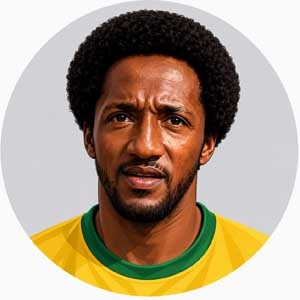
Brazil - Attacking MidfielderPaulo César
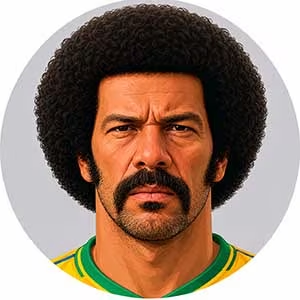
He dyed his hair red and wore it in an Afro modeled on the Black Panthers, drove a convertible through Rio, and became, by his own account and by the account of nearly everyone who covered him, one of the first Black Brazilian athletes to say openly and publicly that he intended to date a white woman — a statement that, in the Brazil of the early 1970s, was itself a political act. The nickname Caju, which stuck to him for the rest of his life, came from that dyed hair. Nobody remembers him by his real name anymore.
Born Paulo Cézar Lima in Rio de Janeiro in 1949, Caju grew up partly abroad — his father managed clubs in Honduras and then Colombia, where the teenager made his professional debut at sixteen alongside other Brazilian expatriates — before returning home to break through at Botafogo in 1967. He was an attacking midfielder of exceptional but deliberately theatrical skill, capable of striking the ball along trajectories few goalkeepers could anticipate, and by his own admission and that of teammates, more interested in the spectacular version of a goal than the easy one — he would pass up a simple finish to attempt something nobody in the stadium expected. He was technically accomplished enough to fill in for Gérson in two matches of the 1970 World Cup without disrupting Brazil's rhythm, despite being a reserve on a squad stacked with genius, a fact he later summarized about himself with characteristic self-deprecation: he was, he liked to say, the only three-time champion with a reputation for being no good — a reference to the Carioca and Brazilian titles he collected at Botafogo and Flamengo layered against a public image shaped as much by controversy as by football. He won two Rio state championships and a Taça Brasil with Botafogo, a further Carioca title with Flamengo in 1972, and the 1970 World Cup with Brazil, playing four matches. He later moved to Marseille, becoming one of the more visible Brazilian exports to French football in the mid-1970s, before returning home through Fluminense, Botafogo again, Grêmio, Vasco da Gama and Corinthians, closing his career with brief stops in the United States and France. For Brazil he won 57 caps and 10 goals across a decade, including the 1974 World Cup.
His limitations were connected directly to the same theatrical instinct that made him compelling. Caju's insistence on the difficult, spectacular option over the routine one cost his teams chances a more disciplined forward would have converted, and his provocative public persona — deliberately countercultural at a moment when Brazilian football and Brazilian society more broadly were far from ready for it — generated friction with institutions that a more conventional player would have avoided entirely.
Temperamentally he was defined by a willingness to challenge social convention that extended well beyond football and that he never appeared to regret. He identified politically with the Black Power movement at a time when doing so publicly carried real professional risk, and he treated his own celebrity as a platform rather than something to manage carefully. Botafogo honored him decades later, in 2005, with a commemorative shirt bearing his name and number, and he became, later in life, a newspaper columnist and a subject of Brazilian television documentary work examining athletes who had faded from public memory after towering fame — a fate that appears to have shaped how he understood his own career in retrospect, candid rather than defensive about it. Provocative, stylistically fearless, and unwilling across his entire public life to separate his football identity from his political one, Caju built a career that mattered as much for what he represented outside the penalty area as for what he did inside it.