We use Google Analytics to understand how visitors use this site. Analytics cookies are only activated with your consent. For details, read our Privacy Policy.
Profile lensThe same player, read from a different angle.
Athletic80
Acceleration
87
Pace
83
Agility
86
Strength
74
Balance
78
Jumping
75
Stamina
82
Fitness
74
Technical85
Dribbling
86
Short Passing
84
Long Passing
85
Finishing
83
Shot Accuracy
77
Shot Power
82
Shooting Technique
82
Heading
71
Tackling
42
Crossing
83
Free Kick
82
Penalties
81
First Touch
87
Mental77
Composure
80
Aggression
74
Consistency
74
Creativity
85
Leadership
78
Work Rate
76
Tactical82
Vision
84
Off the Ball
83
Defensive Positioning
42
Teamwork
83
Anticipation
79
Marking
42
Player Traits
Attacking79
Crossing
83
Finishing
83
Heading Accuracy
71
Shot Accuracy
77
Off the Ball
83
Technique84
Dribbling
86
Free Kick
82
Short Passing
84
Long Passing
85
First Touch
87
Shot Technique
82
Movement84
Acceleration
87
Pace
83
Agility
86
Balance
78
Physicality77
Shot Power
82
Jumping
75
Stamina
82
Strength
74
Fitness
74
Defending42
Marking
42
Tackling
42
Def. Positioning
42
Mentality & Game Reading79
Aggression
74
Composure
80
Penalties
81
Vision
84
Leadership
78
Work Rate
76
Teamwork
83
Anticipation
79
Consistency
74
Creativity
85
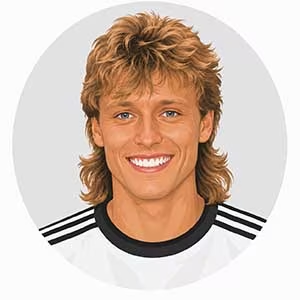
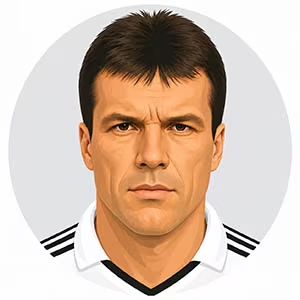
Germany - Attacking MidfielderDoll, Thomas
Bursting across the crumbling geopolitical divide of late-1980s European football with an explosive burst of pace and an artist’s improvisation, Thomas Jens Uwe Doll stood as one of the most electrifying playmaking wingers and attacking midfielders to emerge from East German football. Developed in the rigorous system of Hansa Rostock before becoming the technical crown jewel of BFC Dynamo—where he claimed two DDR-Oberliga titles and two FDGB-Pokal crowns—Doll combined track-and-field agility with exceptional low-gravity close control. Rather than remaining a static wide outlet, his game was defined by dynamic, central verticality: receiving the ball on the half-turn, evading aggressive markers with lightning-quick body feints, and carving open defensive lines with incisive, weighted through-balls. Following the fall of the Berlin Wall, he made an instant, record-breaking impact in the unified Bundesliga with Hamburger SV, earning the 1991 German Footballer of the Year runner-up spot before sealing a high-profile transfer to Dino Zoff’s SS Lazio. In Serie A, his creative dynamism, pinpoint crossing, and rapid one-two combinations in the final third quickly made him a fan favorite in the capital, complementing an international journey that saw him earn 29 caps for East Germany and 18 for unified Germany, culminating in a silver medal at Euro 1992. Psychologically, Doll was an exuberant, fiercely ambitious, and emotionally authentic competitor who viewed the football pitch as a boundless arena of personal and expressive freedom. Having spent his formative years navigating the strict, highly politicized athletic apparatus of the GDR—where individuality was often suppressed in favor of collective conformity—his game exploded with a joyful, almost rebellious creativity once the borders opened. Inside the dressing room, he was a charismatic, highly vocal, and magnetic presence—warm-hearted, quick-witted, and possessing an infectious optimism that made him a beloved cultural bridge between the eastern and western factions of the newly unified German national team. Under peak tournament and Serie A pressure, his mental approach was fearless and high-tempo; he actively craved the ball in tight, pressurized half-spaces, using his lightning-fast instincts to turn suffocating defensive blocks into attacking corridors. Toward match officials and bruising Italian defenders who routinely subjected him to harsh, cynical physical targeting, Doll carried himself with combative dignity: while his passionate nature occasionally sparked fiery reactions against flagrant fouls, he remained fundamentally a purist of the craft who absorbed heavy contact, bounced immediately back to his feet, and let his dazzling technical flair deliver the ultimate response.