We use Google Analytics to understand how visitors use this site. Analytics cookies are only activated with your consent. For details, read our Privacy Policy.
Profile lensThe same player, read from a different angle.
Athletic80
Acceleration
87
Pace
82
Agility
95
Strength
66
Balance
76
Jumping
82
Stamina
79
Fitness
74
Technical87
Dribbling
96
Short Passing
84
Long Passing
81
Finishing
77
Shot Accuracy
75
Shot Power
87
Shooting Technique
89
Heading
72
Tackling
38
Crossing
80
Free Kick
85
Penalties
81
First Touch
93
Mental77
Composure
79
Aggression
74
Consistency
73
Creativity
94
Leadership
80
Work Rate
72
Tactical74
Vision
80
Off the Ball
79
Defensive Positioning
45
Teamwork
63
Anticipation
71
Marking
38
Player Traits
Attacking77
Crossing
80
Finishing
77
Heading Accuracy
72
Shot Accuracy
75
Off the Ball
79
Technique88
Dribbling
96
Free Kick
85
Short Passing
84
Long Passing
81
First Touch
93
Shot Technique
89
Movement85
Acceleration
87
Pace
82
Agility
95
Balance
76
Physicality78
Shot Power
87
Jumping
82
Stamina
79
Strength
66
Fitness
74
Defending40
Marking
38
Tackling
38
Def. Positioning
45
Mentality & Game Reading77
Aggression
74
Composure
79
Penalties
81
Vision
80
Leadership
80
Work Rate
72
Teamwork
63
Anticipation
71
Consistency
73
Creativity
94
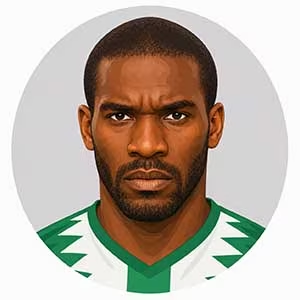
Nigeria - Attacking MidfielderOkocha, Jay-Jay
He beat Oliver Kahn four times in the same passage of play. Karlsruhe against Eintracht Frankfurt, August 1993: a twenty-year-old Nigerian received the ball on the edge of the box, dribbled past three defenders, then went around Kahn, came back, went around him again, and finally rolled it in. The goal was voted German Goal of the Year and Kahn, who did not enjoy being made ridiculous, later admitted it was the most helpless he had felt on a football pitch. Augustine Azuka Okocha spent the following fifteen years doing versions of that in five countries, and almost nobody ever resented him for it.
Born in Enugu in 1973, Okocha was an attacking midfielder whose entire game rested on close control of a kind that barely exists at elite level. At 1.75m he was strong for a technician, low to the ground, and capable of manipulating the ball in spaces where there was no obvious escape — stepovers, drag-backs, and feints executed at full speed and, crucially, in genuinely useful positions rather than as decoration. He struck free-kicks superbly with either foot, scored from distance regularly, and passed with vision, though his output of goals and assists never quite matched the impression he left. He left Nigeria as a teenager, established himself at Eintracht Frankfurt, moved to Fenerbahçe in 1996, and in 1998 joined Paris Saint-Germain for a fee that made him the most expensive African footballer in history, where he played alongside a young Ronaldinho who later described him as an influence. His most celebrated period came at Bolton Wanderers from 2002, where as captain he kept a modest Premier League club in the division and took it to a League Cup final, becoming one of the most popular players in England. For Nigeria he won 73 caps, took Olympic gold in Atlanta in 1996, won the 1994 Africa Cup of Nations, and played at three World Cups, captaining the Super Eagles for years.
The criticism followed him everywhere and was not baseless. Okocha's decision-making was inconsistent, and he attempted the elaborate solution in moments that required the simple one, conceding possession in dangerous areas as a result. His end product was modest for a player of his ability, and coaches at PSG and elsewhere spent years trying to make him more direct without much success. He offered limited defensive work, and against sides that pressed him aggressively and refused to engage his dribbling one-against-one, he could produce entertainment without influence.
What separated him was that the flamboyance was never aimed at anyone. Okocha played with an evident, uncomplicated joy — smiling during matches, laughing after failed tricks, applauding opponents who dispossessed him — and the showmanship read as delight rather than humiliation, which is why defenders he embarrassed tended to speak fondly of him afterwards. He was a genuine dressing-room leader, at Bolton and with Nigeria, and he led by warmth and personal example rather than by criticism: he was described consistently as the player who spoke to everyone, defused tension, and made younger and less-established teammates feel included. He almost never argued with referees, rarely fouled, did not simulate despite being fouled constantly, and responded to heavy treatment by getting up and trying the same thing again. Pressure appeared not to reach him — he took the free-kicks and penalties, and his form did not visibly change between routine fixtures and finals. He carried the burden of captaining a Nigerian side under intense national expectation without ever appearing weighed down by it. Away from football he was religious, family-centred, endlessly good-humoured in interviews, and produced no controversy in twenty years of public life. So good they named him twice, as the Bolton chant had it — and unusually, a player universally admired by the opponents he made fools of.


 All-Time AfricaAfrica