We use Google Analytics to understand how visitors use this site. Analytics cookies are only activated with your consent. For details, read our Privacy Policy.
Profile lensThe same player, read from a different angle.
Athletic83
Acceleration
92
Pace
86
Agility
95
Strength
73
Balance
83
Jumping
74
Stamina
82
Fitness
78
Technical86
Dribbling
95
Short Passing
87
Long Passing
86
Finishing
85
Shot Accuracy
77
Shot Power
84
Shooting Technique
83
Heading
74
Tackling
33
Crossing
82
Free Kick
85
Penalties
86
First Touch
91
Mental76
Composure
76
Aggression
74
Consistency
76
Creativity
93
Leadership
72
Work Rate
77
Tactical80
Vision
85
Off the Ball
84
Defensive Positioning
38
Teamwork
82
Anticipation
77
Marking
38
Player Traits
Attacking80
Crossing
82
Finishing
85
Heading Accuracy
74
Shot Accuracy
77
Off the Ball
84
Technique88
Dribbling
95
Free Kick
85
Short Passing
87
Long Passing
86
First Touch
91
Shot Technique
83
Movement89
Acceleration
92
Pace
86
Agility
95
Balance
83
Physicality78
Shot Power
84
Jumping
74
Stamina
82
Strength
73
Fitness
78
Defending36
Marking
38
Tackling
33
Def. Positioning
38
Mentality & Game Reading80
Aggression
74
Composure
76
Penalties
86
Vision
85
Leadership
72
Work Rate
77
Teamwork
82
Anticipation
77
Consistency
76
Creativity
93
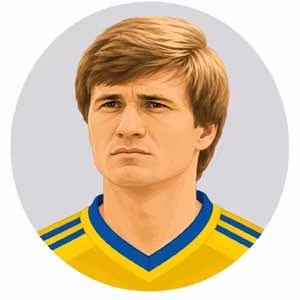
Greece - Left MidfielderHatzipanagis, Vasilic
Hatzipanagis was an attacking midfielder or left-sided forward whose football was built around dribbling, acceleration and extreme freedom of interpretation. Around 1.73 metres tall, low to the ground and exceptionally balanced, he could manipulate the ball through rapid changes of direction while keeping his body between defender and possession. His own explanation of his style was wonderfully uncomplicated: when defenders appeared in front of him, he wanted to dribble past all of them. That appetite made him spectacular but also mechanically distinctive. He did not merely beat an opponent to create the next pass; sometimes beating the opponent was itself the route through which he understood the attack. He could operate from the flank, move centrally, combine in tight spaces and strike dangerous set pieces, including direct corners. Born in Tashkent to Greek parents, he developed at Pakhtakor and entered senior Soviet football as a teenager after taking Soviet citizenship, a requirement for playing at that level. He represented Soviet youth and Olympic selections before moving to Greece in 1975. Iraklis became the defining club of his life. He remained there until 1990, winning the Greek Cup in 1976 and the Balkans Cup in 1985, while accumulating 281 league appearances and 61 goals. Offers or serious interest reportedly arrived from clubs including Lazio, Arsenal, Porto and Stuttgart, but Iraklis repeatedly resisted losing the player around whom both the team and its attendances revolved. In 1984 his standing was recognised internationally when he was selected for a World XI against the New York Cosmos. Greece later chose him as its UEFA Golden Player for the federation’s first fifty years.
The same instincts that made Hatzipanagis extraordinary created genuine limitations. His appetite for taking on defenders increased turnover risk, particularly against compact opponents who could surround him before he escaped the first challenge. He was at his most dangerous when given possession, freedom and space to improvise; a rigid structure demanding immediate circulation and fixed positional occupation would inevitably suppress part of his value. His career also leaves an important uncertainty regarding translation to stronger leagues. Hatzipanagis himself believed he could have played at a higher European level, and contemporary reputation supports the possibility, but because Iraklis never released him during his prime, there is no prolonged evidence against elite continental opposition from which to prove it. That absence matters. His brilliance in Greece should not automatically be extrapolated into identical dominance elsewhere. He was also more creator than defensive worker, and systems requiring constant off-ball discipline from wide attackers would have demanded behavioural compromises that his best football rarely required.
Psychologically, Hatzipanagis’s career is dominated by the contrast between freedom on the pitch and restriction away from it. His first major choice already contained that tension. Pakhtakor required Soviet citizenship before investing fully in him; his family eventually accepted, allowing his career to advance but later contributing to the international eligibility problem that prevented him representing Greece normally. He then voluntarily left a strong Soviet football environment for Greece despite being highly regarded there, choosing cultural belonging over the safer sporting pathway. Once at Iraklis, however, his freedom narrowed again. Hatzipanagis later said that after arriving in Greece the doors to a foreign career effectively closed, and he openly regretted not having played abroad in a stronger championship. He did not retrospectively disguise his own responsibility either. In later interviews he described himself as young, impulsive and insufficiently cautious when signing the agreement that bound him to Iraklis, explicitly saying he should have understood the situation better before committing. This capacity for self-criticism coexisted with lasting grievance toward the restrictions themselves. The frustration was therefore not transient: decades later, when asked what he regretted, both the lost international career and the lost opportunity to test himself abroad remained immediate answers. Yet the striking behavioural fact is what did not happen. Hatzipanagis did not allow professional confinement to reduce his investment in Iraklis. He remained for roughly fifteen years, continued attracting crowds and became overwhelmingly identified with the club rather than withdrawing effort because transfer ambitions had been blocked. His need for autonomy was therefore high, but commitment once on the field remained strong. There is insufficient reliable evidence to assign him a strong profile for retaliation after fouls, referee confrontation or treatment of teammates, and inventing one from his dribbling style would be misleading. What is documented is his appetite for repeated technical confrontation: defenders could stop one run without persuading him to stop attempting the next. Recognition also mattered to him. When named Greece’s Golden Player decades later, he said it moved him to know that his contribution had not been forgotten. Hatzipanagis was therefore neither indifferent to status nor driven primarily by it. What hurt most was unrealised possibility — being prevented from discovering how far his ability could travel.