We use Google Analytics to understand how visitors use this site. Analytics cookies are only activated with your consent. For details, read our Privacy Policy.
Profile lensThe same player, read from a different angle.
Athletic80
Acceleration
79
Pace
78
Agility
79
Strength
80
Balance
80
Jumping
81
Stamina
85
Fitness
77
Technical84
Dribbling
84
Short Passing
85
Long Passing
86
Finishing
87
Shot Accuracy
84
Shot Power
86
Shooting Technique
76
Heading
87
Tackling
44
Crossing
83
Free Kick
84
Penalties
79
First Touch
82
Mental85
Composure
83
Aggression
76
Consistency
92
Creativity
77
Leadership
76
Work Rate
92
Tactical86
Vision
83
Off the Ball
90
Defensive Positioning
44
Teamwork
91
Anticipation
86
Marking
44
Player Traits
Attacking86
Crossing
83
Finishing
87
Heading Accuracy
87
Shot Accuracy
84
Off the Ball
90
Technique83
Dribbling
84
Free Kick
84
Short Passing
85
Long Passing
86
First Touch
82
Shot Technique
76
Movement79
Acceleration
79
Pace
78
Agility
79
Balance
80
Physicality82
Shot Power
86
Jumping
81
Stamina
85
Strength
80
Fitness
77
Defending44
Marking
44
Tackling
44
Def. Positioning
44
Mentality & Game Reading84
Aggression
76
Composure
83
Penalties
79
Vision
83
Leadership
76
Work Rate
92
Teamwork
91
Anticipation
86
Consistency
92
Creativity
77
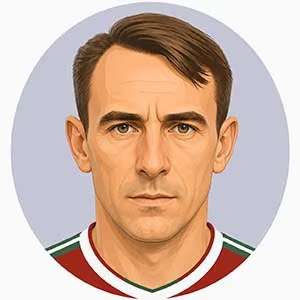
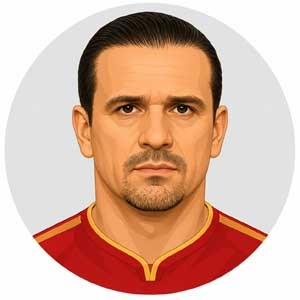
Serbia - ForwardMitić, Rajko
When a partisan crowd at the JNA Stadium turned hostile and began throwing projectiles at an opponent during a heated derby, the legendary captain of Red Star Belgrade ordered his entire team off the pitch, refusing to continue until basic human dignity and sportsmanship were restored. Rajko Mitić was not merely the tactical architect and lethal inside-right of post-war Yugoslav football; he was its moral compass, establishing a standard of aristocratic nobility, self-sacrifice, and spotless sporting conduct that made his name synonymous with sporting integrity.
Operating as an inside-right, creative playmaker, or deep-lying forward, Mitić possessed a panoramic tactical vision, pristine close control, and a signature diving header that saw him arrive in the penalty box with lethal timing. As the founding patriarch, spiritual leader, and first official "Star of Red Star" (Zvezdina zvezda) between 1945 and 1958, he scored 262 goals in 572 appearances, captaining the club to five Yugoslav First League championships and four Yugoslav Cups. For Yugoslavia, across 59 caps and 32 goals, he was the revered captain of the immortal Olympic Team, winning consecutive Silver Medals at London 1948 and Helsinki 1952, while leading the national side across two World Cups (1950 in Brazil and 1954 in Switzerland).
Mitić’s game, however, was fundamentally anchored in collective harmony and structural balance rather than explosive, individual dynamic power. He lacked the blistering linear pace of pure sprinters or the raw physical bulk to wrestle bruising stoppers in chaotic aerial dogfights, relying entirely on spatial geometry, quick give-and-goes, and delicate distribution. When confronted by ultra-cynical, destructive man-marking setups where opponents were permitted to foul continuously without referee intervention, his artistic, flowing rhythm could be disrupted.
Dignified, deeply moral, and carrying an unshakeable sense of chivalry, Mitić approached football as an ethical duty rather than a blood sport. He never engaged in dissent, simulation, or retaliatory fouls, treating teammates, opponents, and officials with immaculate respect. His response to physical adversity became legendary at the 1950 World Cup against Brazil at the Maracanã, where he struck his head on a low steel girder in the dark tunnel minutes before kickoff, bandaging a bleeding wound and taking the pitch despite his team having conceded while playing down to ten men. On the field, his presence was calm, noble, and effortlessly commanding: orchestrating attacking sequences with subtle hand gestures and leading by quiet, courageous example. Inside the Red Star and Yugoslav dressing rooms, his moral authority was absolute—an untouchable gentleman-warrior whose name now permanently graces Red Star's stadium, cementing an immortal legacy as the founding father and soul of Serbian football.



 All Time SerbiaNT