We use Google Analytics to understand how visitors use this site. Analytics cookies are only activated with your consent. For details, read our Privacy Policy.
Profile lensThe same player, read from a different angle.
Athletic84
Acceleration
86
Pace
81
Agility
82
Strength
84
Balance
88
Jumping
86
Stamina
83
Fitness
83
Technical84
Dribbling
84
Short Passing
79
Long Passing
76
Finishing
86
Shot Accuracy
81
Shot Power
90
Shooting Technique
84
Heading
84
Tackling
34
Crossing
76
Free Kick
73
Penalties
83
First Touch
85
Mental84
Composure
85
Aggression
80
Consistency
81
Creativity
75
Leadership
86
Work Rate
86
Tactical84
Vision
82
Off the Ball
89
Defensive Positioning
33
Teamwork
86
Anticipation
85
Marking
33
Attacking83
Crossing
76
Finishing
86
Heading Accuracy
84
Shot Accuracy
81
Off the Ball
89
Technique80
Dribbling
84
Free Kick
73
Short Passing
79
Long Passing
76
First Touch
85
Shot Technique
84
Movement84
Acceleration
86
Pace
81
Agility
82
Balance
88
Physicality85
Shot Power
90
Jumping
86
Stamina
83
Strength
84
Fitness
83
Defending33
Marking
33
Tackling
34
Def. Positioning
33
Mentality & Game Reading83
Aggression
80
Composure
85
Penalties
83
Vision
82
Leadership
86
Work Rate
86
Teamwork
86
Anticipation
85
Consistency
81
Creativity
75
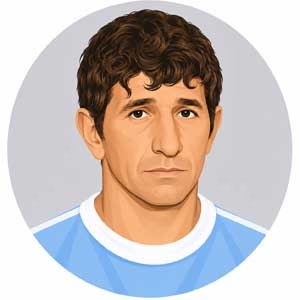
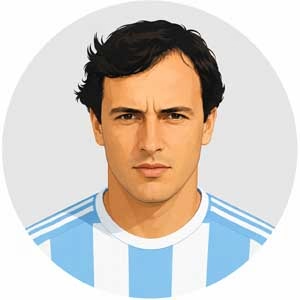
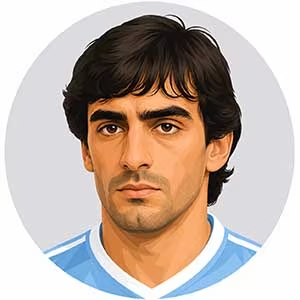
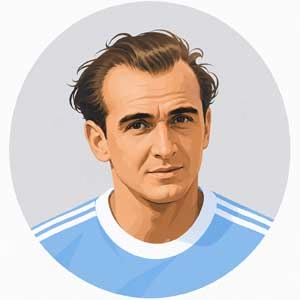
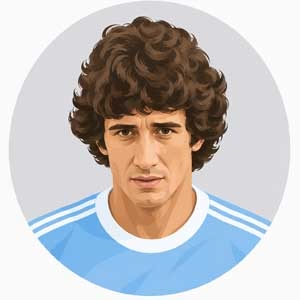
Uruguay - StrikerSasía, José
A cloud of lime kicked up from the edge of the six-yard box amidst the furious roar of the Estadio Centenario, obscuring a grinning, scarred inside-forward who had just whispered a venomous psychological barb into an opposing goalkeeper's ear before snapping a half-volley into the bottom corner. José Francisco Sasía Lugo—immortalized across the Río de la Plata simply as El Pepe Sasía—was the supreme personification of South American viveza criolla and relentless competitive malice: a bruising, immensely cunning forward whose game blended raw physical ferocity, razor-sharp penalty-box opportunism, and an unrivaled mastery of footballing psychological warfare.
Operating as a rugged center-forward, deep-lying inside-left, or auxiliary target-man, Sasía was an agonizing proposition for center-halves across the 1950s and 1960s. He turned every aerial challenge and shoulder-charge into an attritional battle of endurance, using a thick, barrel-chested build and exceptional upper-body leverage to shield possession with his back to goal before spinning explosively to unleash heavy, swerving strikes off either foot. After rising through Defensor Sporting—leading the modest club to a historic 1957 Torneo Cuadrangular triumph over Montevideo's traditional giants—he had a spell with Boca Juniors before reaching his career summit at CA Peñarol between 1961 and 1965. As the aggressive spearhead of Roberto Scarone’s juggernaut alongside Alberto Spencer and Pedro Rocha, Sasía lifted three Uruguayan Primera División titles (1961, 1962, 1964), the 1961 Copa Libertadores, and scored in the decisive third playoff match to capture the 1961 Intercontinental Cup against Benfica. His nomadic journey also saw him leave a lasting impression at Rosario Central, Defensor, and Olimpia in Paraguay. For Uruguay, across 44 official caps and 12 goals between 1956 and 1966, he was a battlefield general: lifting two South American Championship (Copa América) crowns in 1956 and 1959 (Ecuador), while spearheading the Celeste attack at two World Cups—scoring twice at Chile 1962 and starting every match in Uruguay's run to the quarter-finals at England 1966.
That combat-heavy, abrasive style, however, came with severe structural boundaries and constant disciplinary peril. Sasía was an instinctual penalty-box brawler and channel battering ram rather than a delicate, pass-and-move orchestrator built to weave patient triangles through crowded midfields; in matches requiring low-tempo, horizontal ball circulation, his direct mindset could cause attacking moves to break down prematurely. Furthermore, his devotion to gamesmanship, constant verbal baiting, and ruthless off-the-ball shoves routinely skirted the boundaries of the rulebook, leaving him prone to expulsions and heavy suspensions whenever he crossed paths with strict, no-nonsense referees who refused to tolerate his theatrical provocations.
Psychologically, Sasía was a force of pure, unfiltered street defiance—an unapologetic antihero who viewed football not as a polite exhibition, but as a fight for survival where every psychological weakness in an opponent was to be systematically exploited. He reveled in the hatred of rival terraces, drawing energy from hostile away atmospheres in Buenos Aires and Rio de Janeiro, where his sneering confidence and fearless physical confrontations routinely unsettled legendary stoppers. Yet underneath that menacing exterior lay a fiercely loyal teammate and an exceptionally intelligent reader of match psychology, capable of calming anxious young debutants just as easily as he could ignite a dressing room with a single rallying cry. On the pitch, his body language was pure streetwise intimidation: chest flared, jaw thrust forward, constantly chirping at markers, and attacking loose balls with feral intensity. Inside the Peñarol and Uruguayan locker rooms, his folklore was immense—a beloved, incorrigible scoundrel whose relentless grit, iconic clutch goals, and unyielding garra made him one of the most unforgettable cult legends in the history of the South American game.