We use Google Analytics to understand how visitors use this site. Analytics cookies are only activated with your consent. For details, read our Privacy Policy.
Profile lensThe same player, read from a different angle.
Athletic77
Acceleration
74
Pace
73
Agility
76
Strength
82
Balance
81
Jumping
85
Stamina
64
Fitness
83
Technical53
Dribbling
67
Short Passing
66
Long Passing
66
Shot Accuracy
51
Shot Power
85
Shooting Technique
51
Heading
68
Free Kick
59
Penalties
58
First Touch
60
Mental81
Composure
87
Consistency
75
Leadership
70
Goalkeeping88
Reflexes
87
Positioning
88
Handling
86
Kicking
89
Goalkeeping88
Reflexes
87
Positioning
88
Handling
86
Kicking
89
Attacking60
Heading Accuracy
68
Shot Accuracy
51
Technique62
Dribbling
67
Free Kick
59
Short Passing
66
Long Passing
66
First Touch
60
Shot Technique
51
Physicality80
Shot Power
85
Jumping
85
Stamina
64
Strength
82
Fitness
83
Movement76
Acceleration
74
Pace
73
Agility
76
Balance
81
Mentality & Game Reading73
Composure
87
Penalties
58
Leadership
70
Consistency
75
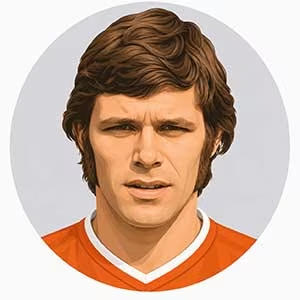
Netherlands - GoalkeeperJongbloed, Jan
Bare hands, an unconventional number eight jersey, and twenty yards of open grass between the goal line and his feet turned Jan Jongbloed into the quintessential tactical outlier of Rinus Michels’ Total Football revolution. Having spent over a decade in the domestic shadows with DWS and FC Amsterdam, the 33-year-old was plucked from relative obscurity ahead of the 1974 World Cup precisely because he rejected orthodox goalkeeping dogma. Standing five-foot-eleven, Jongbloed was neither a towering aerial powerhouse nor a feline shot-stopper; his decisive value lay in his footwork and spatial daring. Operating as an authentic eleventh outfield player, he ventured thirty yards out of his penalty box to sweep behind a high, aggressive offside trap, receiving back-passes on the half-turn and clearing with crisp, short distribution rather than aimless hoofs. While traditionalists cringed at his reluctance to wear goalkeeping gloves and his occasional vulnerability on direct, long-range ballistic strikes—most notably Paul Breitner's and Gerd Müller's goals in the 1974 final—his progressive sweeping anchored the Netherlands through two consecutive World Cup finals (1974 and 1978). Over an astonishing 707 top-flight Dutch league appearances spanning three decades with DWS, Roda JC, and Go Ahead Eagles, he redefined the sweeper-keeper template thirty years ahead of its modern tactical codification across his 24 international caps.
Detached, laconic, and passionately devoted to the tranquility of coarse fishing, Jongbloed treated the high-voltage arena of international football with the nonchalance of a Sunday morning hobbyist. He had zero appetite for celebrity glamour, tactical rhetoric, or the intense financial squabbles that routinely fractured Dutch tournament squads; his locker was notoriously filled with fishing rods, and he viewed matches simply as problems of spatial geometry to be solved with minimalist effort. When selected over the established Jan van Beveren for the 1974 campaign, he faced immense media skepticism with a dry, unbothered smirk, refusing to alter his risky sweeping style to appease critics. Inside the dressing room, he was an unpretentious, quiet veteran whose calm presence helped diffuse the combustible egos around him, taking Cruyff’s barking instructions in stride without taking them personally. His profound mental toughness was tested in the most devastating manner imaginable in 1984, when his 21-year-old son Eric, also a professional goalkeeper for DWS, was fatally struck by lightning on the pitch; Jongbloed absorbed the tragedy with quiet, heartbroken dignity and returned to competitive football, continuing to play until age 45. Toward match officials and aggressive opposing strikers who targeted his physical frame on set pieces, Jongbloed remained completely unruffled: avoiding theatrical simulation, never contesting calls, and letting his pioneer sweeping instincts carve an eccentric,