We use Google Analytics to understand how visitors use this site. Analytics cookies are only activated with your consent. For details, read our Privacy Policy.
Profile lensThe same player, read from a different angle.
Athletic80
Acceleration
74
Pace
74
Agility
86
Strength
85
Balance
80
Jumping
86
Stamina
73
Fitness
80
Technical61
Dribbling
72
Short Passing
71
Long Passing
75
Shot Accuracy
73
Shot Power
87
Shooting Technique
72
Heading
49
Free Kick
87
Penalties
91
First Touch
71
Mental85
Composure
87
Consistency
82
Leadership
79
Goalkeeping88
Reflexes
88
Positioning
85
Handling
86
Kicking
92
Goalkeeping88
Reflexes
88
Positioning
85
Handling
86
Kicking
92
Attacking61
Heading Accuracy
49
Shot Accuracy
73
Technique75
Dribbling
72
Free Kick
87
Short Passing
71
Long Passing
75
First Touch
71
Shot Technique
72
Physicality82
Shot Power
87
Jumping
86
Stamina
73
Strength
85
Fitness
80
Movement79
Acceleration
74
Pace
74
Agility
86
Balance
80
Mentality & Game Reading85
Composure
87
Penalties
91
Leadership
79
Consistency
82
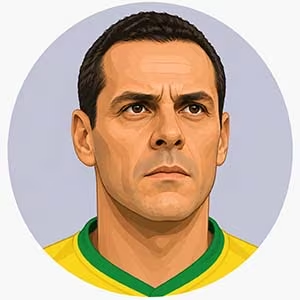
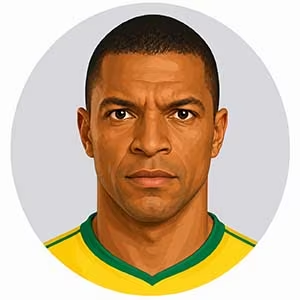
Brazil - GoalkeeperRogério Ceni
An astonishing 131 career goals scored directly from free-kicks and penalties turned an eccentric Brazilian shot-stopper into the most statistically surreal and lethal offensive goalkeeper in world football history. Rogério Mücke Ceni spent a quarter of a century operating as the absolute spiritual deity and captain of São Paulo FC, revolutionizing the modern understanding of the ball-playing goalkeeper. Stationed between the posts across 1,237 official matches, Ceni paired clean handling, agile ground-level diving, and quick distribution with a world-class dead-ball striking technique that curled direct free-kicks over walls and into top corners with mechanical regularity. His legendary apex arrived in 2005, when he captained São Paulo to the Copa Libertadores and the FIFA Club World Cup—netting 21 goals across the calendar year and delivering a historic, man-of-the-match goalkeeping display to shut out Liverpool in Yokohama. Over his monumental career, he lifted three consecutive Campeonato Brasileiro Série A titles (2006, 2007, 2008), two Copas Libertadores (1993, 2005), and two Intercontinental/Club World Cups. For Brazil, across 16 caps, he was a member of the 1997 FIFA Confederations Cup and the 2002 World Cup-winning squads.
Yet Ceni’s hyper-aggressive, high-risk operational style carried natural tactical vulnerabilities. His constant willingness to step high outside his penalty area to act as an auxiliary distributor occasionally left his goal exposed to long-range chips during sudden turnovers in the middle third. Furthermore, in pure aerial shot-stopping duels against towering, physical center-forwards, his command of the six-yard box was sometimes tested by heavy traffic, relying more on reflexes and positioning than overwhelming physical dominance.
Fiercely demanding, intensely charismatic, and possessing an unbreakable competitive ego, Ceni was an authoritarian monarch on the pitch. He had zero tolerance for mediocrity or defensive passivity, berating center-backs and organizing pressing angles with relentless, fiery intensity. On the pitch, his body language radiated absolute authority: sprinting 80 yards up the field to take a 90th-minute free-kick with the game on the line, before sprinting all the way back to reset his defensive line without a second thought. Inside the Morumbi dressing room, his word was unquestioned law, serving as an irreplaceable leader whose obsessive drive for victory set the standard for generations of teammates, cementing an immortal legacy as one of the most iconic, unique, and legendary figures in the history of South American football.