We use Google Analytics to understand how visitors use this site. Analytics cookies are only activated with your consent. For details, read our Privacy Policy.
Profile lensThe same player, read from a different angle.
Athletic78
Acceleration
73
Pace
75
Agility
72
Strength
86
Balance
83
Jumping
70
Stamina
82
Fitness
84
Technical80
Dribbling
78
Short Passing
83
Long Passing
82
Finishing
66
Shot Accuracy
66
Shot Power
82
Shooting Technique
66
Heading
75
Tackling
79
Crossing
64
Free Kick
69
Penalties
66
First Touch
85
Mental85
Composure
85
Aggression
82
Consistency
87
Creativity
76
Leadership
84
Work Rate
82
Tactical79
Vision
83
Off the Ball
68
Defensive Positioning
79
Teamwork
85
Anticipation
74
Marking
75
Attacking68
Crossing
64
Finishing
66
Heading Accuracy
75
Shot Accuracy
66
Off the Ball
68
Technique77
Dribbling
78
Free Kick
69
Short Passing
83
Long Passing
82
First Touch
85
Shot Technique
66
Movement76
Acceleration
73
Pace
75
Agility
72
Balance
83
Physicality81
Shot Power
82
Jumping
70
Stamina
82
Strength
86
Fitness
84
Defending78
Marking
75
Tackling
79
Def. Positioning
79
Mentality & Game Reading80
Aggression
82
Composure
85
Penalties
66
Vision
83
Leadership
84
Work Rate
82
Teamwork
85
Anticipation
74
Consistency
87
Creativity
76
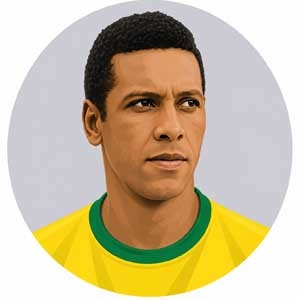
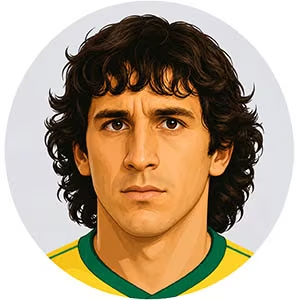
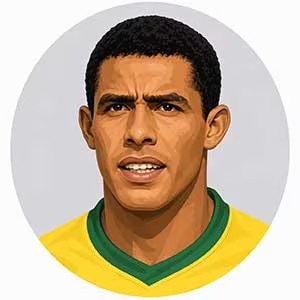
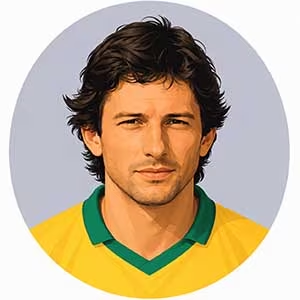
Brazil - Defensive MidfielderBauer
Operating on the right side of the classical diagonal or WM setup, Bauer was the ultimate hybrid defensive midfielder. He possessed exceptional positional discipline, consistently anticipating passing routes to pinch opposition counter-attacks in the bud before transitioning into a launching pad with crisp, low-trajectory ground passes or pinpoint cross-field diagonals to the wingers. At São Paulo FC between 1944 and 1956, he formed the most revered half-back line in Brazilian club history alongside Rui Campos and José Noronha (Rui, Bauer e Noronha), leading the Tricolor Paulista across more than 400 appearances to five Campeonato Paulista titles (1945, 1946, 1948, 1949, 1953). He later had brief spells with Botafogo and Portuguesa Santista. For Brazil, across 29 official caps between 1949 and 1954, he was an indispensable centerpiece: lifting the 1949 South American Championship and the 1952 Panamerican Championship, earning a spot in the 1950 World Cup All-Star Team for his tireless coverage in front of the backline, and wearing the captain's armband with distinction at the 1954 World Cup in Switzerland, where he battled through the infamous "Battle of Berne" against Hungary. His sharp tactical eye would extend far beyond his playing days; during a coaching stint in Mozambique in 1960, he famously spotted a teenage Eusébio running in Lourenço Marques and immediately alerted Béla Guttmann, forever altering European football history.
That refined, equilibrium-focused style was bounded by the physical realities of his era. Bauer was an orchestrator and defensive organizer rather than a dynamic box-to-box dribbler who broke lines through individual ball-carrying; in congested final thirds against stacked defensive banks, he rarely looked to penetrate on his own, choosing instead to recycle possession through the half-spaces. When dragged out into wide isolation against low-gravity, hyper-agile wingers who relied on sudden bursts of lateral agility, his recovery turn was steady rather than explosive, forcing him to rely strictly on angles and anticipation rather than pure recovery speed.
Psychologically, Bauer was a bastion of quiet fortitude, serene balance, and noble leadership. Unlike many of his contemporaries who were mentally crushed by the psychological fallout of the 1950 defeat, he absorbed the national trauma with stoic dignity, channelling that disappointment into the disciplined resolve that saw him captain Brazil in Europe four years later. He commanded absolute respect across dressing rooms without ever needing to shout, relying on impeccable professionalism, tactical lucidity, and a generous spirit that nurtured younger teammates. On the pitch, his presence was characterized by fluid, upright balance: swiveling his head constantly to scan the pitch, organizing midfield transitions with measured hand signals, and cleanly dispossessing attackers without crossing into malice or brutality. Inside the locker rooms of the Morumbi, the Maracanã, and the Seleção, his legacy remains unblemished—an enlightened gentleman-tactician whose vision, composure, and historic resilience established the timeless template for Brazilian defensive pivots.